CITY
Agafay, Zagora or Merzouga: 3 Deserts, 3 Different Experiences from Marrakech
One word covers a stone plateau forty minutes from the city, the first low dunes of the Draa and a sand sea on the Algerian border. How far each one is, how to get there, how long to stay.
Timence Guide Editors · 16 September 2026
Almost everyone who comes to Marrakech wants to see the desert, and almost everyone books it with a single word in mind. The word hides three different trips. One is a plateau of grey stone under the Atlas, close enough to reach for dinner. One is a two-day run down the longest valley in Morocco to the first small dunes of the Sahara. The third is the picture in your head, dunes a hundred and fifty metres high on the edge of Algeria, and the usual trip there takes three days. Which of the three you choose depends on the time you have: a few hours, two days or three.
Sahara comes from the Arabic sahra, which simply means desert; sahara is its plural, so "the Sahara Desert" says desert twice. What the word describes is not a sea of sand but nine million square kilometres of rocky plateau, gravel plain and dry riverbed, with the dunes as the exception. The Arabic has a name for each surface: hamada for the bare rock, reg for the gravel, erg for the dunes. Morocco's south gives you all three, in that order, as you drive away from the city.
Agafay: the stone desert
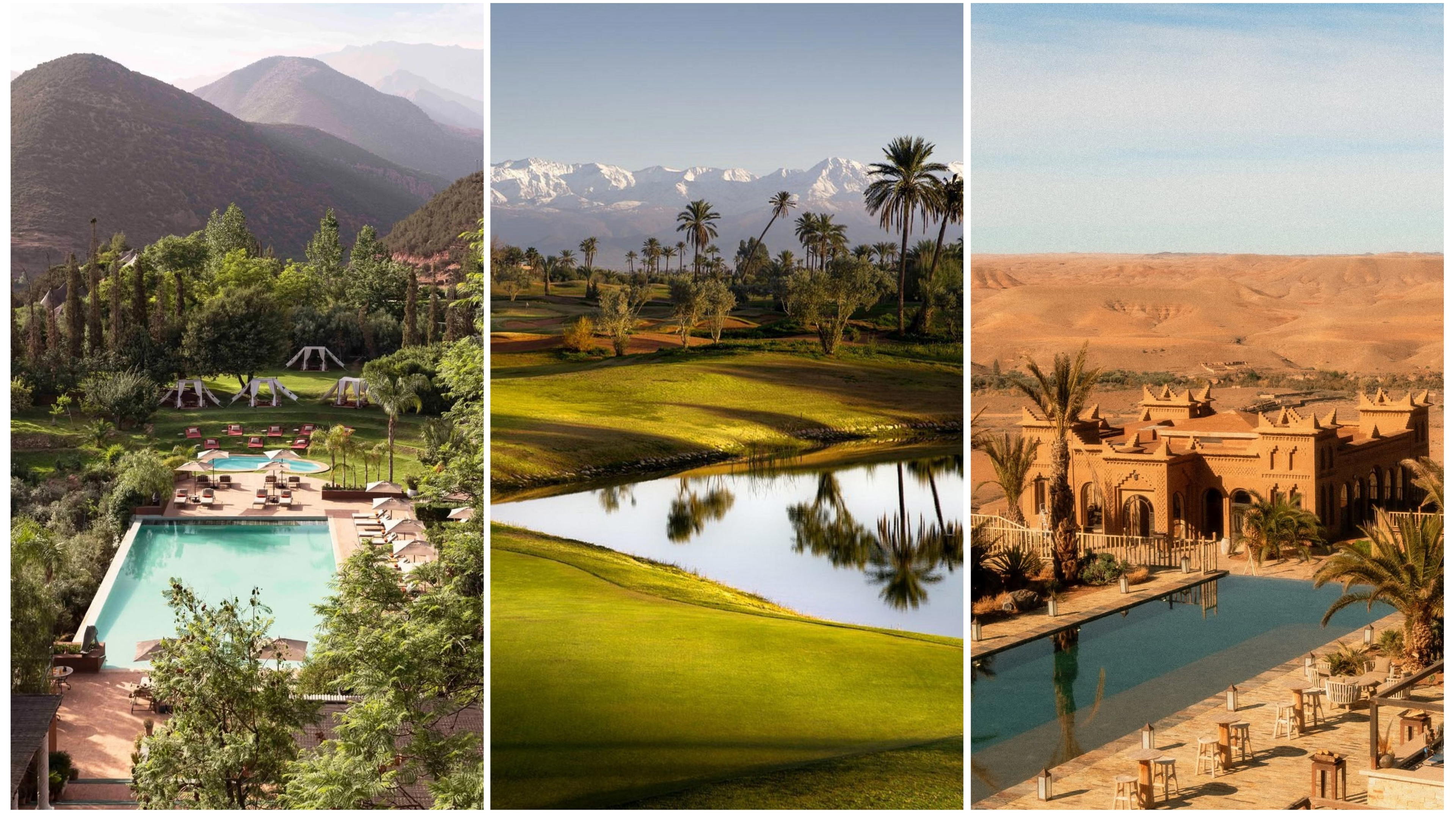
Take the road towards Amizmiz and after thirty kilometres the green of the Haouz plain stops and the ground turns to pale, folded stone. This is the Agafay, a reg, a plateau of gravel and marl with dry wadis cut through it and the High Atlas standing directly behind, white in winter. There is not a single sand dune. What there is, on a clear evening, is an empty horizon with the mountains lit pink at the far end, less than an hour from your riad.
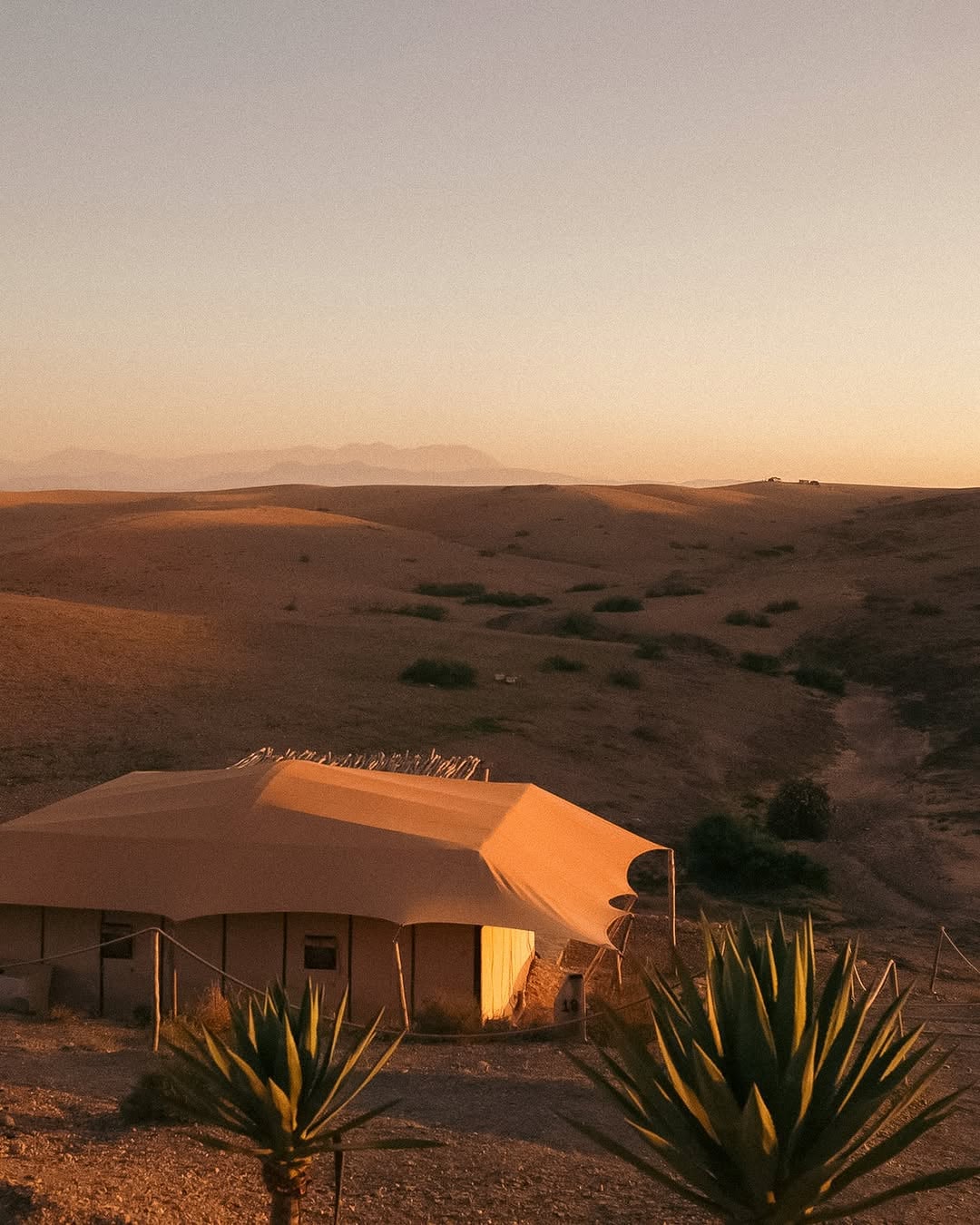
The Agafay can be experienced in three lengths. A day: several camps sell a day pass to their pools, and the hours between breakfast and dinner in town go on a swim with the Atlas in front and lunch on the terrace. An afternoon: departures around four, a quad or a buggy across the stone, a camel at sunset, dinner in a tent with a fire and musicians, and back in the Medina before midnight. A night: once the evening visitors have gone, the plateau falls silent under the stars. The seven stone camps in the Agafay cover the whole spectrum, from La Pause, which runs on candles and has no electricity at all, to Inara and The White Camel, with air conditioning in every lodge and a proper spa. One thing to know before choosing a camp: some camps sit at the edge of the plateau, a few minutes from the tarmac, with the glow of the city still on the horizon, and others are well inside it, at the end of a track, where the night is properly black. The camps will say which, when asked.
With a private driver the ride is a quiet one. Driving yourself is possible too, and a 4x4 suits the road best: there is tarmac, but it is one car wide, so when two cars meet one of them takes to the dirt, and the further in the camp, the wilder the last stretch. The Agafay is open in every month, and in every season the temperature drops hard once the sun is down: the nights on the plateau are cold even in July, which is why the camps light the fires.
Zagora: the low dunes
The second desert is three hundred and sixty kilometres away, and much of the trip happens on the road. A typical day with a driver leaves Marrakech around nine. The N9 climbs the High Atlas to the Tizi n'Tichka, two thousand two hundred metres, built by French military engineers in 1936 along the old caravan trail, and drops into the south past Aït Ben Haddou, the earthen ksar the cinema has used for half its ancient cities, where tours usually stop for lunch. After Ouarzazate the road enters the valley of the Draa, the longest river in Morocco, and for two hundred kilometres you drive through one continuous palm grove, oasis after oasis, with kasbahs of mud brick on the slopes above Agdz. Arrival is around four.
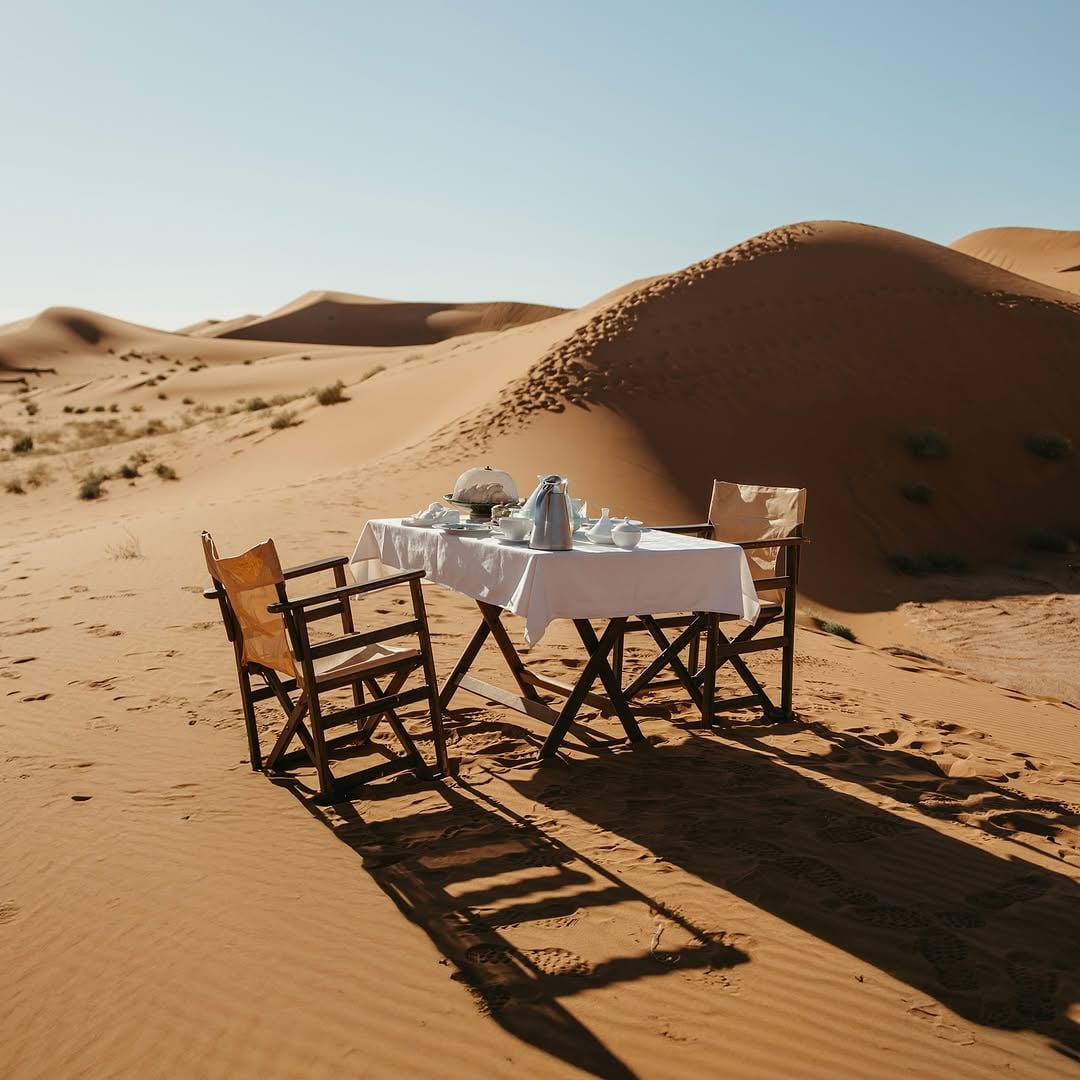
Zagora itself is a provincial town with a painted sign at its edge that reads Tombouctou 52 jours, fifty-two days by camel to Timbuktu, the length of the caravan route this valley once fed. The dunes come after the town: Tinfou, twenty kilometres south, and Erg Lihoudi further on. They are real Saharan sand, low and not very extensive. The camel crosses them at sunset to a camp, there is dinner and a fire, and in the morning the road climbs back up the valley. The most common format is two days and one night: a day on the road through the Draa, a night in the sand.
The most comfortable way to do the route is with a private driver, stops included; it can also be driven in a rental car, on tarmac all the way. It can also be reached by helicopter.
Merzouga: the desert we all have in mind
Erg Chebbi is the desert on the postcard, and the postcard is accurate. The dunes rise to a hundred and fifty metres above the surrounding hamada, in a field twenty-eight kilometres long and five to seven wide, on the far western rim of the Sahara, with the Algerian border on the other side. Merzouga is the village at their foot, a line of kasbahs and auberges along the western edge, and from any of them you walk out of the door onto the sand.
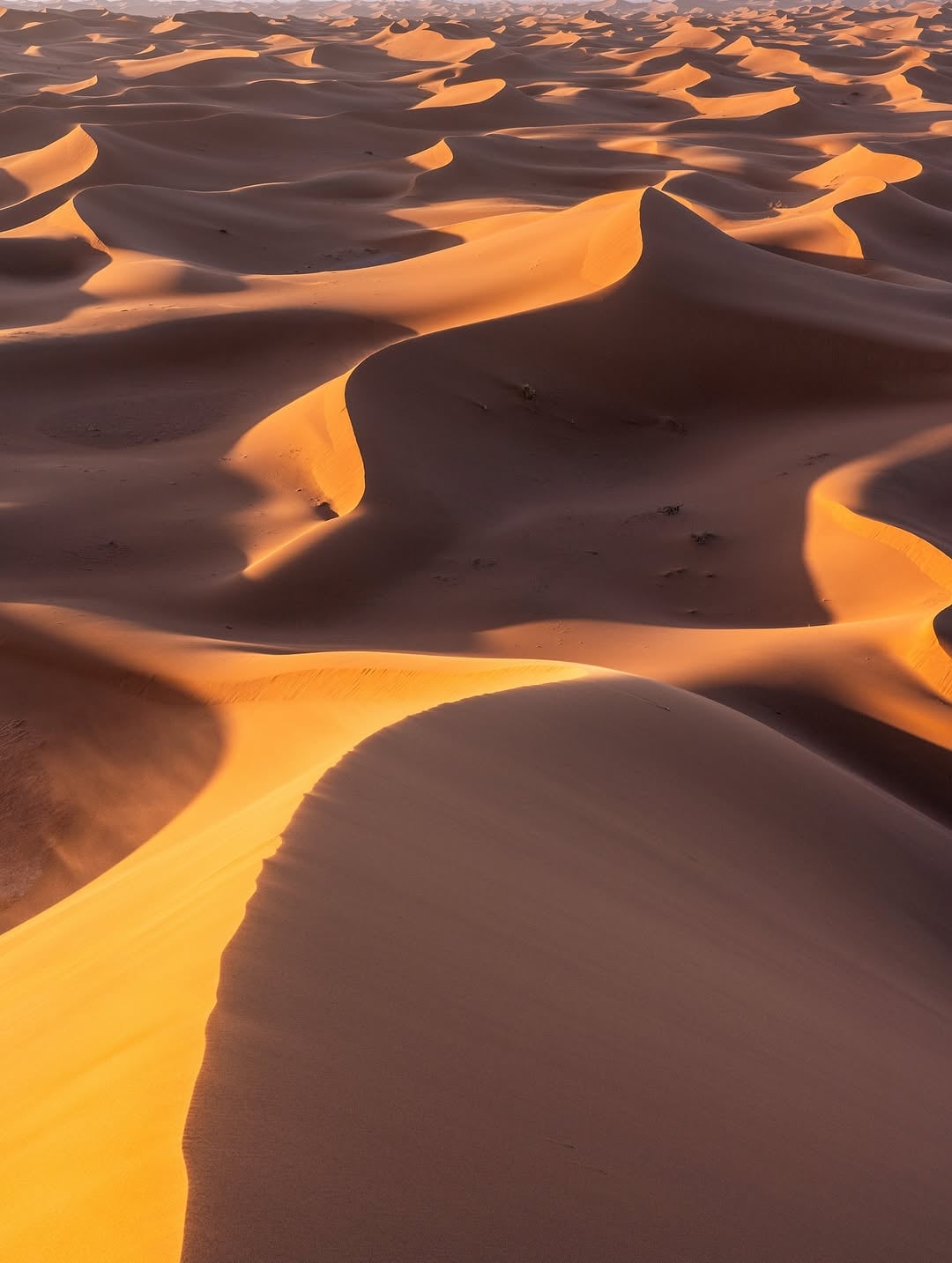
The distance is five hundred and sixty kilometres, nine to ten hours of driving without stops. The most common formula is three days and two nights. A typical first day leaves around eight, crosses the Tichka, stops at Aït Ben Haddou and sleeps in the Dadès valley, among the red rock. The second threads the Todra gorge, passes Rissani, where the souk still trades on the site of Sijilmasa, the caravan city founded in 757 that once handled the gold and salt of the trans-Saharan trade, and reaches the dunes around five. The camp is reached by camel in an hour or two, or by 4x4 in twenty minutes, and the night is spent with the erg all around. The third day is the long drive back, to Marrakech by early evening. With more days the trip slows down, without the rush, and leaves time for the silence of the desert.
The trip can take other shapes. The return can follow another road: from Merzouga the N13 runs north through the Ziz valley and Midelt to Fes, four hundred and seventy kilometres, and the desert becomes the middle of a crossing of the country. There is the flight: Errachidia has an airport under two hours from the dunes, and Ryanair opened a Marrakech–Errachidia link in 2024, with fewer flights out of season. And there is the helicopter, which turns two days of road into a morning but lands at Errachidia, not at the camp: the erg sits against the Algerian border, and landing beside the tents needs an authorisation requested well in advance. From the airport it is the same road as the flight, under two hours to the dunes. For anyone driving, fuel stations grow scarce after Ouarzazate and the roads are unlit after dark.
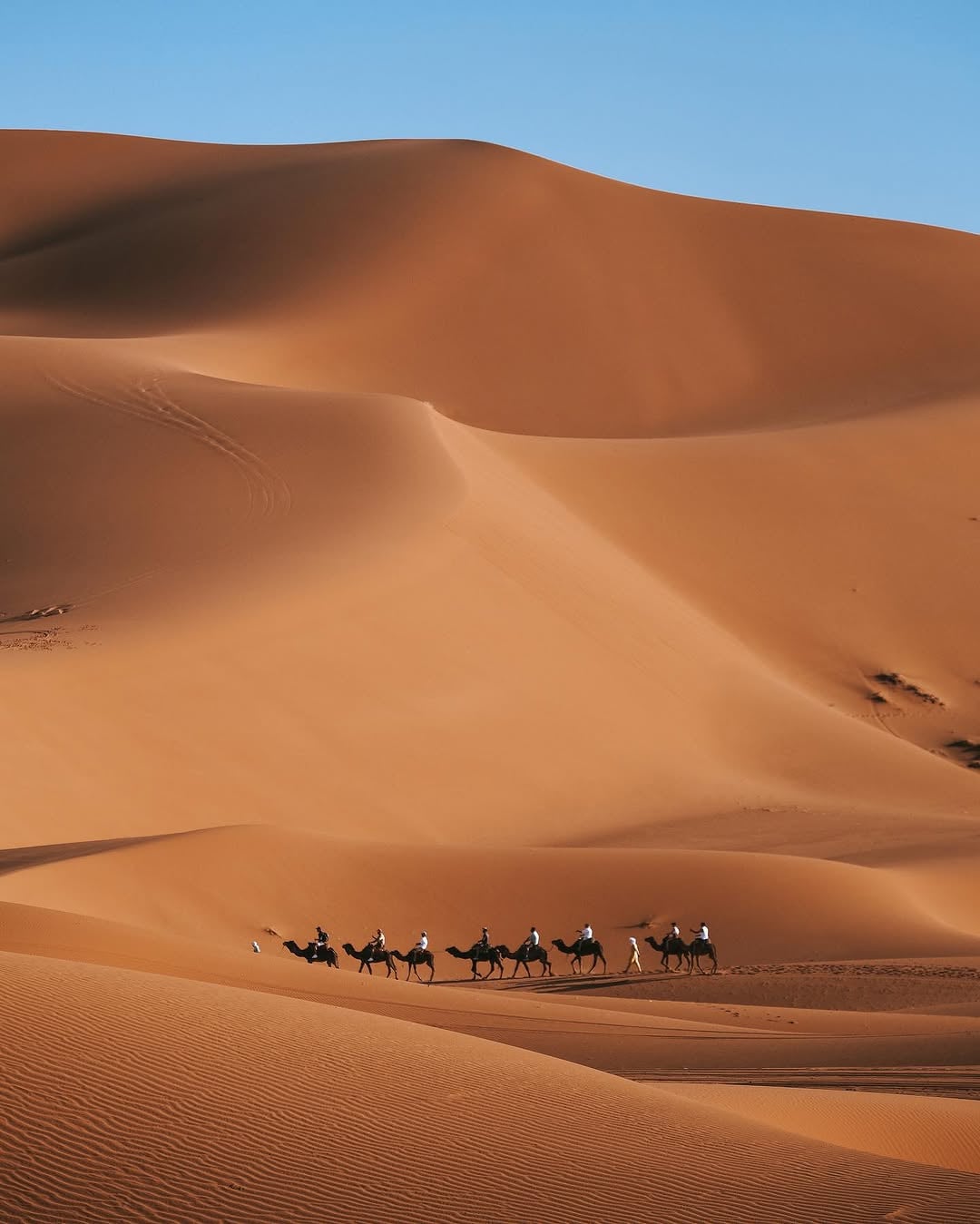
Before sunrise, while the sand is still cold, there is the climb up a dune to watch the sun come up over the border, and at sunset the way back to the top, on foot or by camel. In the evening there is the fire and Berber music, and on a moonless night the sky over the erg is dark enough to draw astronomy enthusiasts. Around the dunes, half a day by 4x4 takes in Khamlia, the village where descendants of sub-Saharan Africans who came up the caravan routes still play Gnawa music, an abandoned French mine whose mud-brick village has stood empty since 1956, and the tents of nomad families who offer tea. On Tuesdays, Thursdays and Sundays there is the market in Rissani, with dates, spices, livestock and a car park just for donkeys. After a wet winter the lake of Dayet Srji fills and the flamingos come, and in the hottest weeks of summer Moroccans travel here to be covered to the neck in hot sand, a remedy for rheumatism older than any hotel. The season runs from October to April: in summer the dunes pass forty-five degrees, and in January the day is mild and the night touches zero.
Which one depends on the time you have
In all three deserts the camps offer a range of experiences, from the simplest, a camel at sunrise or at sunset or bread baked in the sand by a nomad, to the most exclusive, a candlelit dinner laid for two on a dune or a bed made up outside the tent for a night under the stars. What changes from one desert to the next is the landscape, the time it takes to reach it, and so the intensity and the pace at which the experience is lived.
The three deserts line up by the time they take. The Agafay fits into a day, an afternoon or a single night: stone, silence and the Atlas, less than an hour from the city. Zagora takes two days, with the Draa valley as much a part of the trip as the low dunes at the end of it. Merzouga takes three days or more for dunes up to a hundred and fifty metres, with the return by the same road, the exit through Fes or the flight from Errachidia.
The Agafay is open in every month, cold nights included. Zagora and Merzouga have their mildest weather in autumn and spring, and October is when the camps fill again and the fires are lit before dinner. Both routes cross the Tichka, and towards winter there can be snow on the pass on the morning of departure for the sand.
You may also like…