Casa Memoria Marrakech: Architecture as Accumulated Memory
A villa of restrained eclecticism on three hectares of olive groves, where two figures from different disciplines shaped a single sensibility.
5 April 2026
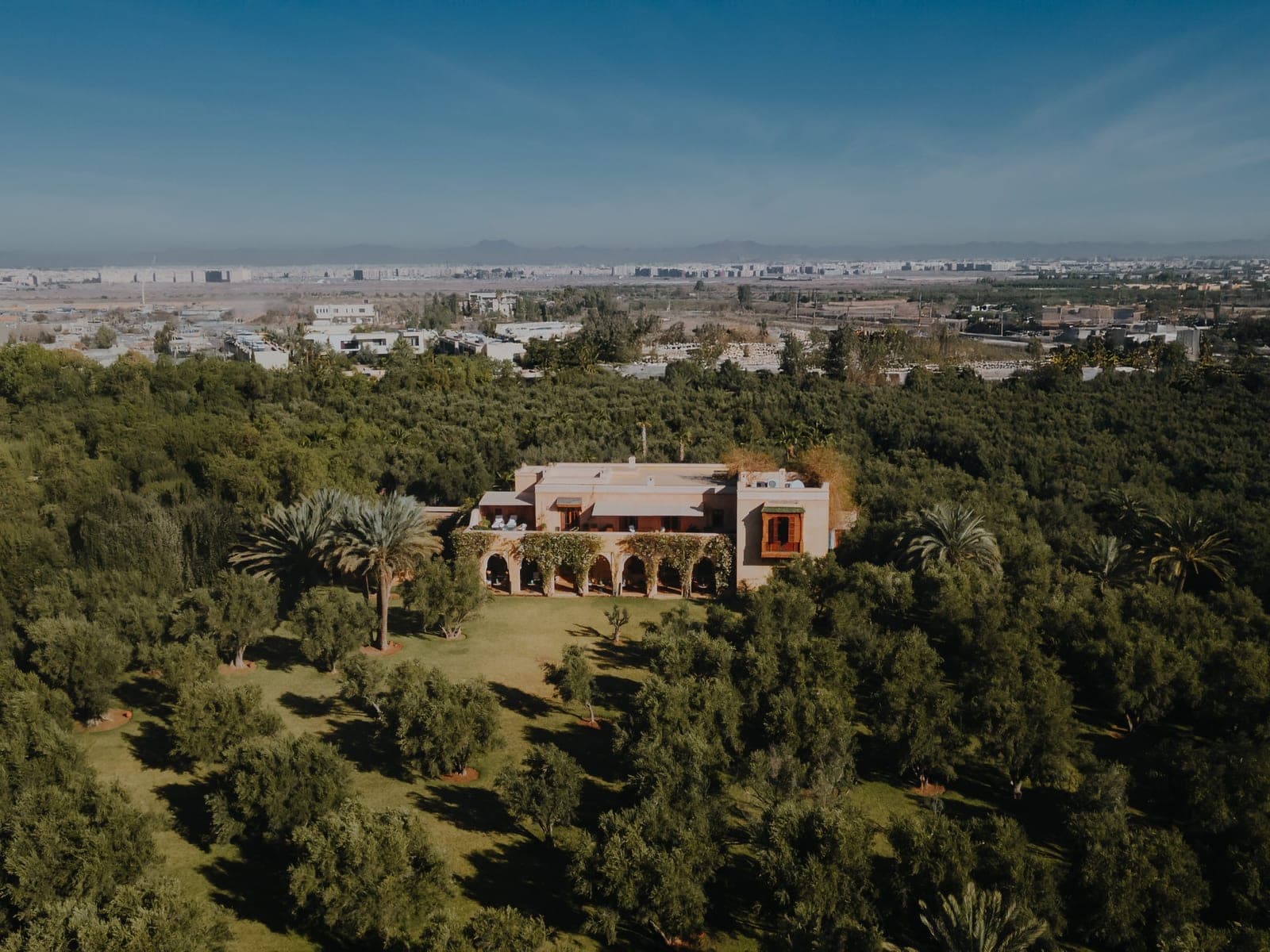
The approach arrives as a series of thresholds. You pass through the aqua gate at kilometer 8 on the Route d'Amizmiz, walk among olive trees that have been claiming their space for centuries across three hectares, and only then see the house. Its architecture announces itself gradually, not dramatically, the way things do when they belong to a landscape rather than dominate it.
Casa Memoria sits outside the medina on the southern road that leads toward the Atlas foothills, suspended in the quiet of old groves. The name carries a clear intention, a commitment to preserve what is rare and particular, what resists the erasure of time and fashion. The property describes itself as a memory sculpted in stone, light, and silence, which in this case is less poetic license than literal description.
Two Architects, One Sensibility
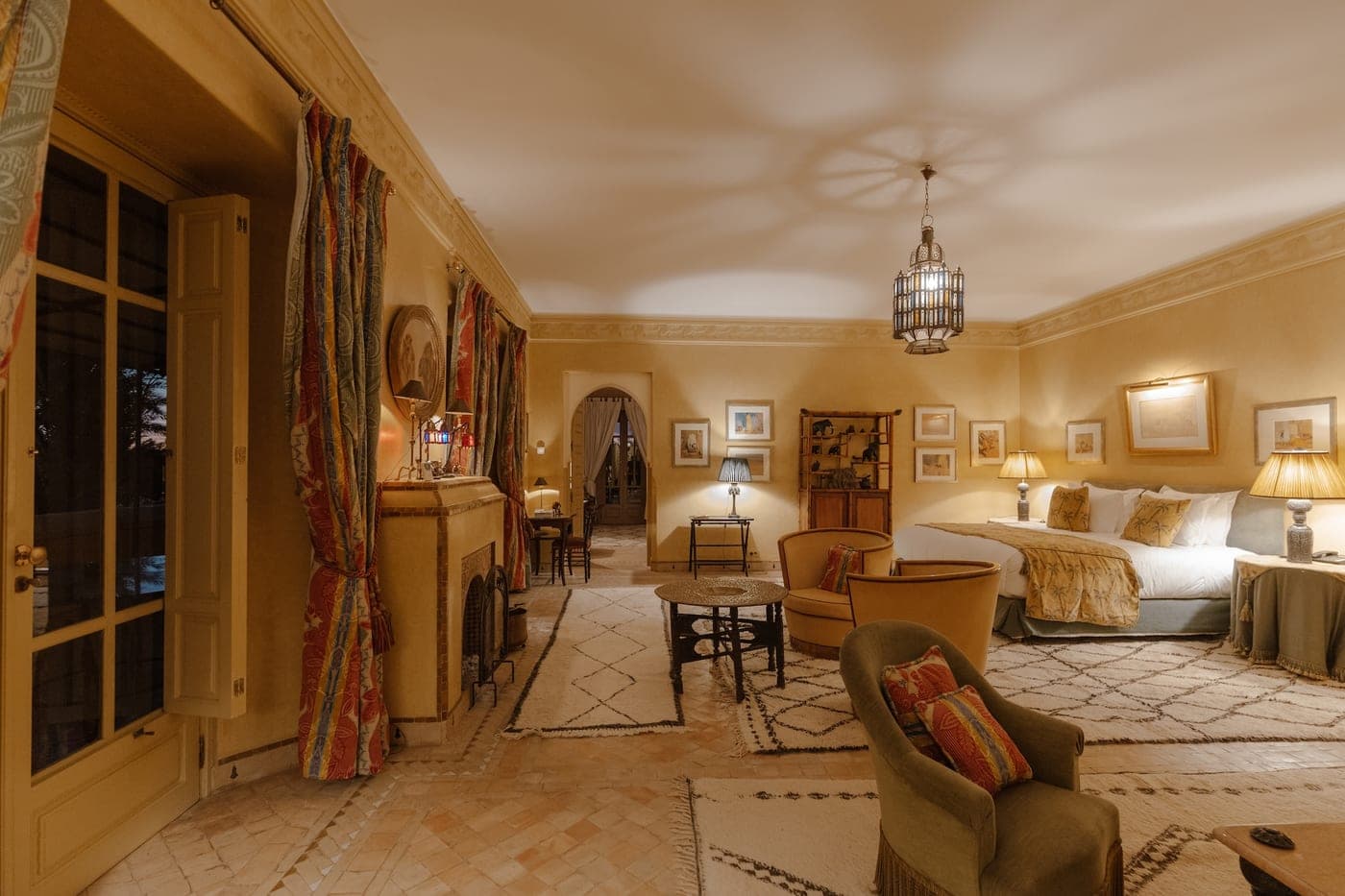
Charles Boccara conceived the structure. The Tunisian-born architect has spent decades in Marrakech building a body of work that understands how space, material, and light form a conversation rather than a monologue. At Casa Memoria, he worked with vaulted ceilings and sculpted fireplaces as poetic compositions, reinterpreting Moroccan traditions through zelliges, arches, and carved plasterwork without reproducing them as formula. The spatial logic is modern; the material sensibility is grounded in centuries of local craft.
Bill Willis furnished it. Willis was an American architect who arrived in Marrakech in the 1960s and never entirely left. His most cited early commission was the redesign of the residence adjacent to Jardin Majorelle for Yves Saint Laurent and Pierre Berge, a project that established his reputation in the city and beyond. His approach created what he described as a delicate marriage of Moroccan legacy and baroque opulence: audacious furnishings, sculptural pieces, and a layered density of surface that resists easy reduction to any single style.
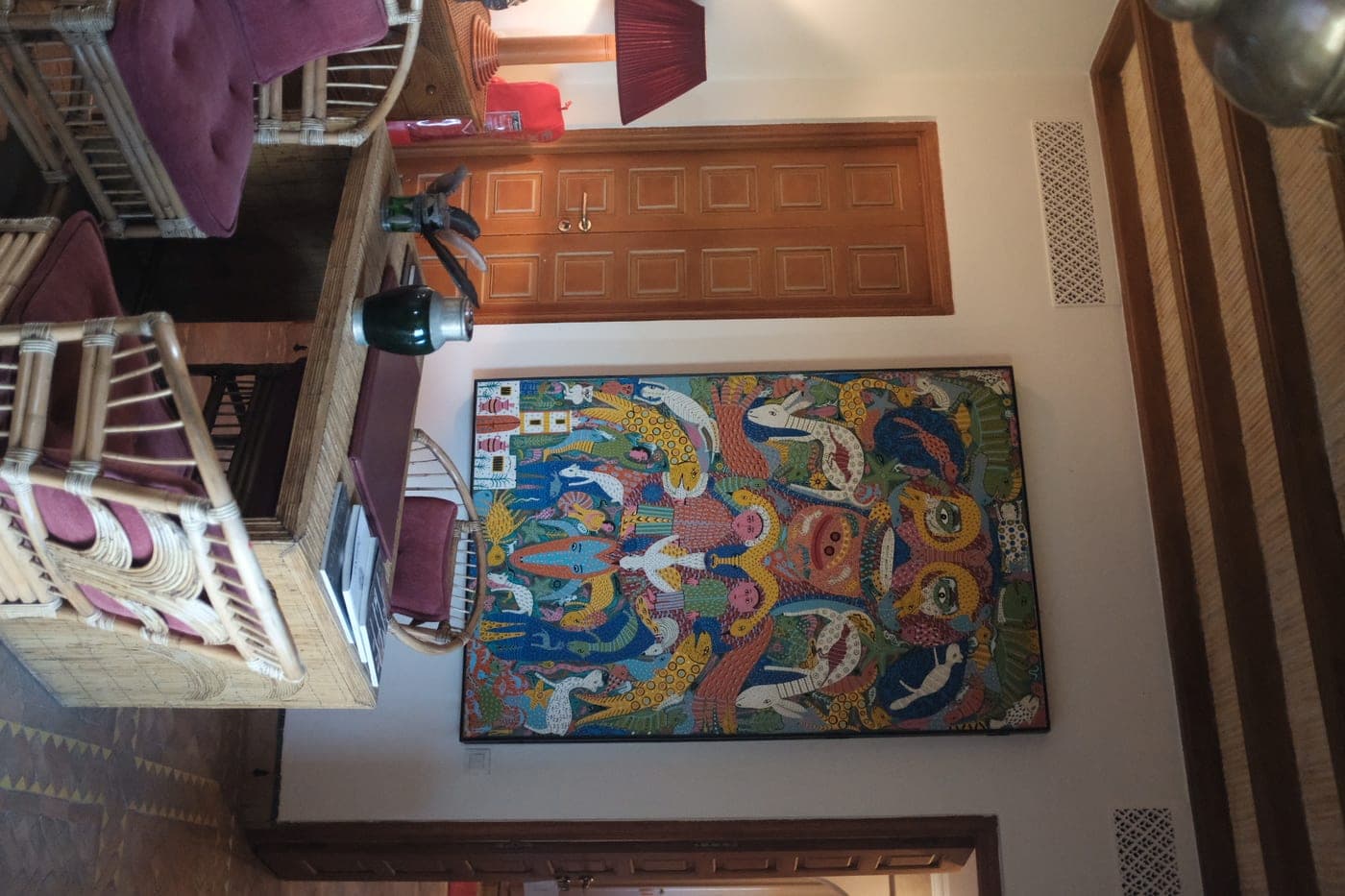
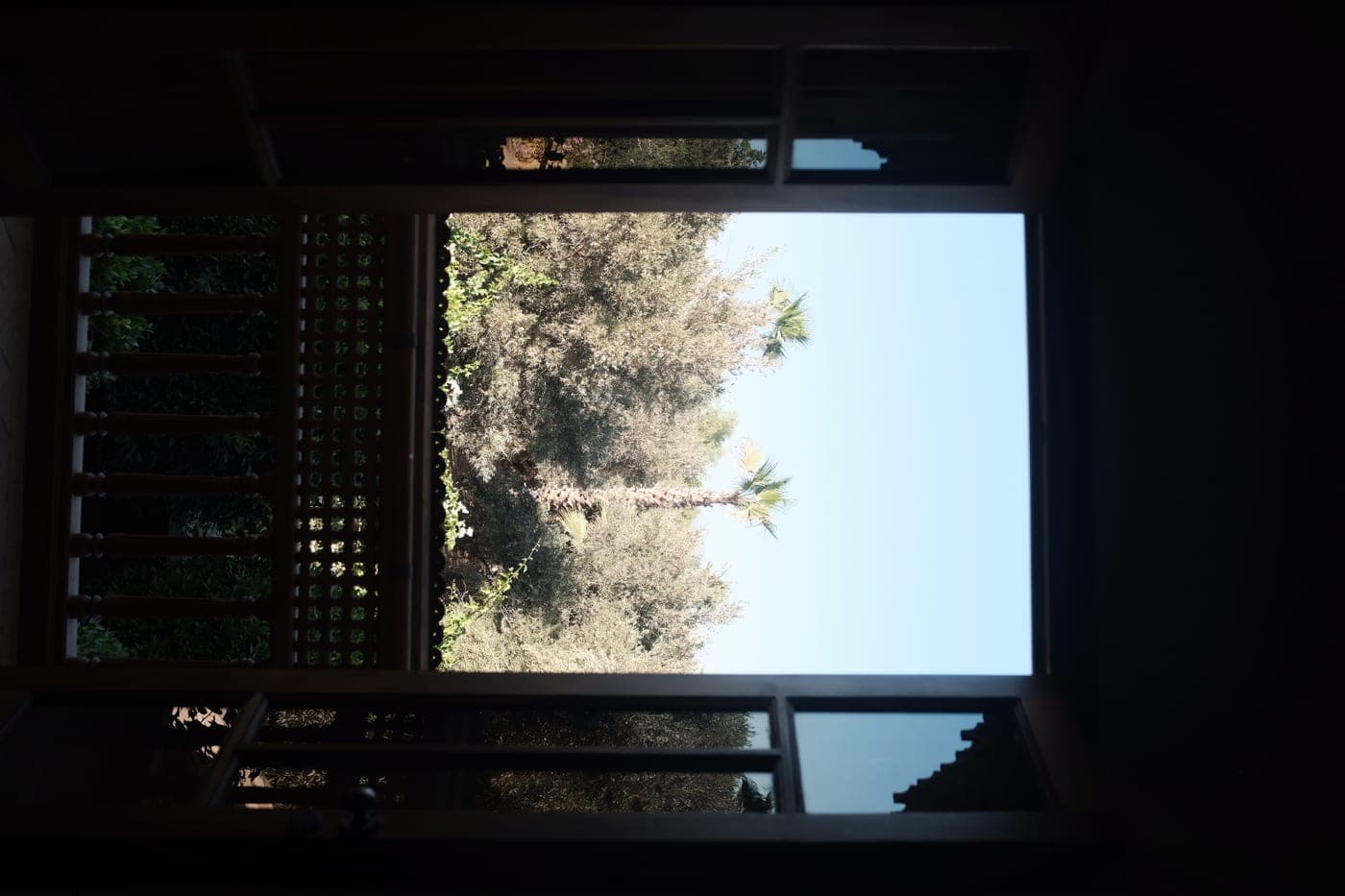
Casa Memoria bears the mark of that sensibility throughout. Willis was not interested in period reproduction; he was interested in the kind of space that accumulates presence over time, that resists the feeling of being recently arranged. Together, the two practices produce something uncommon: a property that is neither museum nor conventional luxury accommodation, but rather a private house with a particular intelligence, scaled for guests who want to inhabit rather than simply visit.
What the Interior Holds
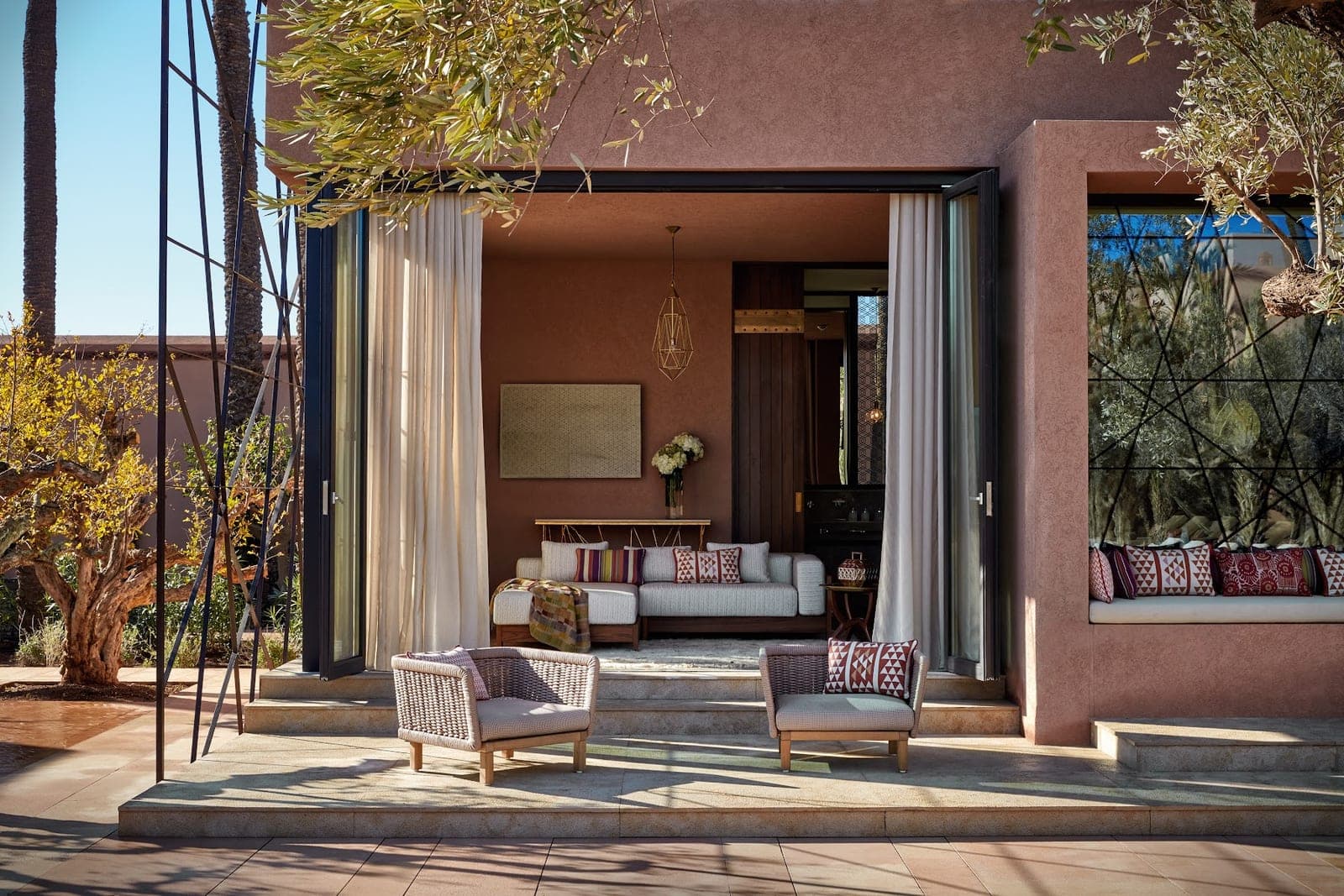
The tadelakt plaster on the walls catches light the way water does, shifting across the day as the angle of the sun changes. Zellige tilework appears not as ornament applied to surfaces but as structural color, embedded in materials that would feel incomplete without it. Cedar wood and sculptural pieces anchor rooms where silk drapery hangs in the cross-ventilation created by the spatial layout. Marble appears in measured moments, placed with the restraint of something that does not need to announce itself.
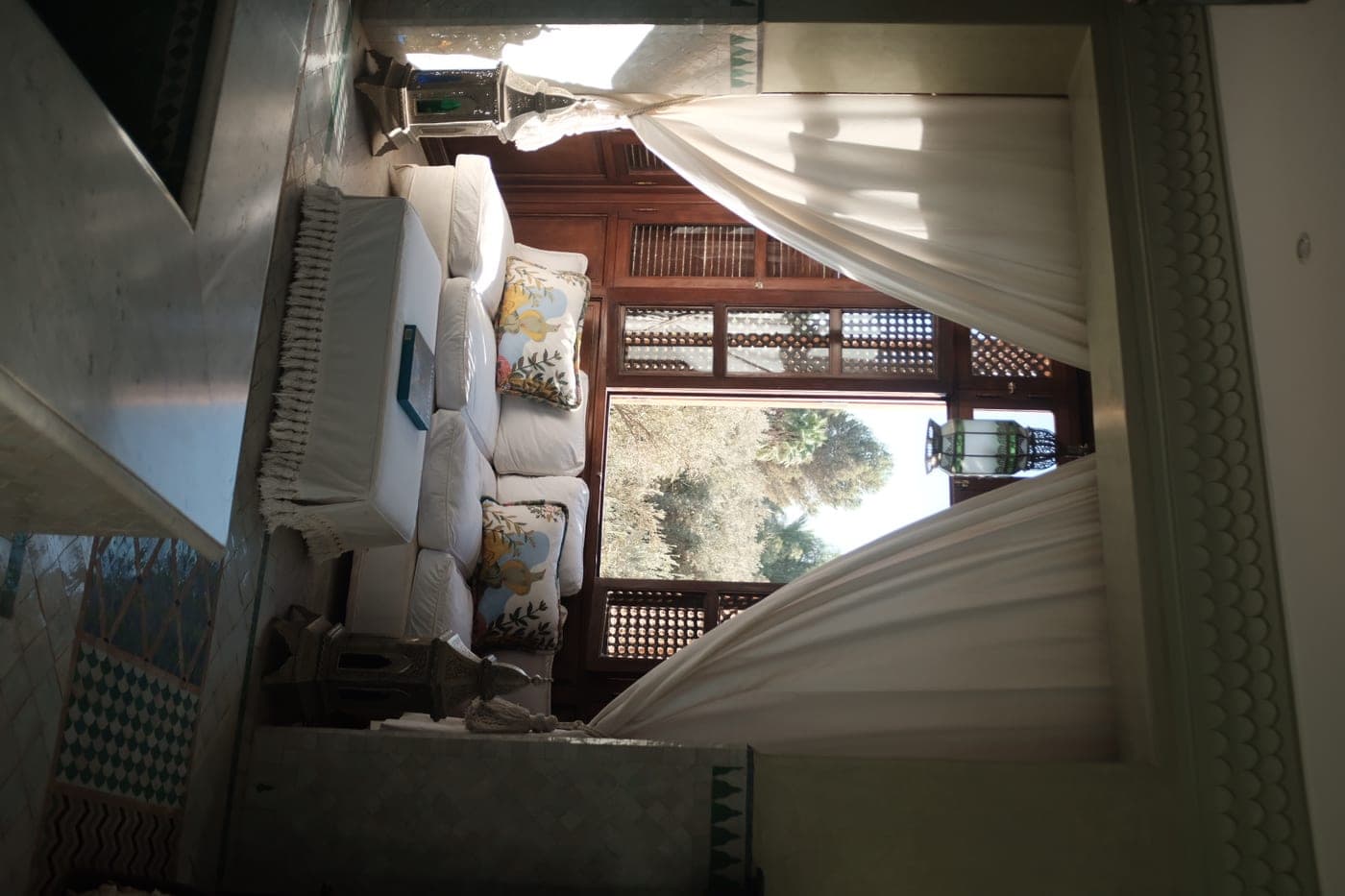
The six suites each carry their own chromatic identity, each a variation on the same underlying philosophy of material honesty and spatial intention. Some rooms turn toward the groves; others open onto internal courtyards where light collects differently. Boccara's vaulted ceilings do not announce themselves through ornament but through proportion and through the way they distribute light from the morning hours through the cooler geometry of late afternoon.
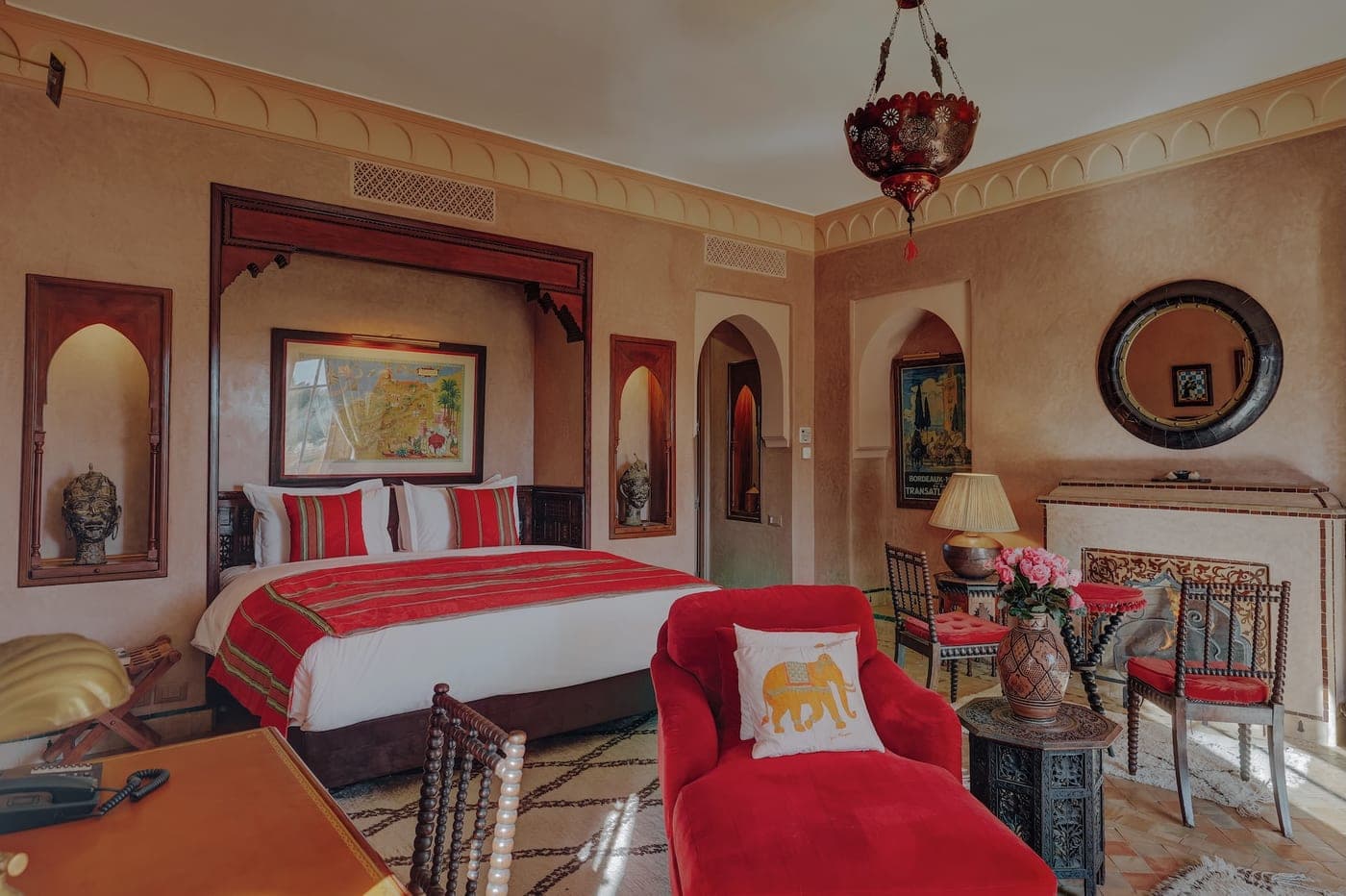
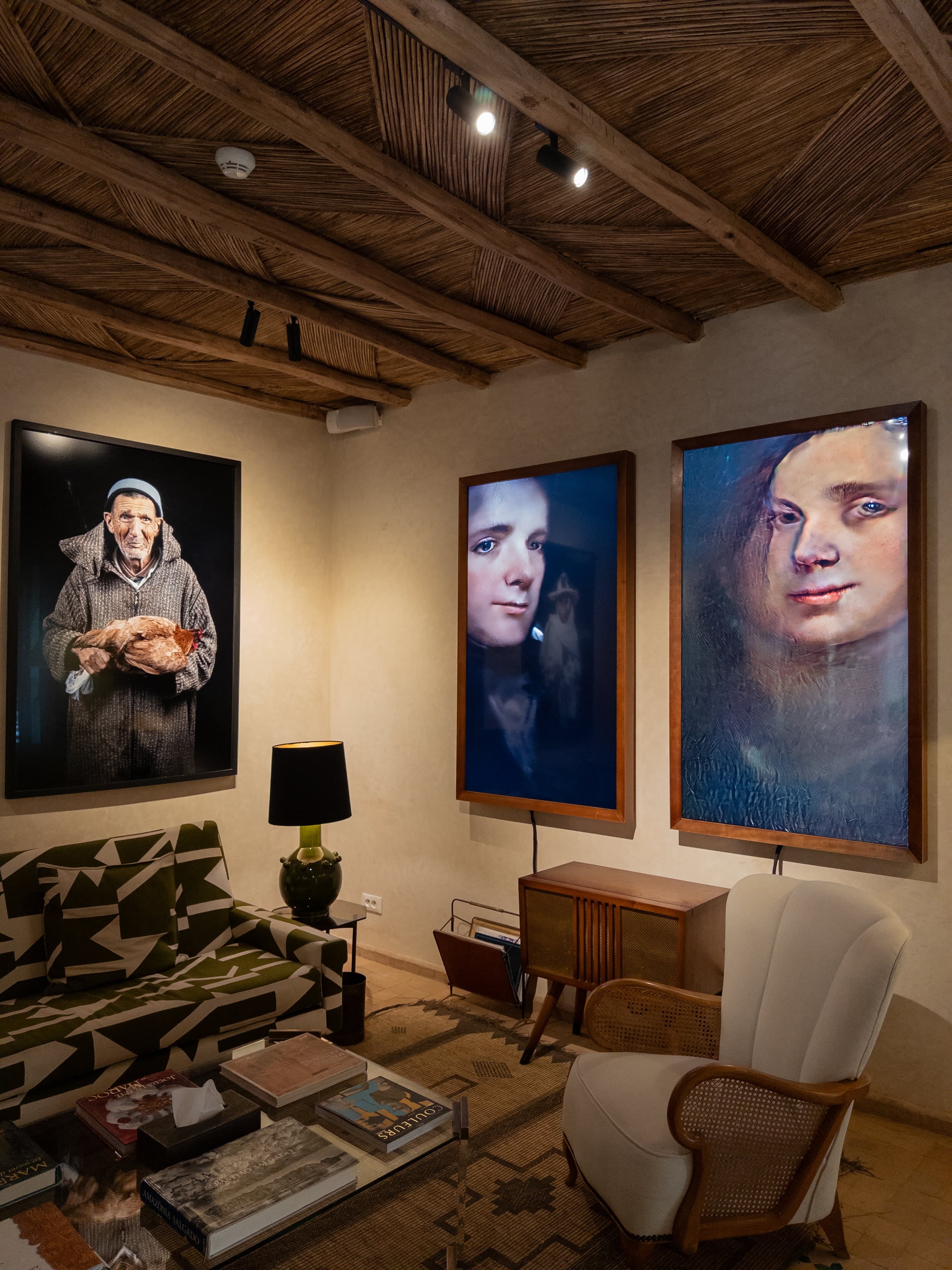
The fireplaces, designed by Boccara as spatial anchors, draw rooms together in winter. Luminous patios create pockets of stillness within the larger composition. The Bill Willis collection holds its own: furniture, sculpture, accumulated objects that carry weight and history, evidence of a sensibility that knew the difference between decoration and presence.
The Land Around the House
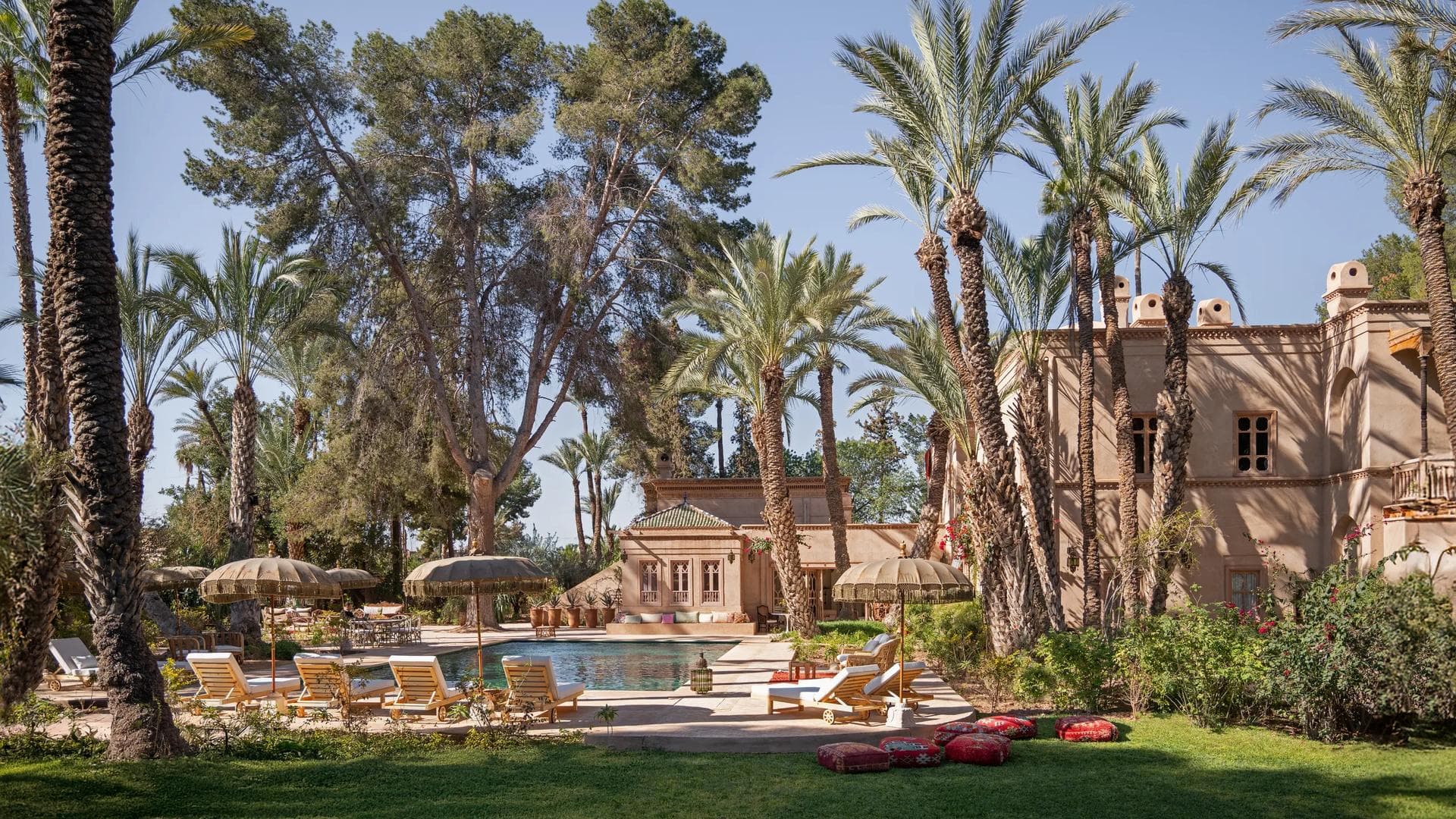
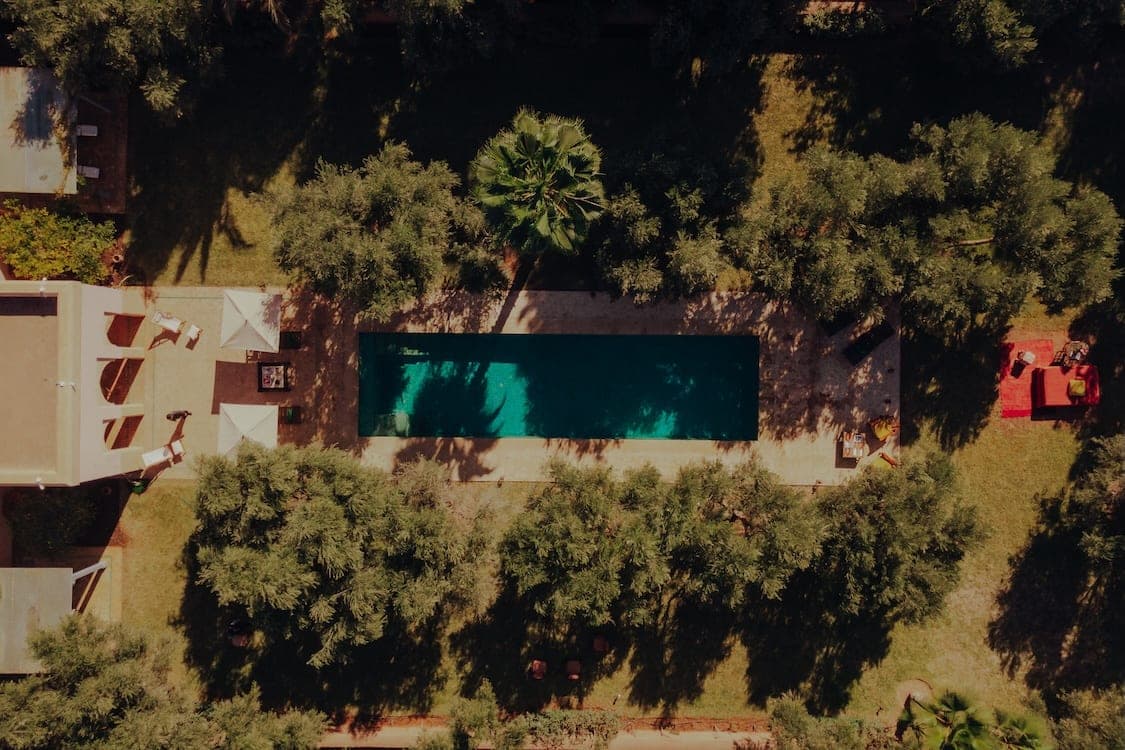
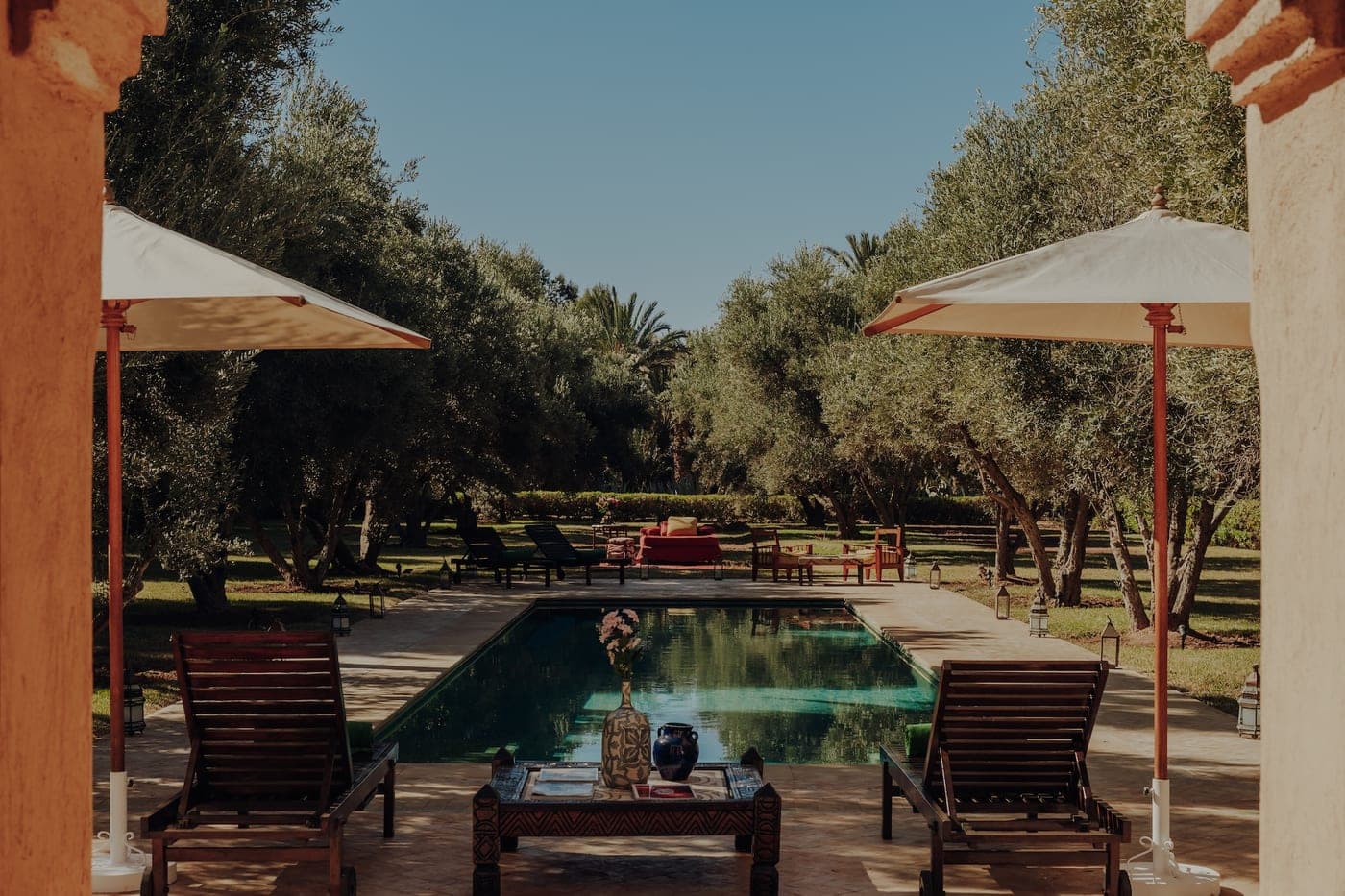
The three hectares carry olive trees that predate the house, alongside date palms, jasmine, and the quieter vegetation that fills in the spaces between them. Peacocks move through the grounds with that characteristic sense of occupying space without announcing it. The heated pool extends over the grove, offering the clean geometry of a reflecting surface against the organic irregularity of the orchard below.
The gardens respond to the seasons in ways the interior does not need to. Spring brings density and bloom. Summer heat transforms the light and the smell of the groves. Autumn strips things back to their essential structure, the olive trees revealing their true form as color fades. This seasonal variation is part of what the property offers: a landscape that moves, framed by a house that stays constant.
Position and Quiet
Route d'Amizmiz is not the Palmeraie and not the medina. It is a road that leaves Marrakech toward the mountains, moving through a landscape that still holds agricultural logic, where the city releases itself gradually. Casa Memoria occupies this in-between with intention. Its distance from the center is not inconvenience but structural condition: the quiet here is built into the location, not produced by sound-proofing or garden walls alone.
The journey from the medina takes fifteen minutes. That short distance crosses a threshold that feels longer. What arrives on the other side is a different quality of attention, the kind that only certain properties manage to produce and that fewer manage to sustain across every room and every hour of the day.
What Casa Memoria represents within Marrakech is a particular form of conviction: the belief that restraint and luxury are not opposites but collaborators, that a space can be precisely considered without becoming cold, that the finest interiors in this city have always understood weight and silence as design principles rather than deficiencies.
Address: Km 8, Route d'Amizmiz, Marrakech 40000
You may also like…