Contemporary Art Galleries in Marrakech: Five Addresses Shaping the City's Creative Present
From a renovated 1950s Gueliz building to a concept store named after its artist-founder spelled backward, these galleries each occupy a distinct position within Marrakech's expanding contemporary art geography.
14 April 2026
Marrakech has always attracted artists, and the city's relationship with visual art has deepened and diversified in the last decade. The medina's craft culture, which was never separate from visual practice, now shares the city's attention with a contemporary art scene distributed across specific nodes: Sidi Ghanem's repurposed industrial warehouses, the renovated mid-century blocks of Gueliz, and institutional spaces embedded in the city's luxury hospitality infrastructure. The five contemporary art galleries in Marrakech presented here represent distinct positions within this scene, with different programming philosophies, different spatial languages, and different relationships between the gallery as institution and the city as context.
What they share is a seriousness of purpose and an appetite for work that treats Marrakech not as an exotic backdrop but as a city with its own intellectual and artistic life, connected to African, Mediterranean, and international circuits in ways that continue to evolve.
Loft Art Gallery
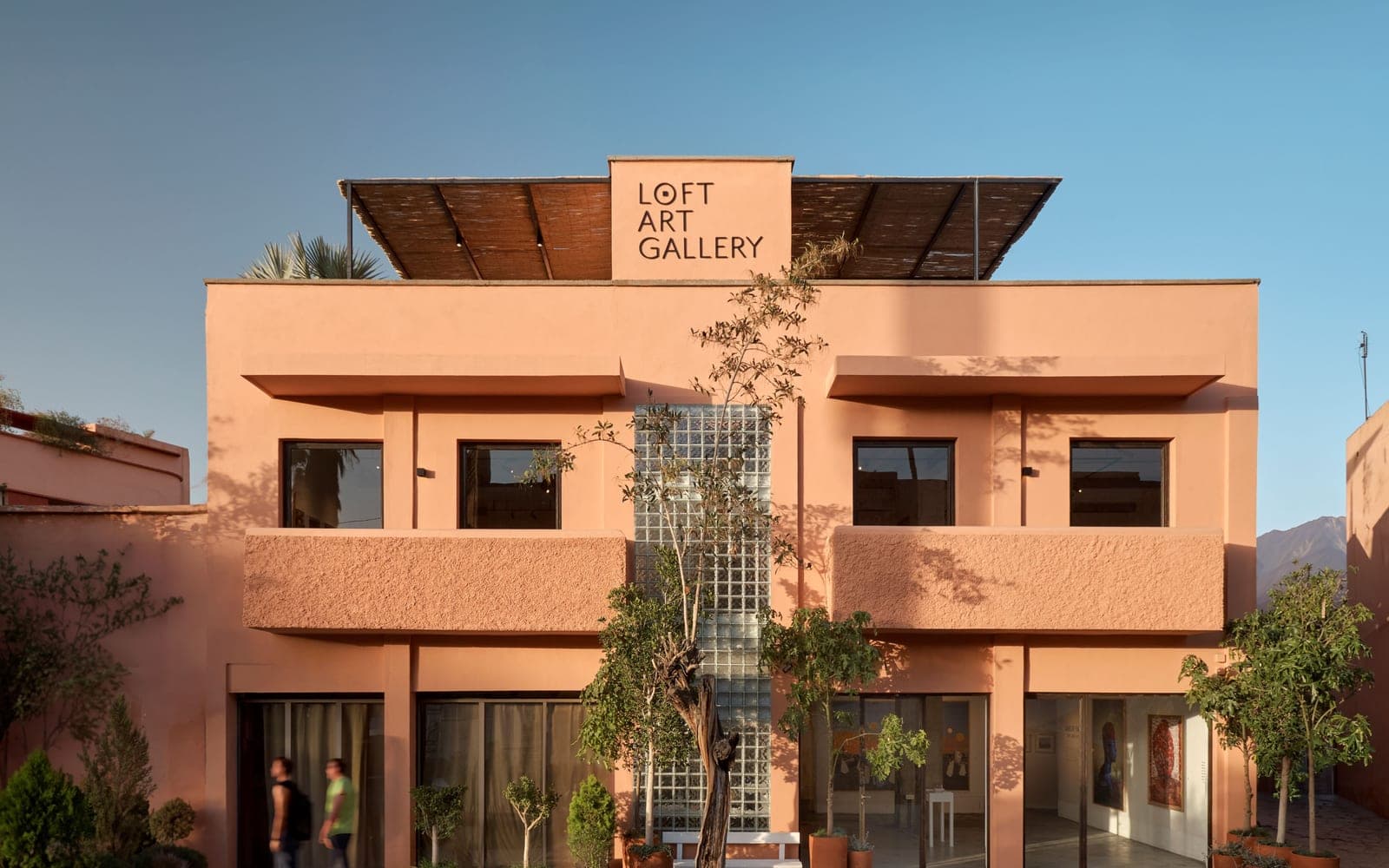
Founded in Casablanca in 2009 with a program centered on modern and contemporary Moroccan art, Loft Art Gallery opened its Marrakech branch in Gueliz in February 2024, during the week of the 1-54 Contemporary African Art Fair. The timing was deliberate: the gallery has participated in 1-54 since its early editions and has treated Marrakech as a natural extension of its continental ambitions. The space occupies more than 500 square metres in a renovated 1950s building at 60 Boulevard El Mansour Eddahbi, redesigned by architects Dorothee Ricard and Sylvain Ragueneau of Studio Aire Au Carre.
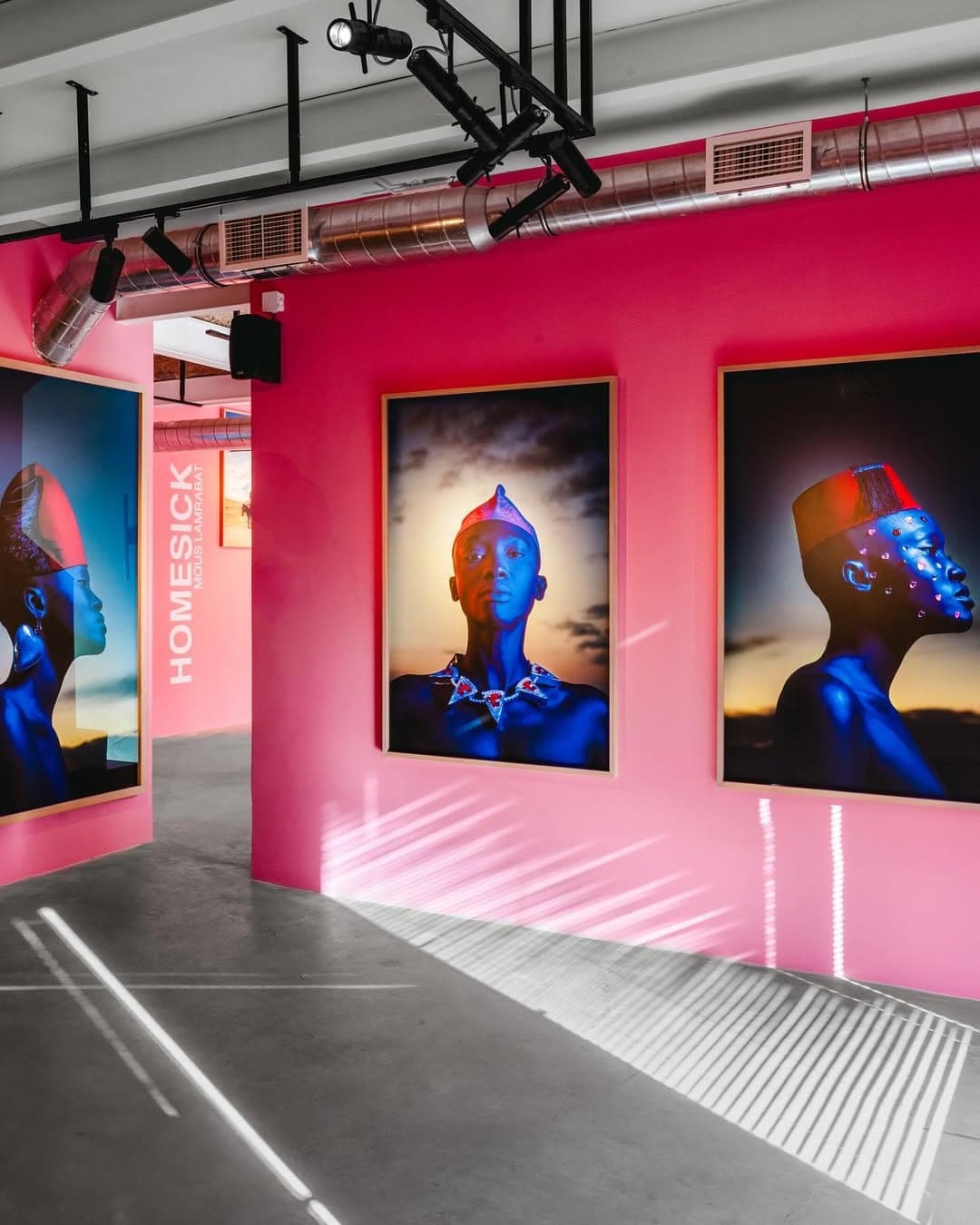
The architectural result is well-matched to the program: an Art Deco-inspired facade with balconies, two floors of exhibition space with a rooftop, and industrial interiors with polished concrete floors that can hold monumental work without competing with it. The gallery's scope has broadened from Moroccan to pan-African, representing established figures alongside emerging voices. Mohamed Melehi, Farid Belkahia, and Mohamed Chebaa anchor the historical end of the program; Amina Agueznay, Mous Lamrabat, and a younger generation occupy the contemporary end. Loft Art Gallery also participates in Art Basel, and the Marrakech space signals its intention to function not as an outpost but as a full exhibition program in its own right.
Address: 60 Boulevard El Mansour Eddahbi, Gueliz, Marrakech
Galerie Rigotang
Rigotang was founded by the creators of Riad Jardin Secret and operates from Sidi Ghanem with an appointment-only access model and a programming logic that begins long before any exhibition opens. The gallery runs a dedicated artist residency program in partnership with Riad Jardin Secret, offering selected artists time, space, and proximity to Marrakech's artisan networks. Every work shown at Rigotang has been produced or substantially shaped by the residency experience, which gives the gallery's exhibitions a material coherence that distinguishes them from programming that receives finished work from the outside.
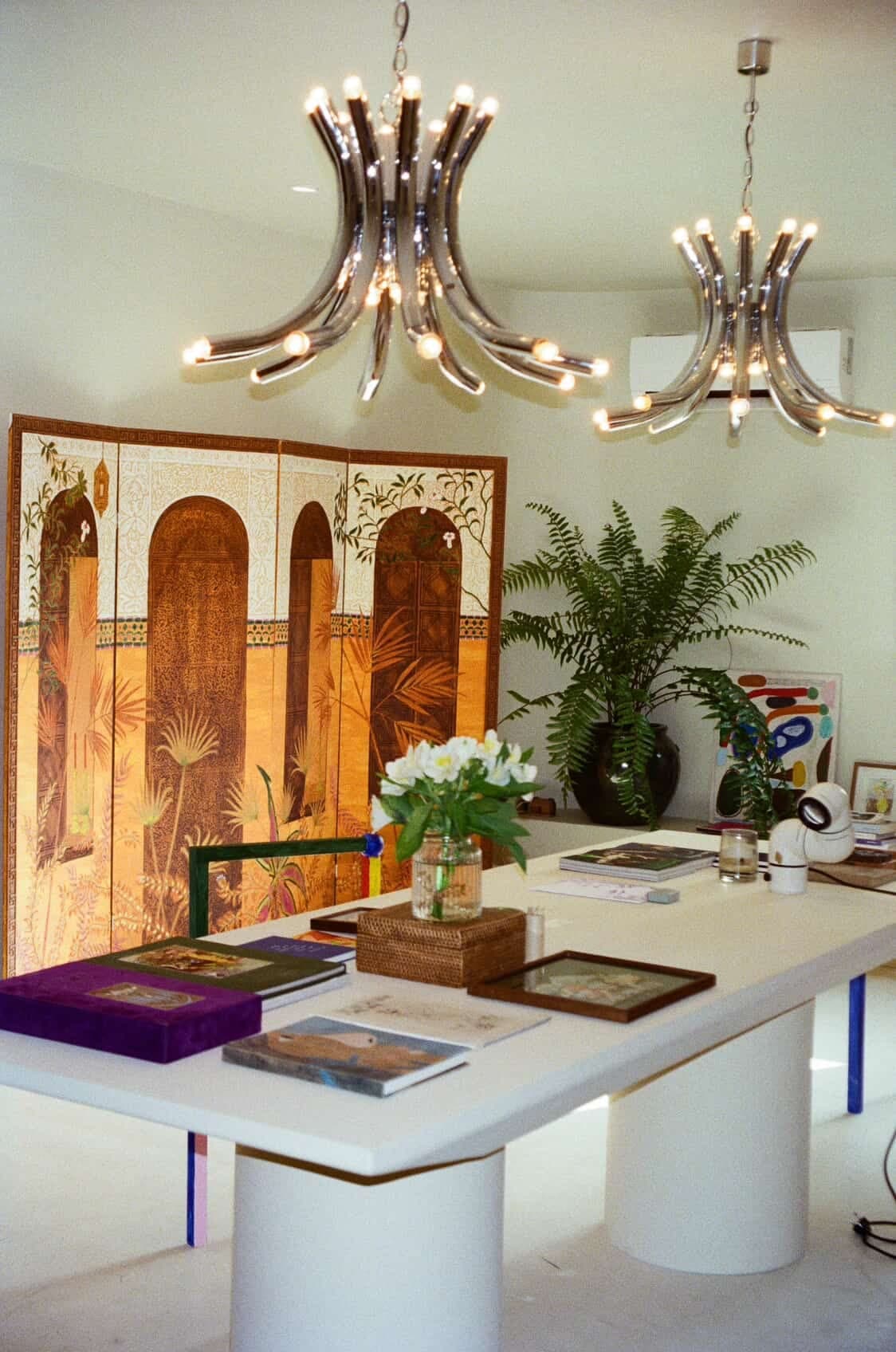
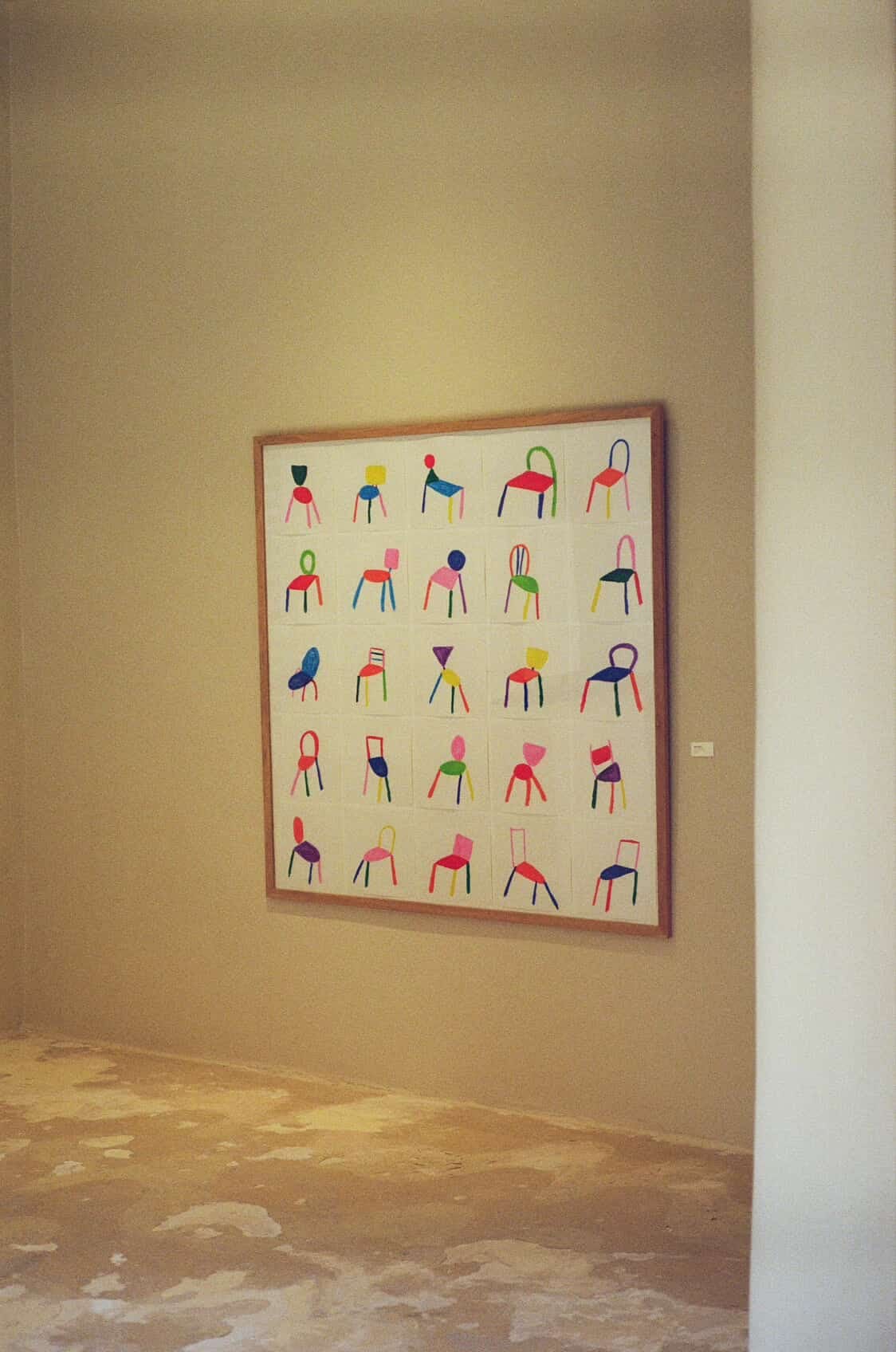
As the gallery describes its approach: poetic, thoughtful, and editorial. The emphasis falls on dialogue between artist, city, and local craft tradition, with works emerging from the encounter rather than being brought to it. The Sidi Ghanem location, an industrial quarter that has become Marrakech's creative district over the last decade, provides an environment in which that dialogue can unfold with minimal interference from the city's more pressured economies. Visiting requires prior arrangement by email, which is itself a considered statement: the gallery treats the encounter between viewer and work as something deserving of preparation on both sides, rather than a condition to be scaled by open hours.
Address: Sidi Ghanem, Marrakech (by appointment: hello@rigotang.com)
MCC Gallery
Fatima-Zohra Bennani Bennis, known as FZB, opened Dar El Bacha Gallery in the medina in 2018, one of the first galleries in Morocco dedicated exclusively to contemporary photography. In 2020 she relocated to a 600-square-metre warehouse in Sidi Ghanem and reopened as MCC Gallery, a program broad enough to hold painting, sculpture, installation, and performance alongside the photography practice from which it started. The gallery's stated commitment is to ambitious work that addresses contemporary issues through evolving, interdisciplinary formats, and to an engagement with critical reflection that resists the merely decorative.
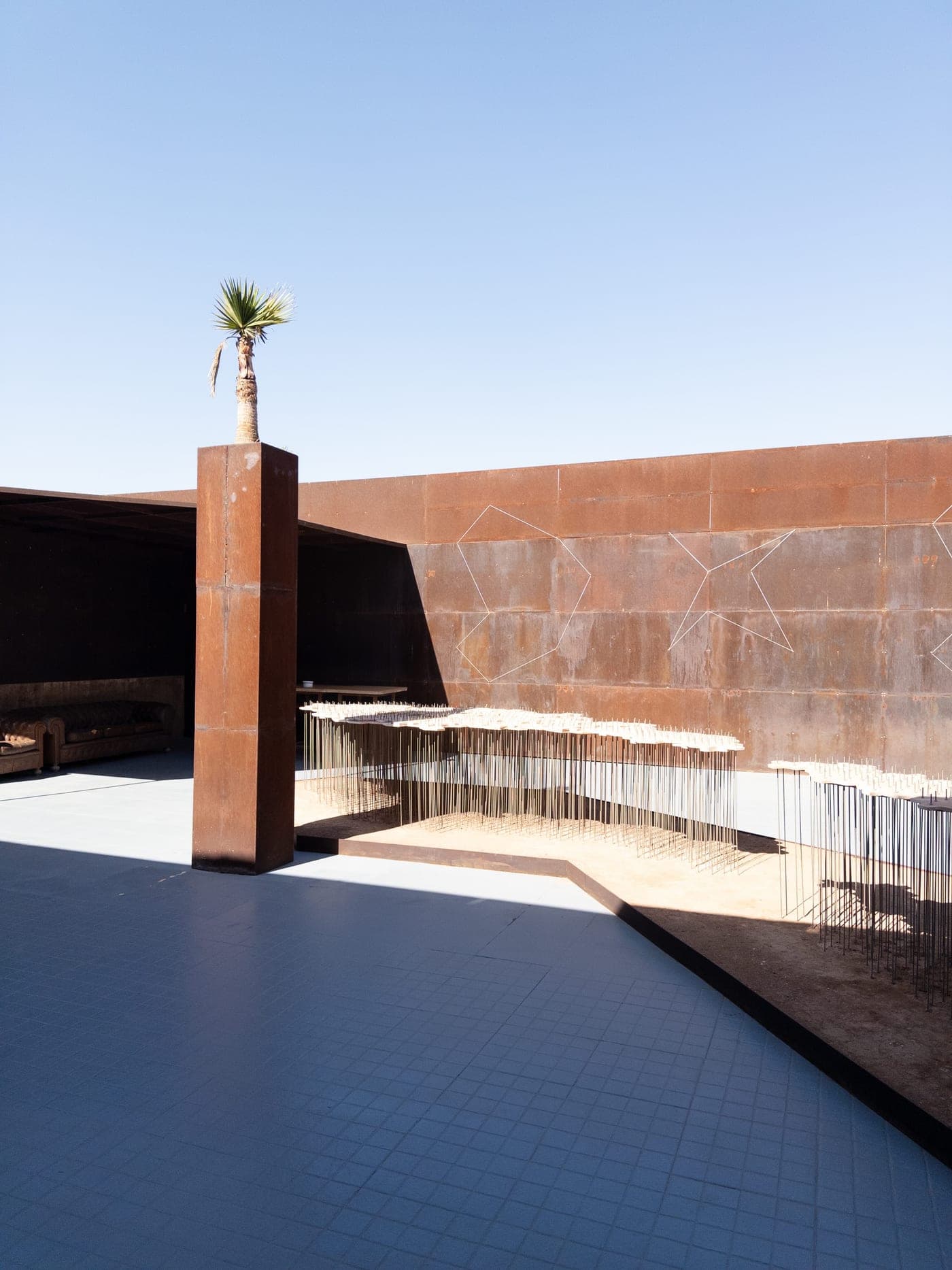
The inaugural program at Sidi Ghanem established the register immediately: a museum-scale presentation of Amine El Gotaibi's "Visite" in 2021 demonstrated the gallery's capacity for monumental work in the new space. Subsequent exhibitions have included "CHARADES" by Yassine Balbzioui, curated by Simon Njami, and "UNDER THE SILVER TREE" by Mo Baala. The gallery represents Amine El Gotaibi, Houda Kabbaj, Malika Sqalli, Mustapha Azeroual, Hamza Kadiri, and others, and participates regularly in international fairs including AKAA Paris and 1-54. MCC Gallery functions as one of the city's primary institutional anchors for serious contemporary programming with an international reach.
Address: 281 Rue Principale, Sidi Ghanem, Marrakech
Jajjah by Hassan Hajjaj
Hassan Hajjaj was born in Larache in 1961 and moved to London at twelve. He left school early to open R.A.P. (Real Artistic People), a Soho shop selling reimagined luxury-brand streetwear in 1984. He returned to Marrakech and built a photographic practice that has placed his work in the Brooklyn Museum, the Guggenheim Abu Dhabi, and the Victoria and Albert Museum. He is sometimes described as the Andy Warhol of Marrakech, a label he accepts with the equanimity of someone who has heard it many times. His photographs place subjects dressed in Moroccan traditional clothing and colorful contemporary fashion against bold geometric backdrops, then frame the prints in constructions built from tin cans, tea packaging, and domestic goods, making the frame as much a part of the work as the image.
Jajjah is his name spelled backward, and also the name of both his tea brand and the concept space he opened at 114-116 Rue Sidi Ghanem. The space operates simultaneously as cafe, boutique, and gallery: tea is brewed, Moroccan food is served in Hajjaj's visual language, objects and prints are sold, and exhibitions rotate through the gallery section. A recent collaboration with Atay Atelier, the "Cross Lens" exhibition, brought together eight emerging artists from Morocco and the Netherlands to address cultural identity through photography, which is as clear an illustration as any of how Hajjaj uses the space: as a platform for the kind of international artistic exchange that shaped his own practice in its early years.
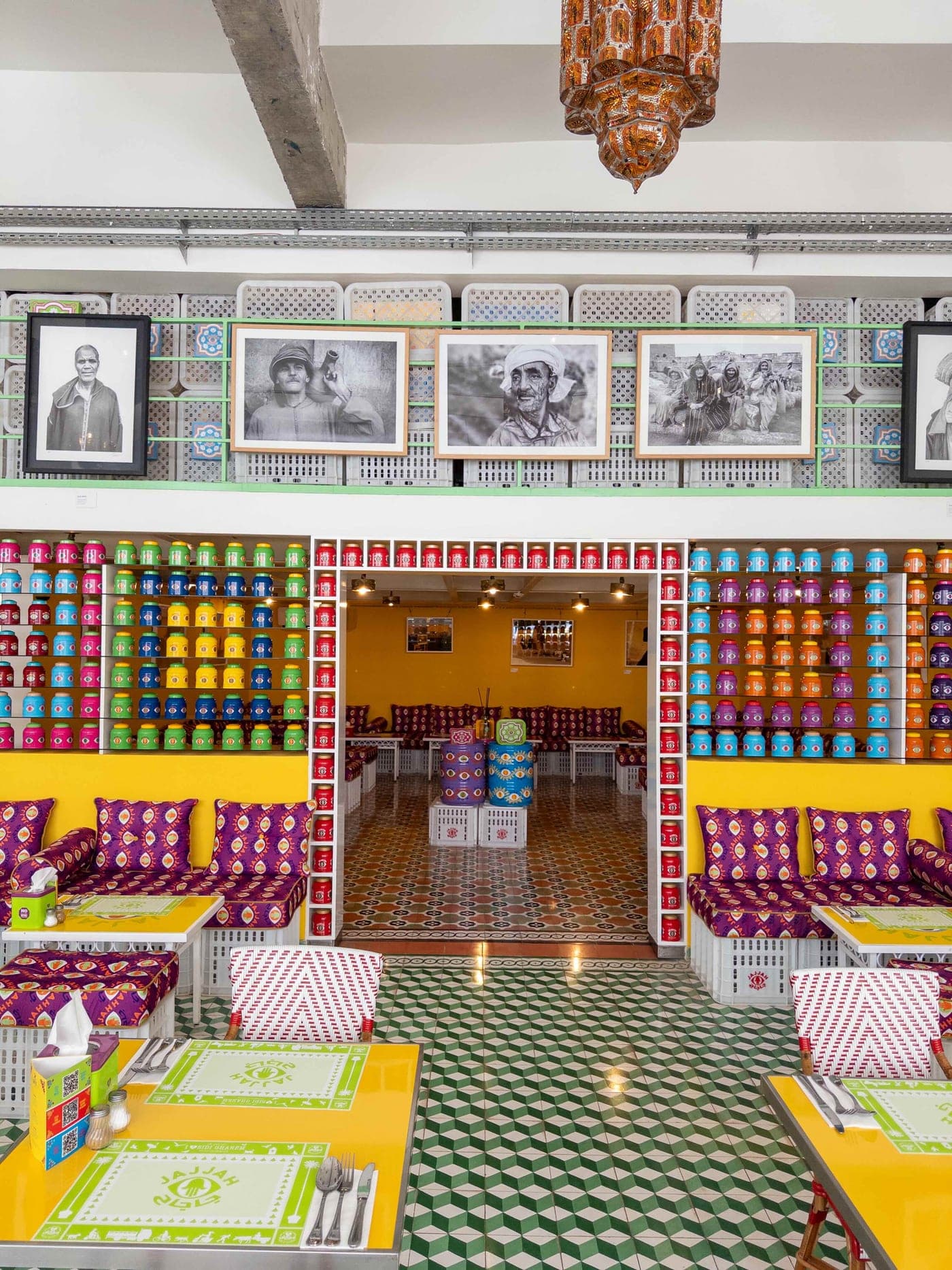
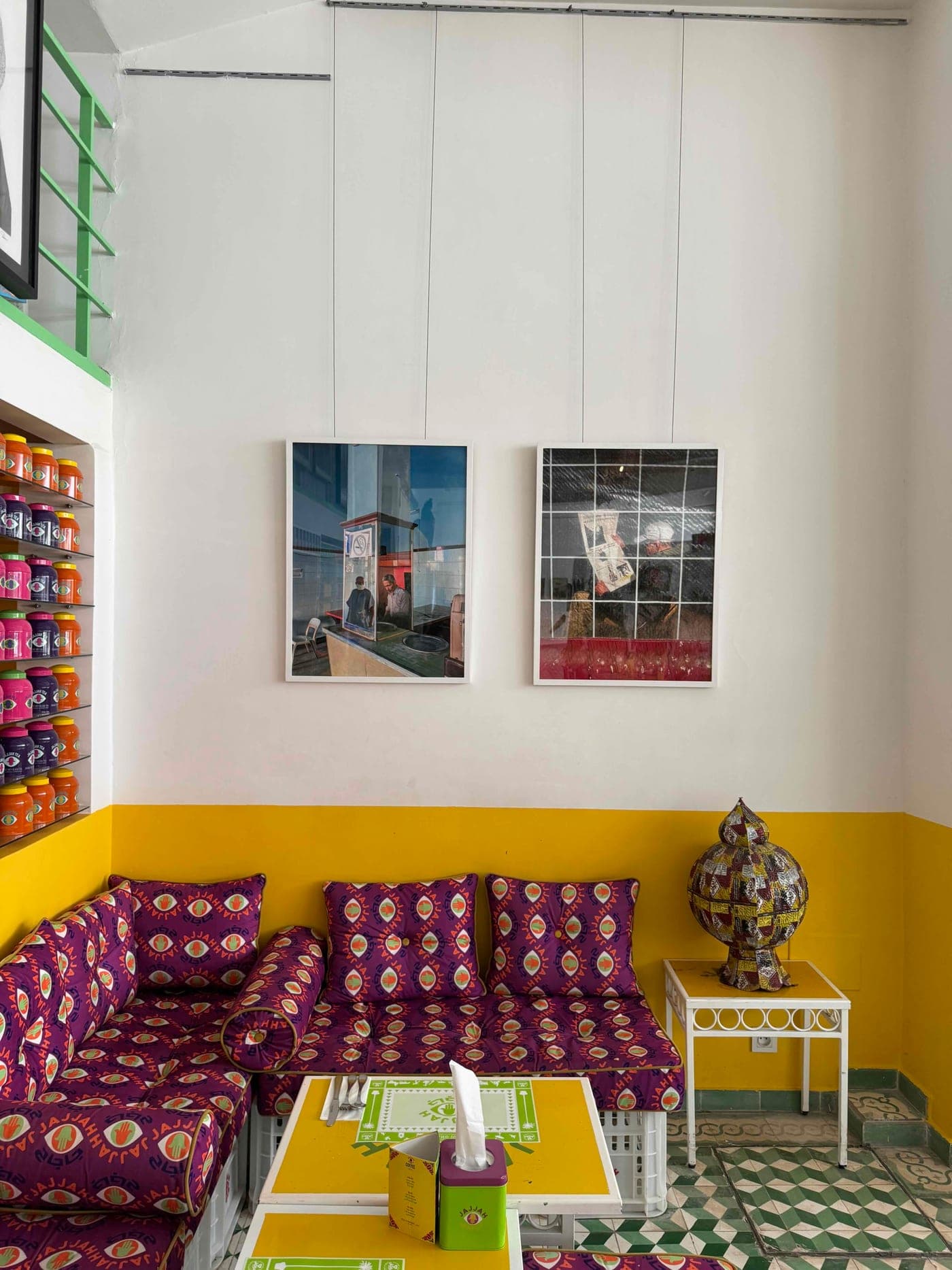
Jajjah is the only gallery in this selection that operates simultaneously as a place to eat, buy, look, and be in, and that ambiguity is not a compromise but a position. Hajjaj's practice has always dissolved the boundaries between high culture and street culture, between commodity and artwork, and Jajjah the space embodies that dissolution at 1:1 scale. The tin-can frames on the wall sell the same logic as the tea tins on the shelves. The price of entry is a cup of tea.
Address: 114-116 Rue Sidi Ghanem, Marrakech
Galerie 208 at M.O. Studio
Galerie 208 was founded in Paris in 2006 by Patricia Chicheportiche, a gallerist known for placing monumental and innovative contemporary work in contexts that are architecturally or institutionally unexpected: the Invalides, the Palais de Tokyo, Printemps Haussmann. In 2024, she brought the gallery to Marrakech through the M.O. Studio at the Mandarin Oriental, a space co-conceived by Carmen Haid and Moroccan artist Idriss Karnachi. The spatial language of M.O. Studio is deliberately contrastive: a black-and-white interior informed by the 1903 Wiener Werkstatt movement that holds itself in formal tension with the warm material palette of the hotel surrounding it.
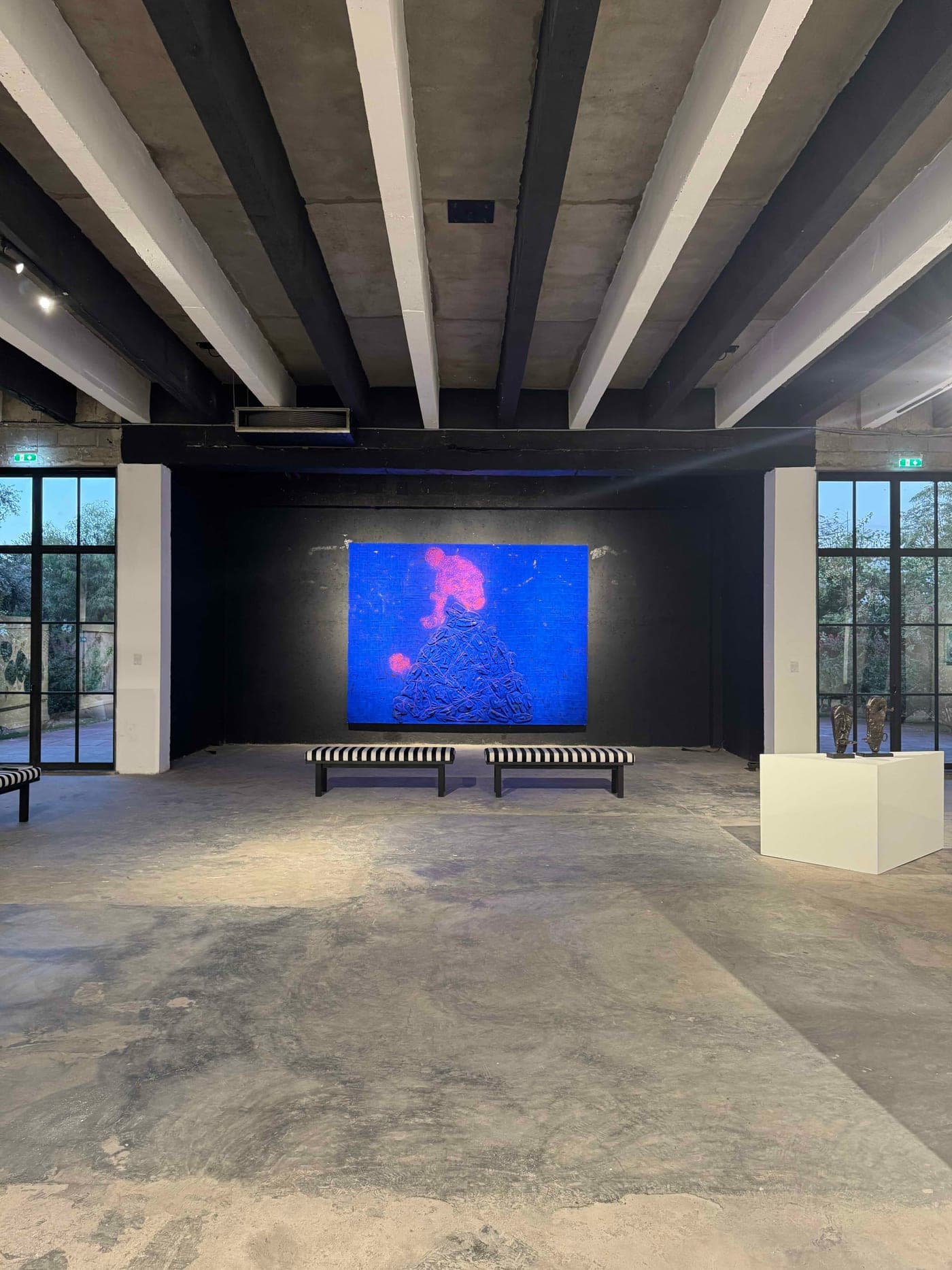
The inaugural exhibition, "Rythme des Dunes" by Franco-Chinese artist Li Chevalier, established the gallery's appetite for work positioned at a cultural intersection. Subsequent exhibitions have included "Silent Elevations" by Mahi Binebine and "La Memoire des Gestes," a curatorial project bringing together eleven artists from Morocco and the contemporary African art scene. The studio functions as gallery during daylight hours and transforms into an event space by night, integrating the gallery program into the social life of the hotel without subordinating it. For Galerie 208, the Marrakech space is not a satellite location but an argument: that the city's appetite for contemporary art at international scale deserves an institutional response at the same level.
Address: Mandarin Oriental, Al Maaden, Marrakech
Marrakech's contemporary art geography has shifted substantially in the last five years. Sidi Ghanem has consolidated as the city's creative quarter, drawing MCC Gallery, Rigotang, Jajjah, and others into an informal cluster where the industrial building type provides the spatial vocabulary for ambitious programming. Gueliz offers a different register: Loft Art Gallery's 1950s renovation situates the gallery within the city's mid-century architectural heritage while projecting a continental ambition. Galerie 208 at the Mandarin Oriental operates from within the luxury hospitality economy and uses that position as a curatorial platform rather than a constraint. The 1-54 Contemporary African Art Fair, which holds its Marrakech edition annually, functions as the connective tissue across all of them, bringing collectors, curators, and critics into a city that no longer needs to position itself as emerging. The five galleries together constitute a scene rather than a collection of isolated spaces, and a scene has a momentum of its own.
You may also like…