Where to Eat in the Marrakech Medina: The 47 Best Restaurants
Timence Guide Editors · 14 November 2026
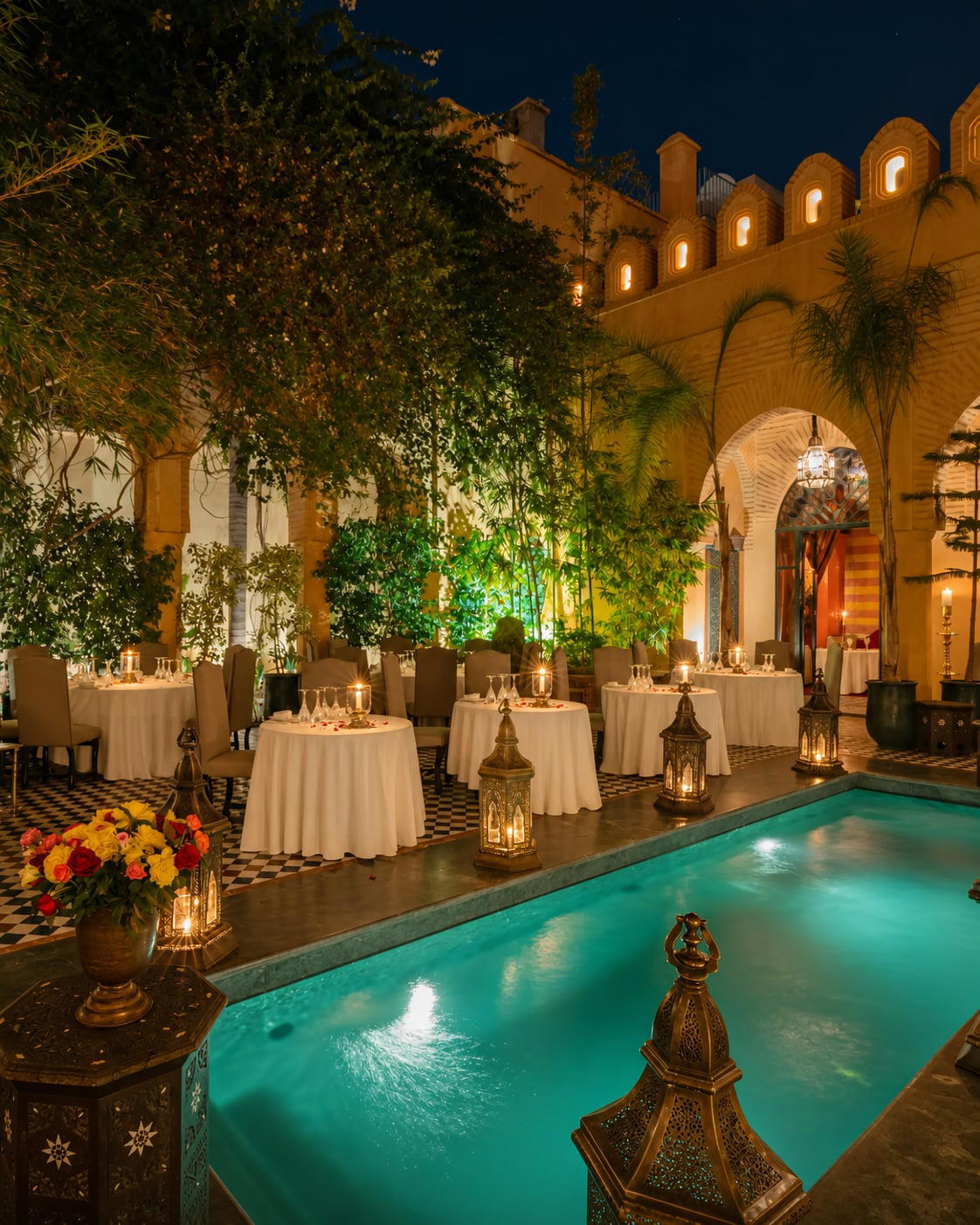
Forty-seven tables inside the old walls, from couscous eaten from a shared bowl to the dining rooms of the great palace hotels, sorted by price.
Under €30
Eleven addresses where dinner stays under thirty euros a head: couscous from a shared bowl, lamb from an underground oven, rooftops over the spice square and courtyard kitchens hidden behind a door. Average price per person for dinner, drinks excluded.

On the edge of Rahba Kedima, the old spice square, three floors of red tadelakt, rough wood and woven chairs climb from the market to the sky. The ground floor faces the stalls, the second floor has a fireplace, and the rooftop looks over terracotta roofs to the Atlas. The menu stays simple: Moroccan breakfasts with amlou and crepes, salads, sandwiches, tagines, fresh juices and mint tea. A place for the pause between two souks rather than a long dinner.

Just off Jemaa el-Fna, inside the old Fondek El Massioui on Derb Dabachi, Chez Brahim serves Moroccan home cooking on two upper floors: a salon of lamps, carved plaster and coloured glass, and a covered rooftop where the noise of the square drops to a hum. Tagines anchor the menu, with pastilla, rfissa, couscous and merguez brochettes from the charcoal grill, and set menus run from salads to mint tea and pastries. Portions are generous and the service unhurried.
Jamaâ El Fna Rue derb dabachi n° 38, fondek El Massioui n° magasin 26، Marrakech 40000, Morocco
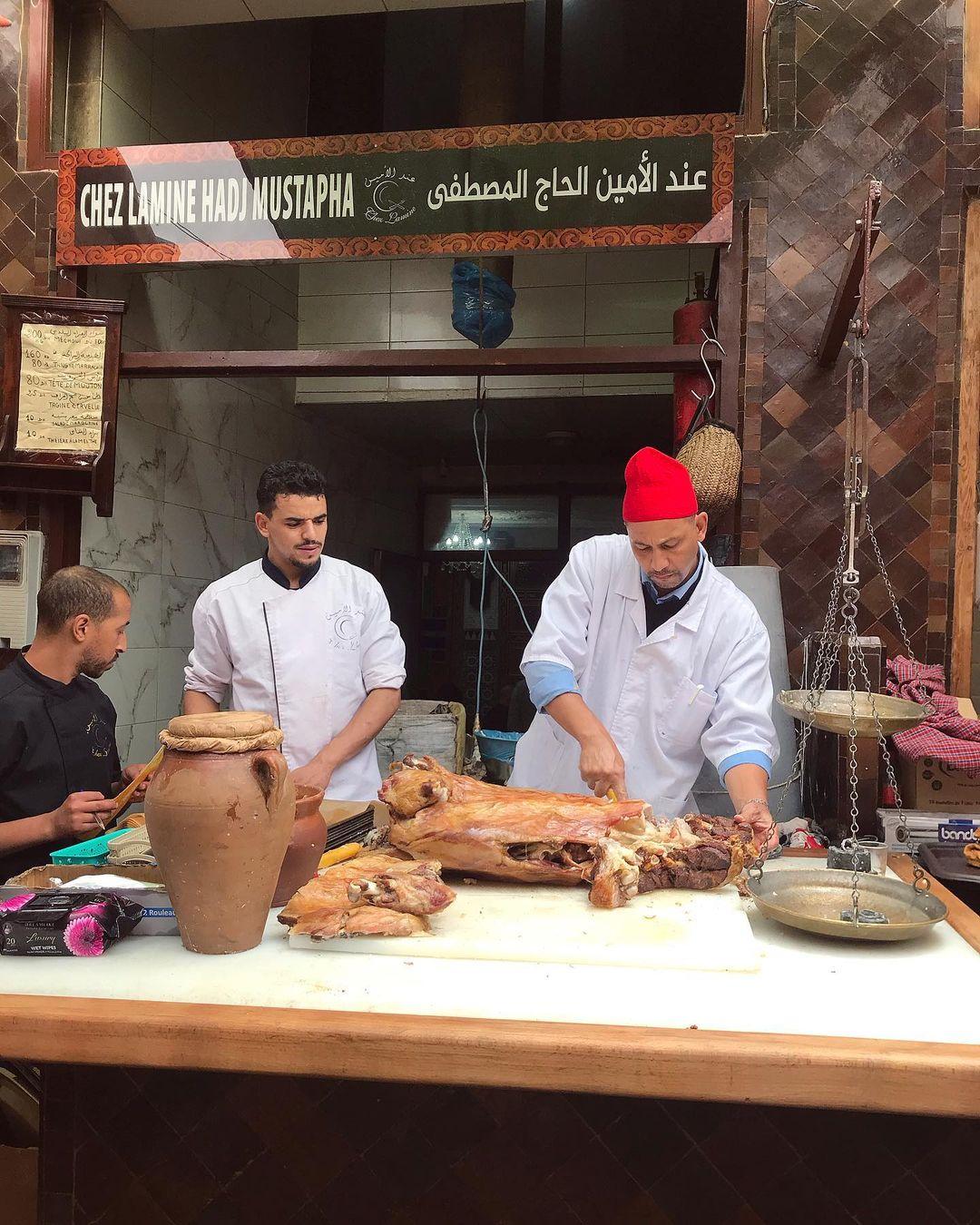
At the entrance to Mechoui Alley, on the north side of Jemaa el-Fna, Chez Lamine has been roasting lamb since 1965. Each morning up to forty whole lambs go into an underground wood-fired oven for three to four hours; the meat is sold by weight, with cumin, coarse salt and khobz. The other signature is tangia marrakchia, meat sealed in clay urns and cooked overnight in the embers of the hammam furnace. Come at lunch, when the méchoui is served, and avoid Fridays and Sundays.

In a two-storey house off Rahba Kedima (the name is Darija for table), L'mida has several different spaces to eat in, where industrial edges meet Moroccan craft: white marble, green and mustard banquettes, rattan. The menu is evolving under Chef Abdel Alaoui, also the chef of Mizaan, who is adding new dishes and desserts in the house's signature fusion spirit. Upstairs, a high rooftop has one of the most interesting views of the Medina, across to the Koutoubia and the Atlas, best at sunset. Mocktails and mint tea instead of alcohol.
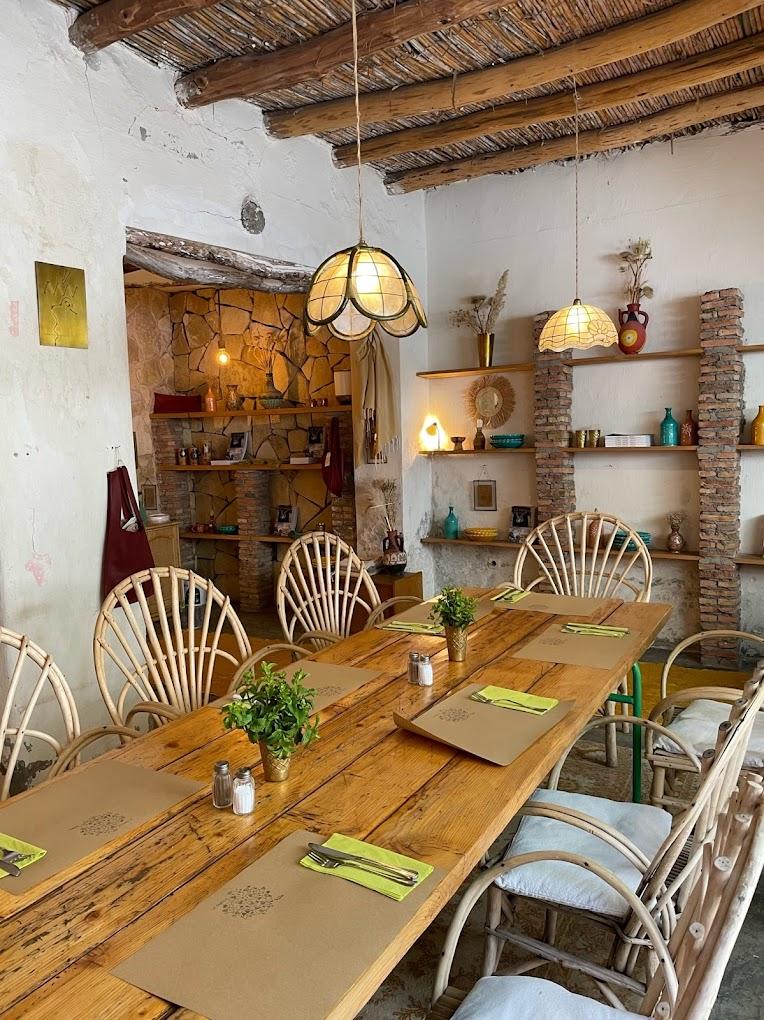
Since 2015 this courtyard restaurant a few steps from the souks has served only vegetarian food, in a garden shaded by lemon trees where the noise of the medina stops at the door. The kitchen follows the market: seasonal dips with homemade crackers, then a barley and vegetable salad, a pasta or a focaccia with grilled vegetables. Open for lunch only, Monday to Saturday.

Behind a painted door on Rue Diour Saboun, near Bab Taghzout, Limoni opens onto a tiled courtyard where lemon and orange trees brush the tables. The owner is Italian, and the pasta shows it: ravioli limoni with ricotta, mint and lemon zest, tagliatelle, gnocchi, plus pizzas. A full Moroccan menu runs alongside, pastilla included, and there is a sunny rooftop upstairs.

Two terraces with garden chairs and parasols sit right above Jemaa el-Fna, and at golden hour the square turns gold below them. Inside, the small rooms borrow from the square, with hand-painted murals and pastel lamps. The menu is Mediterranean and Moroccan mezze to share, with a slow-cooked tanjia marrakchia, and mocktails to drink. No reservations: tables go to whoever arrives first.
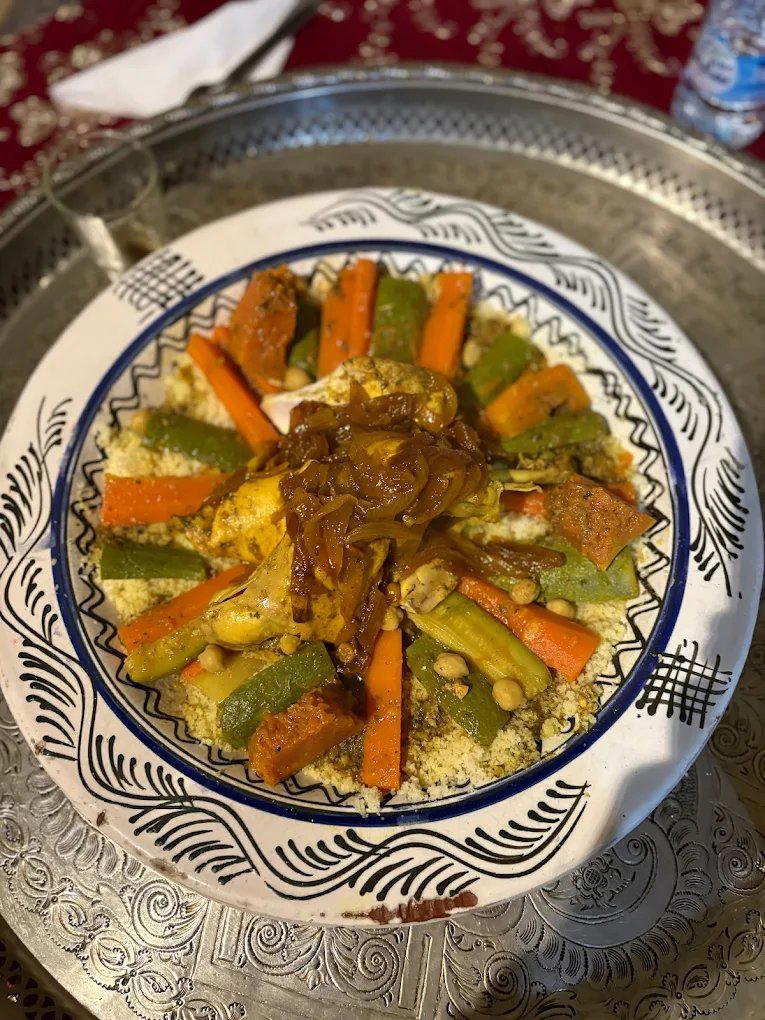
Near Medersa Ben Youssef, where the souk stalls thin out, Naima Couscous is a room of six tables around an open kitchen, with no sign and no menu. The couscous cooked since morning arrives in one bowl at the centre of the table and everyone eats from it, as a Moroccan family does on a Friday. Fine semolina, slow-cooked vegetables, a broth that carries it all, then mint tea and almond pastries. When the pot is empty, the day is over.
Rue Azbezt, Marrakesh 40000, Marocco
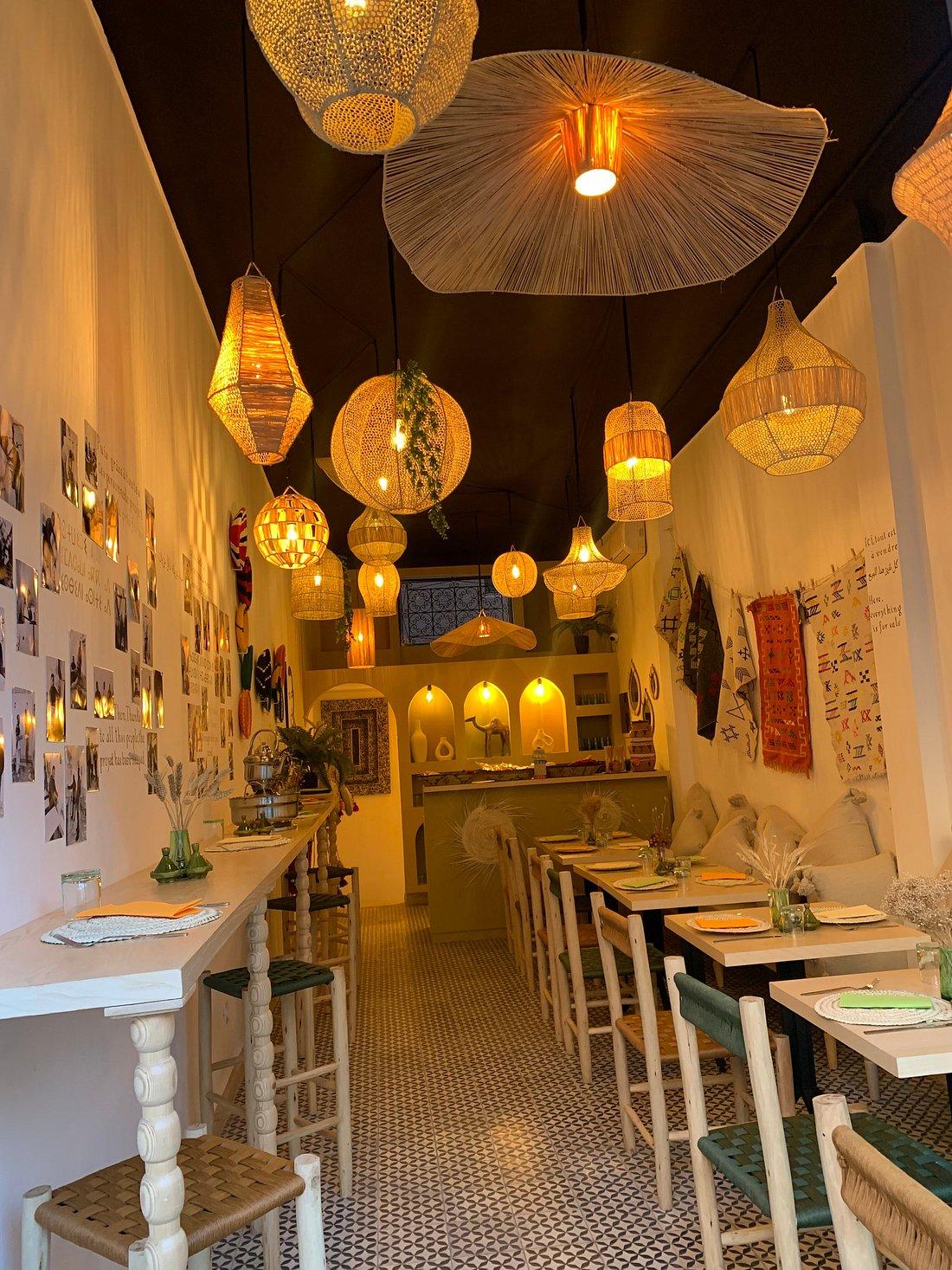
On Rue Fatima Zahra, between Jemaa el-Fna and Dar El Bacha, the name means eat well in Darija, and the open kitchen shows how: a team of dadas cooks everything from scratch each morning, bread included. Tagines, harira, bissara, briouates and batbout sandwiches follow the rhythm of a Moroccan home, with rfissa on Wednesdays, couscous on Fridays and pastilla on Mondays. Most of what is on the walls, from baskets to cushion covers, comes from women's cooperatives and is for sale.

Off Rahba Lakdima, the name means sieve in Darija, a memory of the building's past. Today it stacks a concept store of Moroccan and African designers, a hairdresser and, at the top, a compact terrace of green banquettes and banana trees with a 360-degree view to the Koutoubia. The kitchen keeps to tagines, salads, kefta sandwiches and fresh juices, plus a date and amlou cocktail made without alcohol. The soundtrack is electronic and vintage funk, with the occasional DJ set.
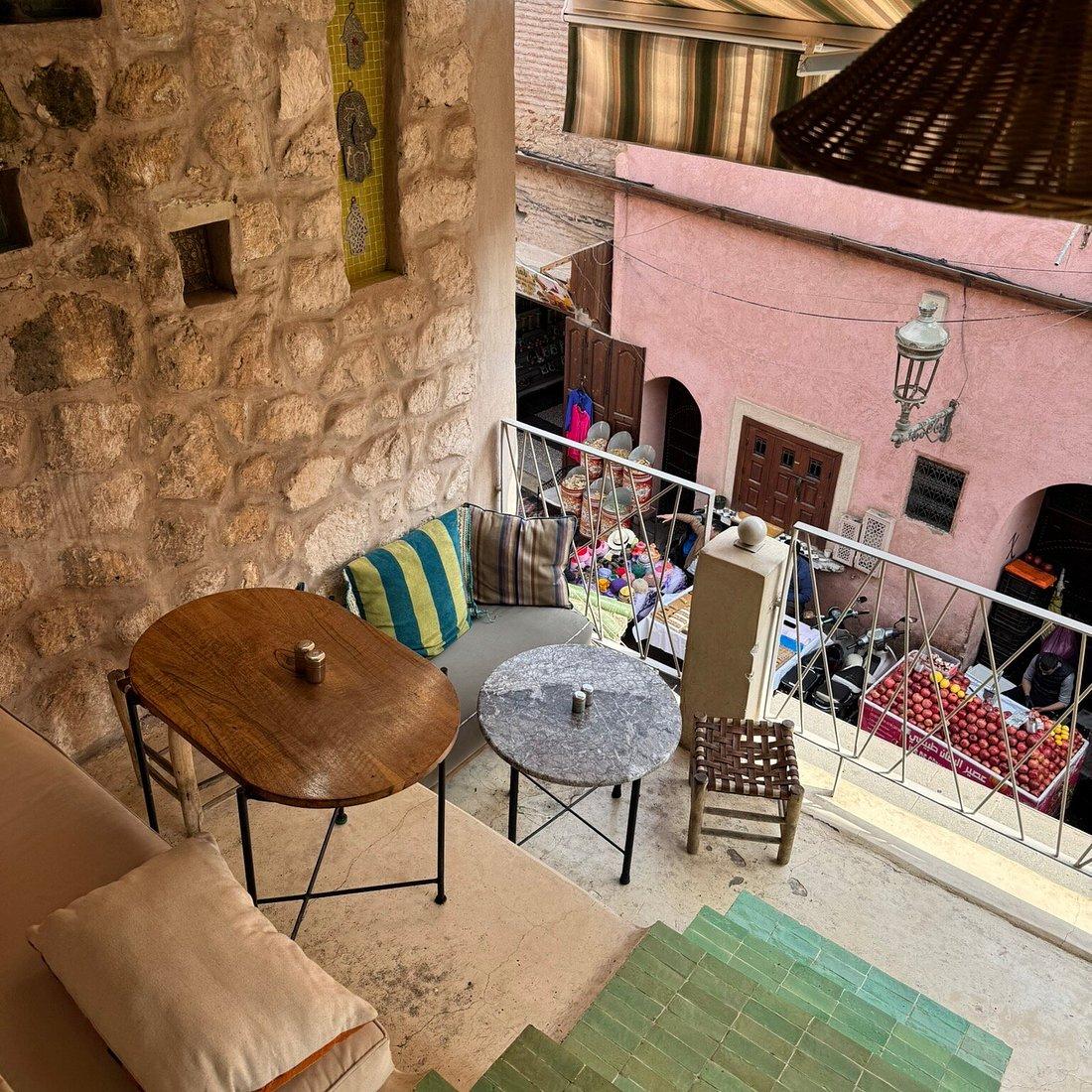
A few doors from Le Jardin Secret on Rue Mouassine, Yazel climbs to a small terrace above the street, a balcony for watching the medina go by, with a covered level below for wind or midday sun. The short menu is Mediterranean and Moroccan mezze: beetroot and pumpkin hummus, feta cigars, falafel, kofta pita, sardines, fattoush. No alcohol, but fresh juices and juice cocktails made to order. An easy stop between the souks and the garden.
€30–60
The widest band, twenty-three restaurants: riad courtyards, rooftop terraces over the souks, Moroccan cooking reworked by a new generation, and kitchens from Lebanon to Mexico. Average price per person for dinner, drinks excluded.

Behind a raw wooden door in the lanes of Dar El Bacha, Azulik Inla is run by Laetitia and her daughter Inès, for whom it is a first restaurant. They spent more than a year with Moroccan craftsmen shaping the house by hand, over three levels named after towns of the Yucatán: Valladolid, the patio where the evening begins; Mérida, small earthen salons in low light; Tulum, a rooftop under a pergola among cacti and pottery. The kitchen is Latin with a Mediterranean streak and made in the house: tortillas and nachos, tacos to share, ceviches and slow-cooked meats, churros prepared to order. The bar is built around tequila and mezcal. Open every evening from 6pm.
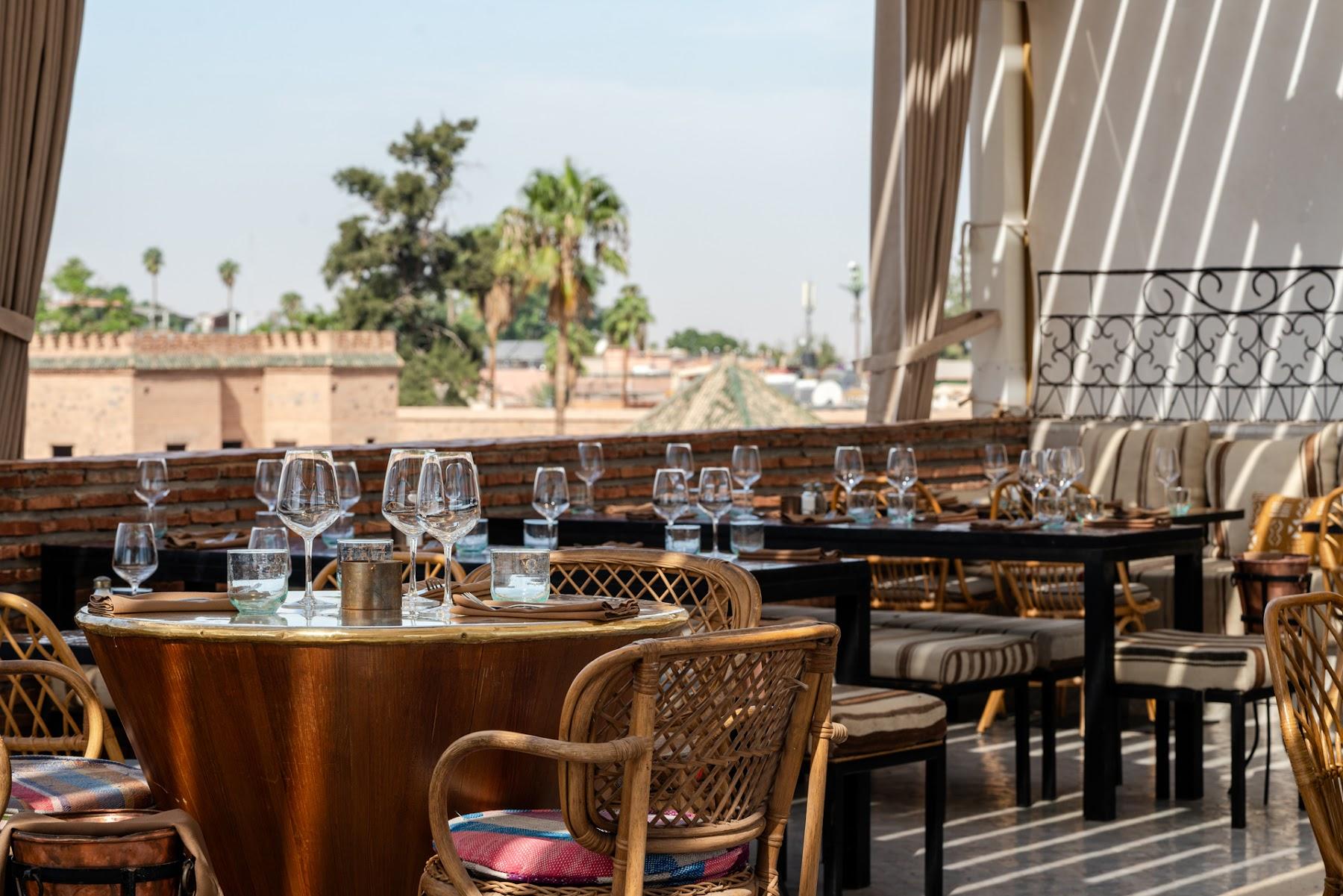
A few minutes from Jemaa el-Fna, Dardar stacks a lounge restaurant and bar, a club and a wide rooftop facing the Koutoubia, with the Atlas beyond on clear days. Open from noon to 2am, it changes with the hours: burgers and poke bowls at lunch, tapas and cocktails at sunset, pink couscous and tangia at dinner. After dark come DJs, dinner shows and, on some nights, live music. Smart casual dress.
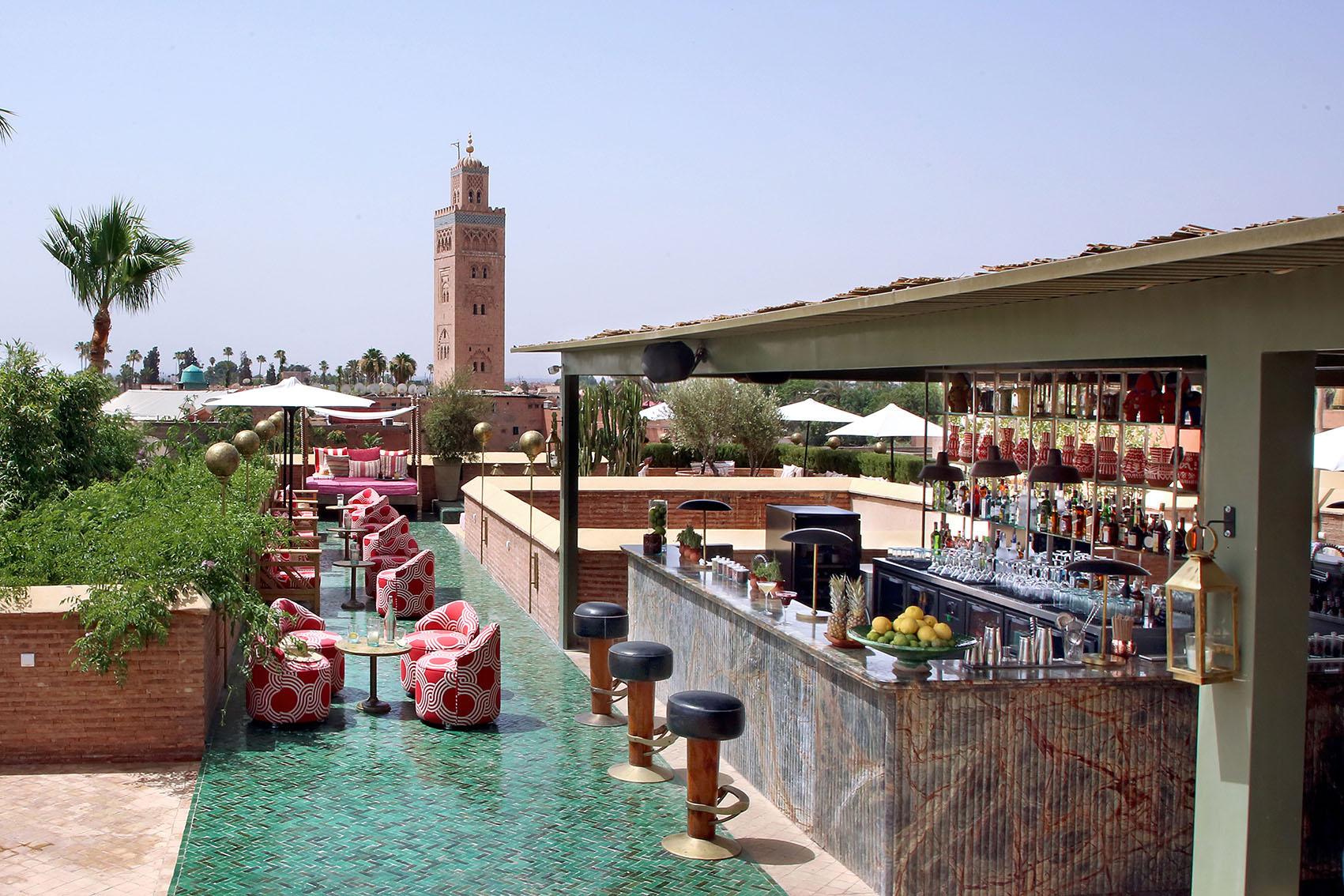
An evergreen of the Medina, the El Fenn rooftop is the part of the hotel open to everyone: 1,300 square metres facing the Koutoubia and the Atlas, with a 30-foot marble bar, daybeds and shaded corners. The restaurant serves lunch and dinner, with seasonal cooking built on produce from nearby farms, Atlantic fish and Atlas meat. Jasmine in summer, woodsmoke from the fires in winter. Non-residents enter through the El Fenn Boutique, and sunset fills up fast.

A year after opening, Flowers has already left its mark. On the rooftop of Dar Marjana, it is built around a wood fire and seasonal plates to share, with produce from local growers. Bouquets everywhere, colourful and delicate tableware. The cooking sits between North Africa and the Mediterranean. Chef Richard McCormick, born in Sweden and raised across Southeast Asia, made Marrakech his home after a career in Helsinki.
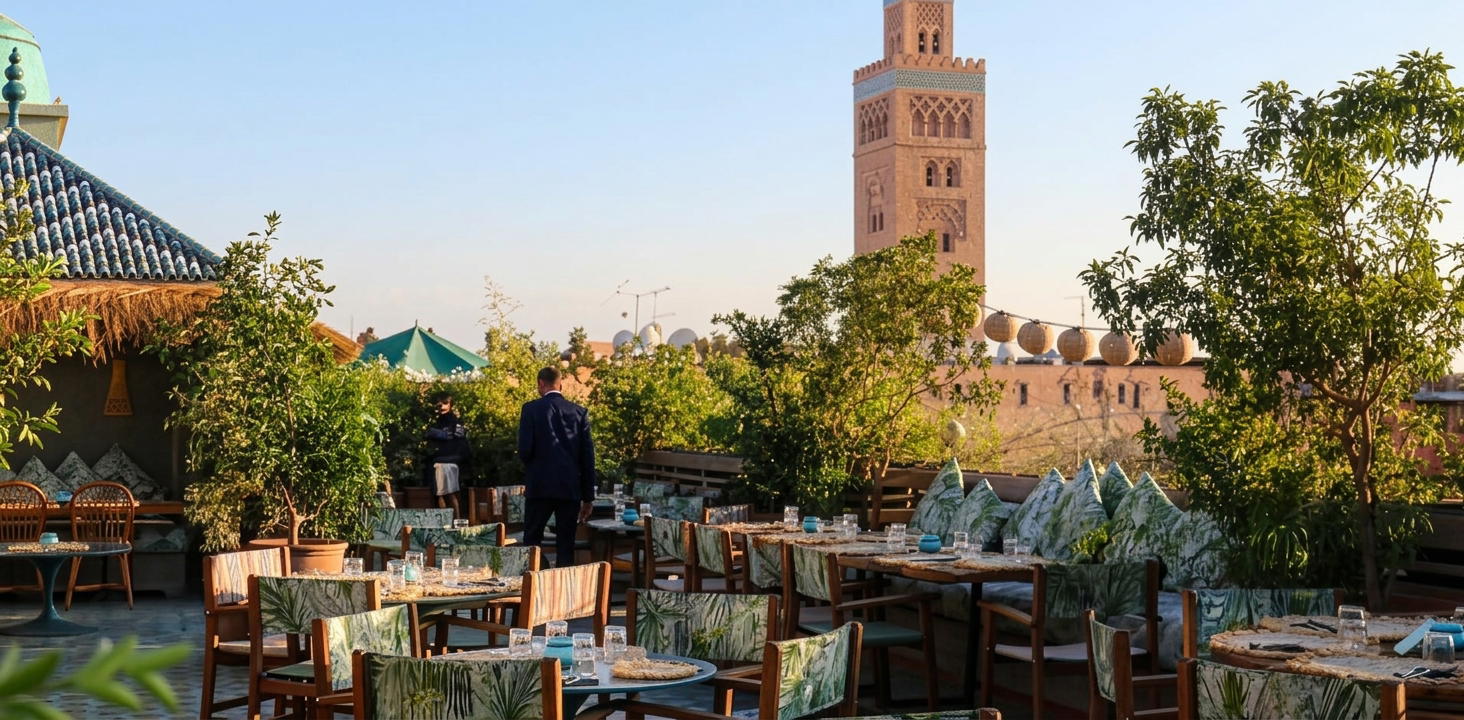
Another evergreen, and one that works at any hour: Kabana has a complete and varied offer from lunch to sunset drinks, dinner and after dinner. A rooftop at the gates of the medina, so close to the Koutoubia that the minaret anchors every table and lights up at sunset. Palms, rattan and jungle prints dress the terrace, with an indoor bar under a cabana. Chef Luisma Naranjo, from Ibiza, cooks modern Mediterranean plates to share (the truffle and parmesan fries are the signature), and a sushi chef runs a menu of his own. Live bands from Thursday to Sunday. Open 11am to 2am.
Kissariat Ben Khalid R'mila, 1 Rue Fatima Zahra, Marrakesh 40000, Morocco
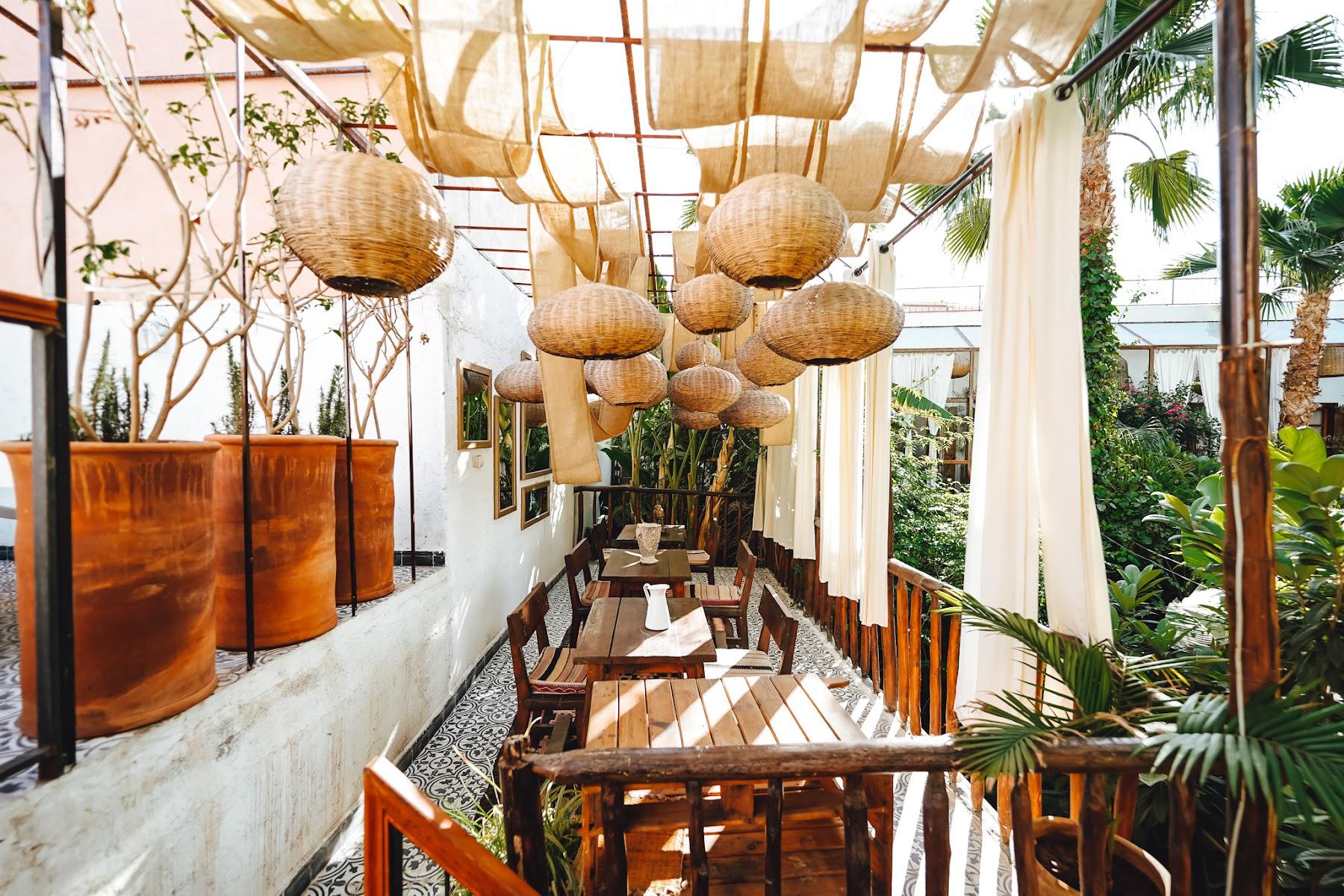
Behind tall wooden doors on Rue Riad Laarous, a short walk from Jemaa el-Fna, a vertical garden opens up: palms, trailing vines and plants climbing every surface, a green greenhouse in the middle of the medina. Tables sit on several levels among the greenery. The kitchen is Mediterranean and Moroccan, tagines, couscous and grills, seasonal and locally sourced, with real vegetarian and vegan dishes. Open every day from 8am to 11pm.
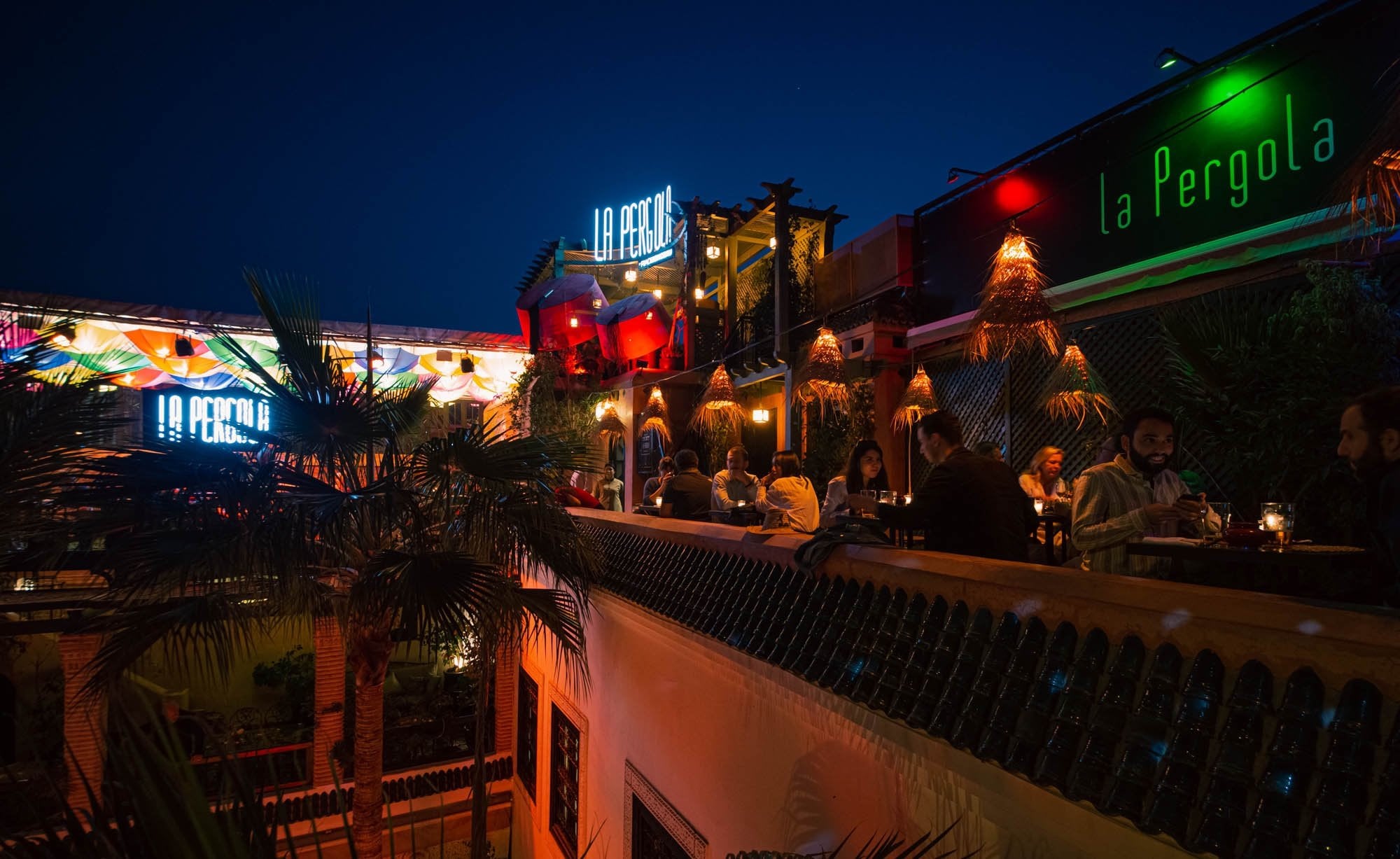
On the planted rooftop of Riad Monceau, above the palms of its patio and about a hundred metres from Jemaa el-Fna, La Pergola serves Moroccan food rooted in street food, in small plates to share. The house cocktails include a Berber Mojito and a Sangria Marrakchia. The mood is casual.
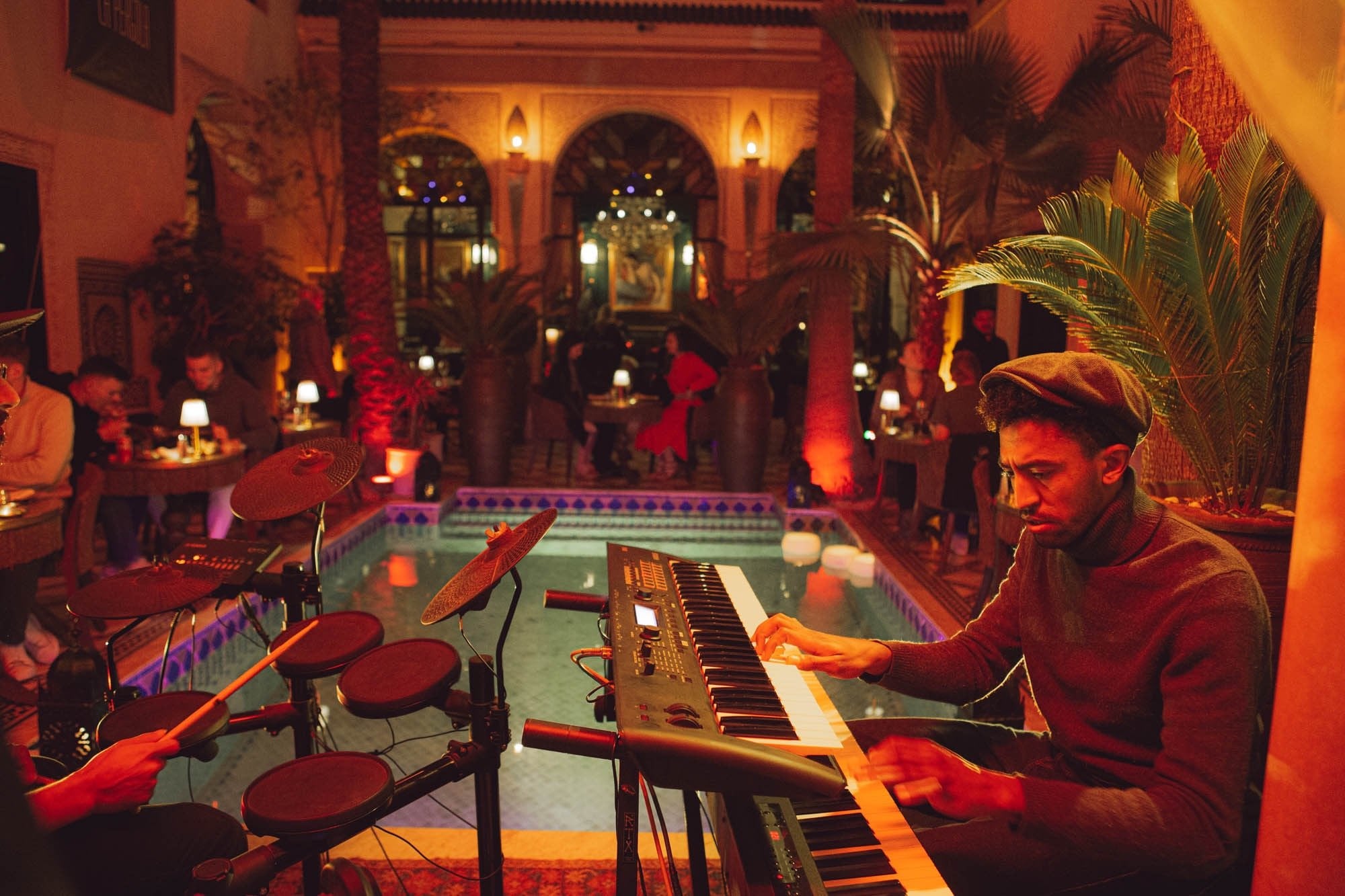
The restaurant of Riad Monceau, an Arab-Andalusian house in Riad Zitoun Lakdim, open for dinner only. Chef Myriam Ettahri signs a menu of traditional Moroccan recipes made lighter, with plates to share, while a jazz band plays through the evening. Before or after, the Caravan is the house cocktail and jazz bar.

On Jemaa el-Fna, in a century-old former hotel, the first-floor dining room is a cabinet of curiosities: flea-market objects, old mirrors, worn leather, and a small stage for DJ sets. The kitchen runs from a proper tanjia to a pastilla of praline for dessert. Upstairs, the rooftop faces the Koutoubia, with a smaller sky area at the very top for the full view.
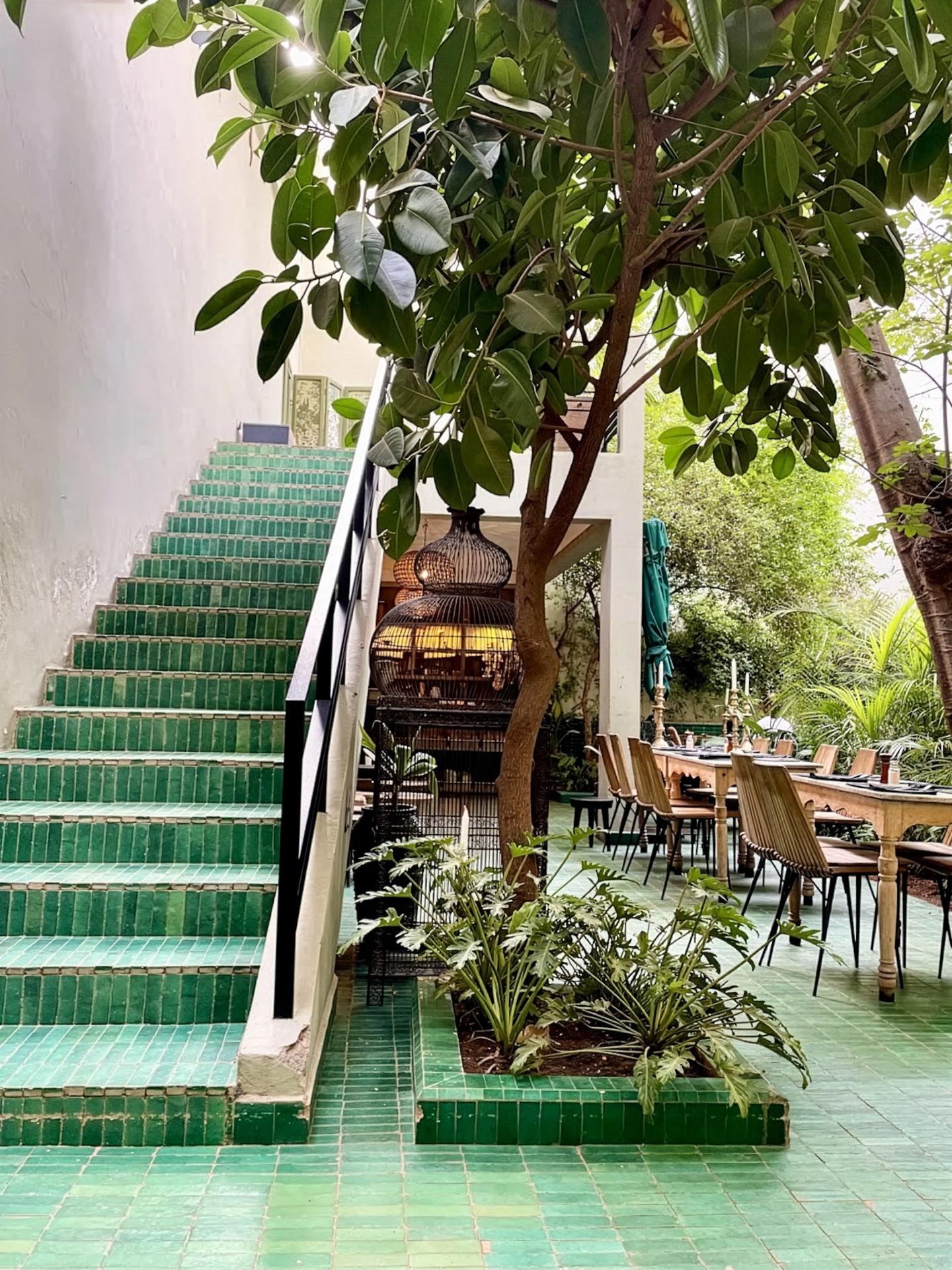
Behind an unmarked door in Mouassine, a 1960s riad redesigned by Anne Favier holds a courtyard of banana trees, palms and green zellige, with birds overhead and a resident tortoise. The menu runs from a chicken and pear tagine and a beef tanjia to grilled octopus and a partridge pastilla. No alcohol, but mocktails and fresh juices. Classic films are sometimes projected on the upper terraces.
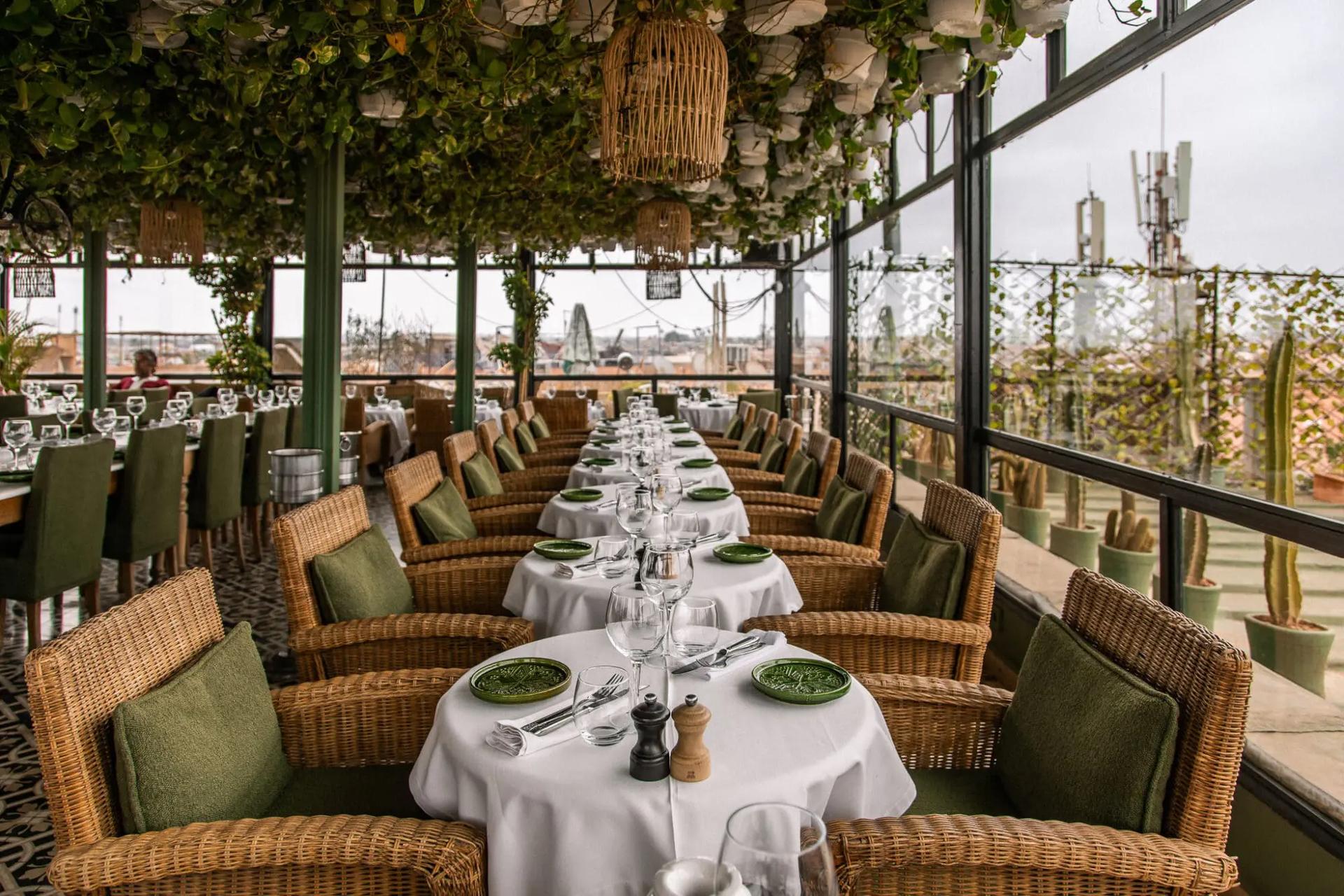
Three floors above Rue des Banques, just off Jemaa el-Fna. Downstairs, a colonial style of moucharabieh, leather armchairs, chandeliers and a grand piano played as the evening begins. The tanjia marrakchia is the plate to order, with lamb shoulder and kémias to share. The rooftop Sky Bar looks over the minarets to the Atlas. Later come belly dancers and music, until 2am.

Inside a traditional riad on Kaat Benahid, deep in the medina, Le Slimana moves between cool interior rooms and an open rooftop lined with palms. The kitchen starts from Moroccan classics with a Mediterranean accent: kémias of black olive hummus, confit pumpkin and turmeric cauliflower, lamb shoulder ravioli, caramelised octopus, carefully made tagines. The pistachio crème brûlée is the signature. A mixologist runs the cocktails, from afternoon tea to late evening on the terrace.
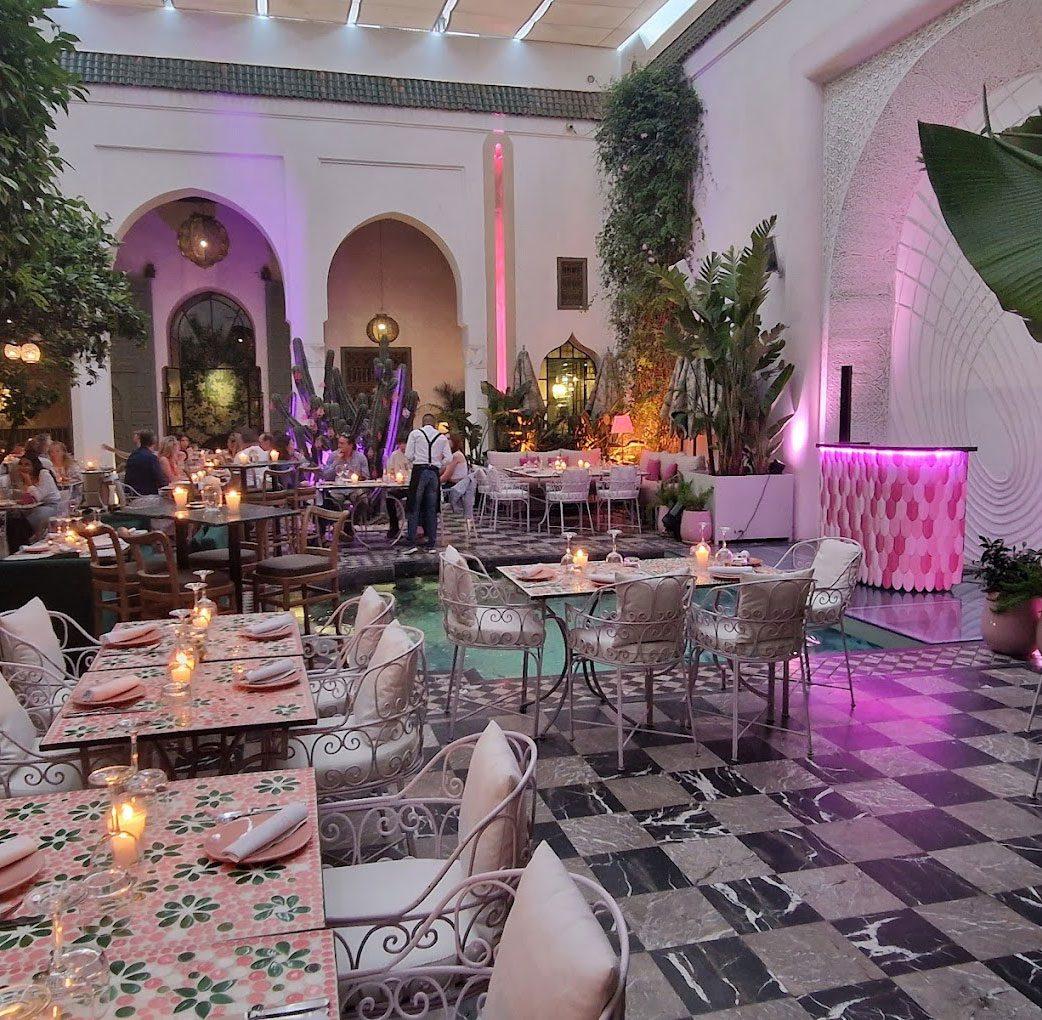
A 19th-century princely residence at the end of a narrow derb in Dar El Bacha: a patio with a black and white marble floor, orange trees, a pond among tall cacti, and a pink-arched bar under an oversized chandelier. The kitchen's heart is Mexican, coconut shrimp tacos, tuna tostadas, mushroom quesadillas, with lobster rigatoni and caramelised octopus alongside. After dinner, oriental dancers, live musicians and a resident DJ move through the garden. Open noon to 2am.

Three floors of a townhouse on Rue Riad Zitoun el Jdid, a few minutes from Bahia Palace, with sourdough proofing in the open kitchen and a rooftop facing the Atlas. The kitchen is meat-free, with fish from local fishermen and almost everything made in-house: oat pancakes with orange blossom honey, shakshuka with buckwheat, charcoal-roasted Buddha bowls, a plant shawarma with smoked aubergine and shiitake. Founded by a Moroccan and an Icelander, it began in Essaouira. Specialty coffee too.

Opened in November 2025 on Rue de la Koutoubia, between the mosque and Jemaa el-Fna, the second Mandala has three floors of arched windows, a reading corner with bookshelves and a rooftop framed by both landmarks. The menu is meat-free and pescatarian, like Bahia: pancakes and shakshuka in the morning, then dishes from the charcoal oven, a salmon burger on rye sourdough, the Líf salad of venere rice and fermented vegetables. A street-level counter serves coffee and juices to take away.

A medina house in Bab Doukkala reworked with Italian design and Marrakchi artisans: nine-metre ceilings, bejmat and zellij laid with precision, furniture in sand tones. There is a patio with a pool, and a rooftop over the medina where tafarnout bread is baked in a traditional oven. The kitchen runs on a Josper charcoal grill: octopus with muhammara, aged beef ribs, aubergine with stracciatella, fresh cavatelli, a chicken tagine with Jerusalem artichoke. From morning coffee to dinner under the sky.

On Rue Riad Zitoun el Jdid, a Lebanese-Syrian couple who came to Marrakech by way of Vienna cooks Levantine food with produce bought at the market each morning. The mezze can carry the meal: fatet batinjan, kibbeh, falafel wraps with fattoush, and a belboula salad with caramelised onions, cashews and argan oil. Pita arrives warm with every order. Khamsa mirrors, kilims and copper light inside, a rooftop above. No alcohol, but Levantine mocktails made with care.
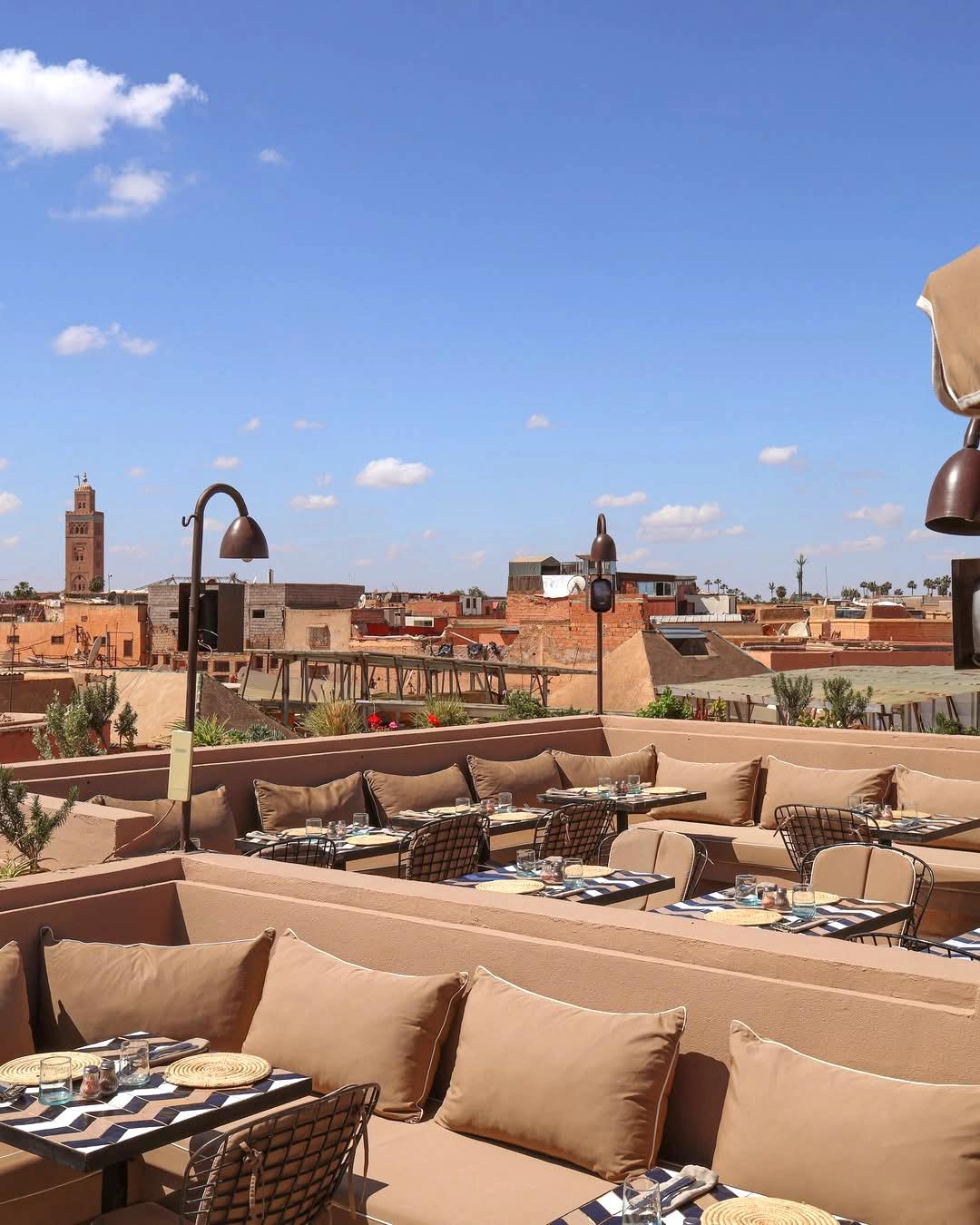
Since 2014, Nomad has filled a restored carpet store on Derb Aarjane, above the Rahba Kedima spice square: four floors, with two levels of terraces looking over the rooftops to the Atlas. The kitchen lightens Moroccan flavours on a short seasonal menu: courgette fritters with jben, an Agadir sardine tart, slow-braised lamb, a flourless orange cake with cardamom. No alcohol, but mocktails and fresh juices.
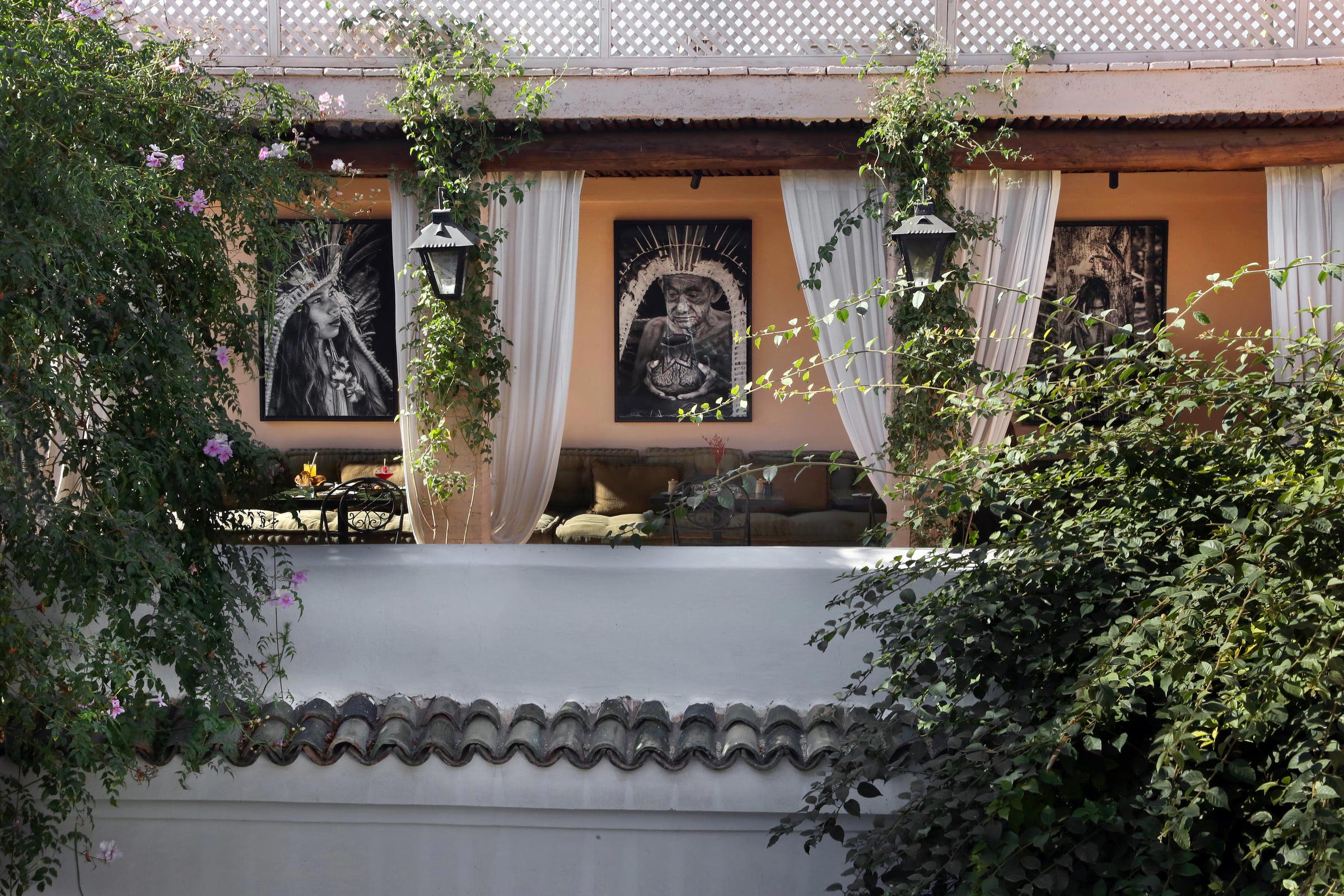
The rooftop restaurant of Izza, an art hotel of seven interlinked riads hung with more than 300 contemporary and digital works; its name comes from Dar Noujoum, the nearby former home of designer Bill Willis. Non-residents can come up, past the art, to gardened terraces over the old city. Head chef Ahmad El Hardoum, formerly of El Fenn, cooks Moroccan with a European hand on a menu devised with Paul Weaver: aubergine caponata, chicken or monkfish tagine, seafood pasta with langoustine bisque. Desserts are by pastry chef Abderazzak El Boukhari.
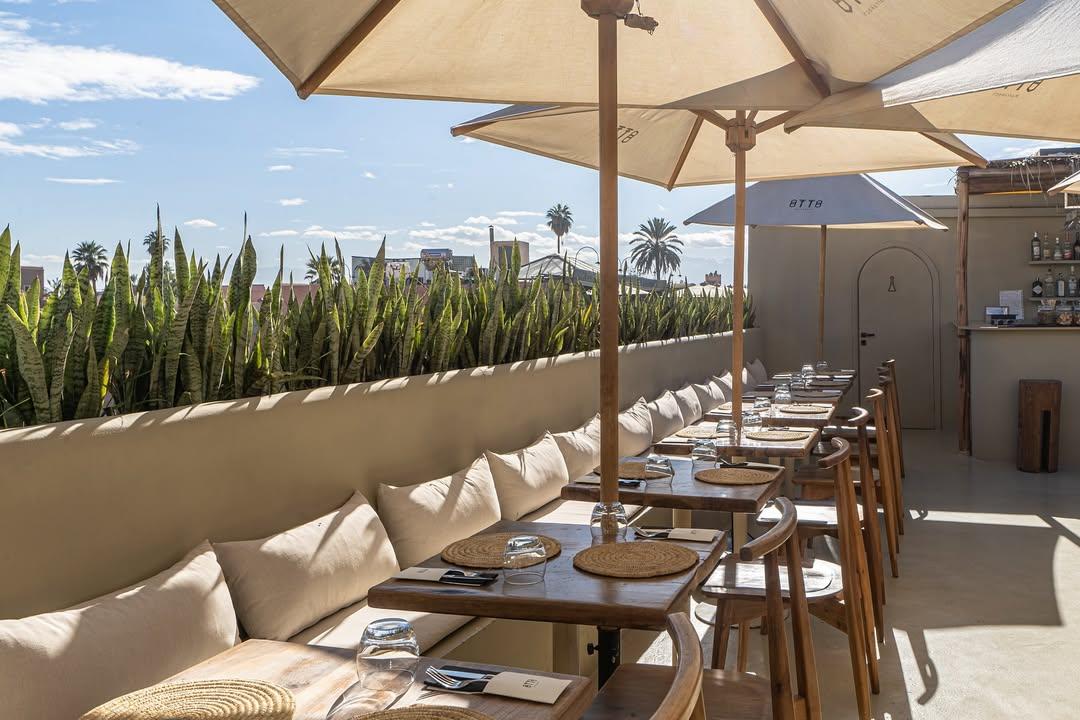
A few steps from Bahia Palace, Otto rises to a rooftop facing the Koutoubia, with a design that is unusually spare for the medina: beige tones, clean lines, niches and candlelight. The kitchen is Mediterranean with a modern European accent: ricotta and lemon ravioli, braised octopus with sage, tuna in a pistachio crust, paccheri with prawn bisque. Cocktails are named after African cities, the wines are French and Moroccan. After sunset, resident DJs play afrobeat and the terrace gets louder.
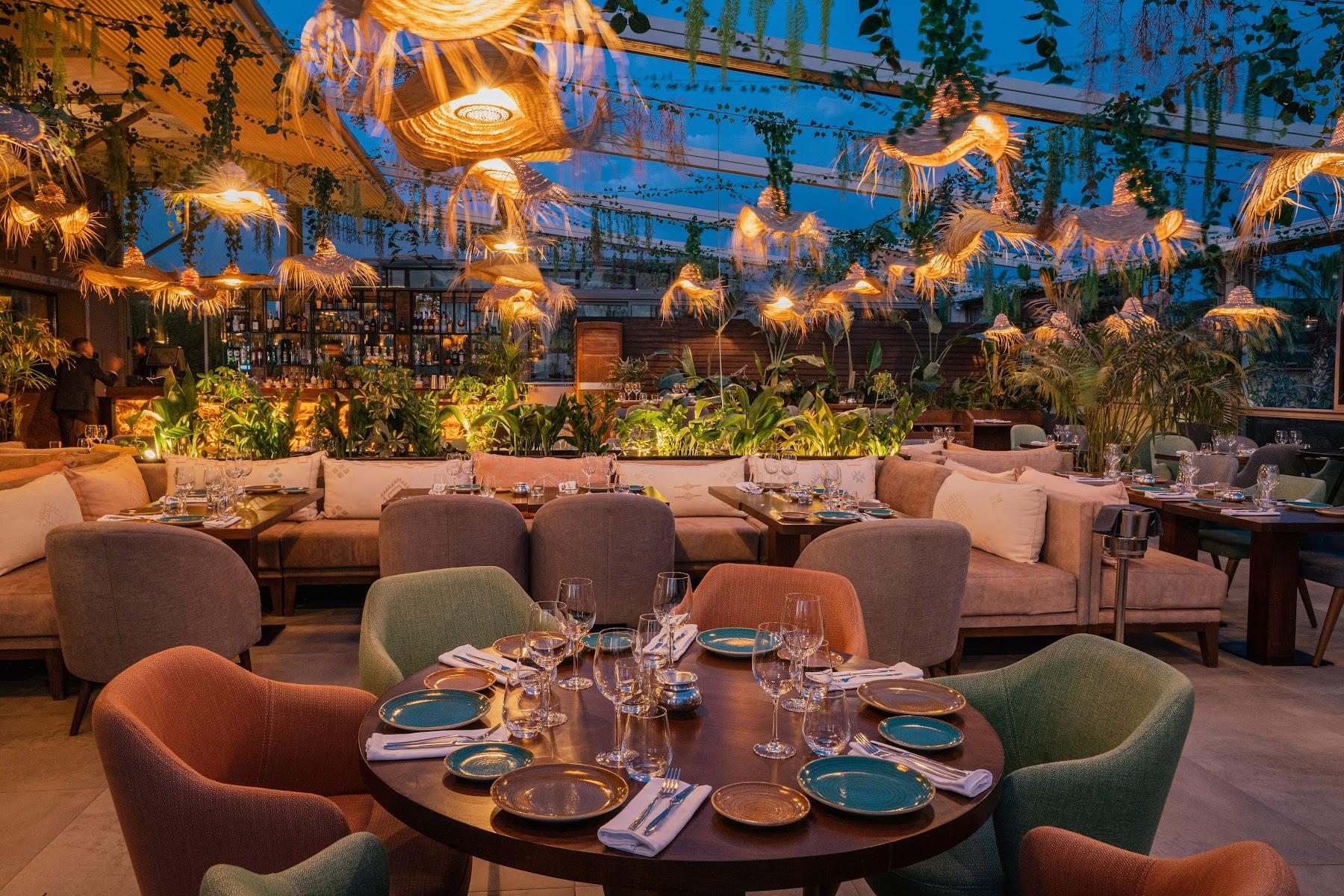
A rooftop in the medina on Rue Jbel Lakhdar, where the evening matters as much as the food. Executive chef Mouhssine Nouni cooks across the Mediterranean, from lamb tagine with prunes and saffron seafood risotto to grilled octopus and black cod with miso. From around nine, Gnawa musicians, oriental dancers, folk performers and DJs take over until late.

On the rooftop of Souk Cherifia since 2007, above the artisan boutiques, with the Koutoubia to the south and the Atlas on the horizon. Mist fans in summer, heaters in winter. The house tanjia marrakchia has been on the menu since opening day; tagines, briouates and a chocolate pastilla sit beside grilled fish. A full bar, champagne included.
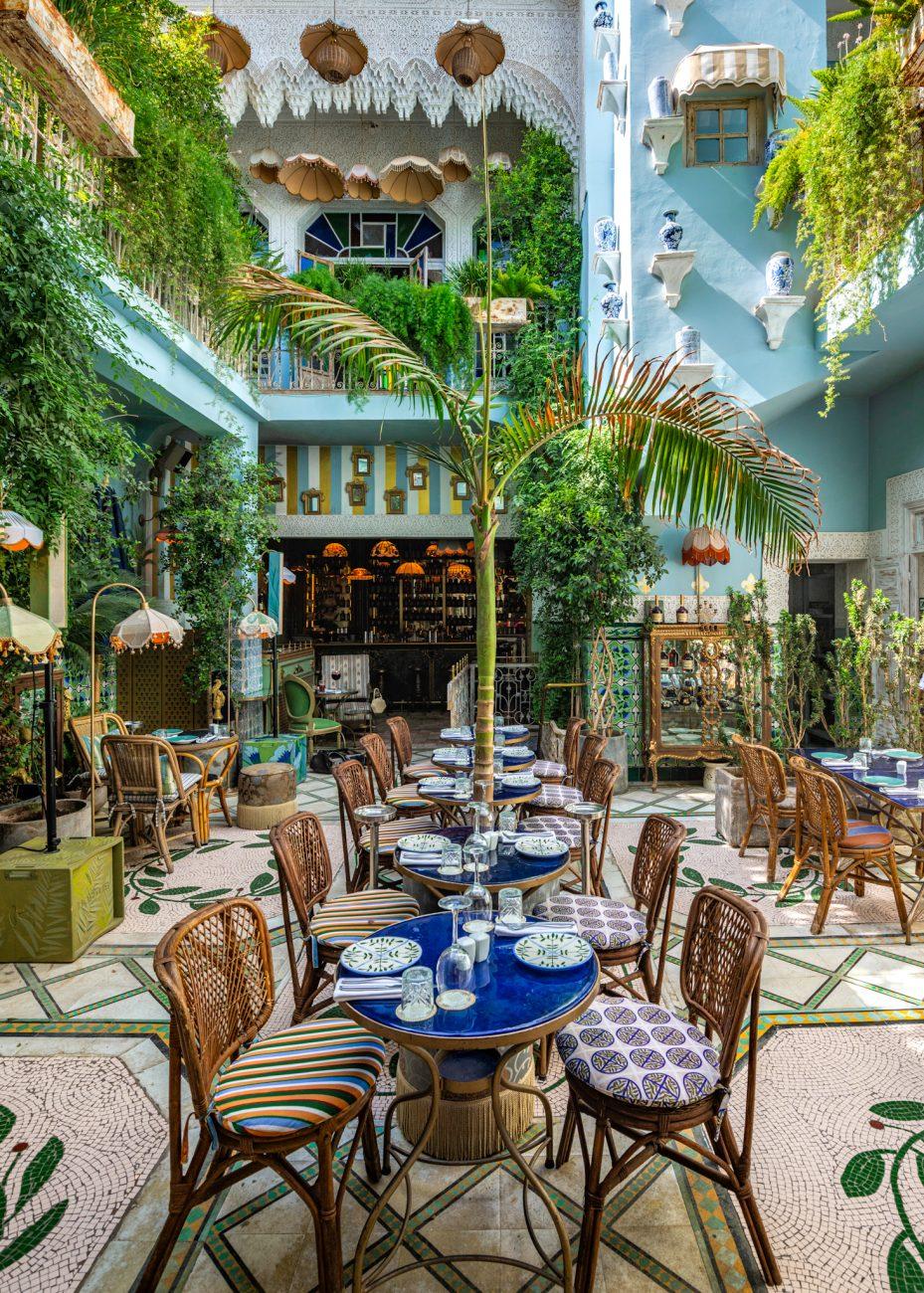
A family house from 1936 near the Kasbah, a short walk from Jemaa el-Fna, restored with its original layout: mosaics, greenery and a vintage-style bar at the centre, by interior designer Michèle-Rose. Chef Luisma Naranjo cooks Mediterranean and Moroccan dishes to share, ravioli with chakchouka, spiced pastrami, and a salted caramel rice pudding. Some evenings bring a double bass, a singer or a DJ. Private parking, rare in this part of the city.
€60–100
Ten dining rooms where the setting is part of the meal: the restaurants of La Mamounia, the Royal Mansour, La Sultana and La Maison Arabe, alongside Dar Moha, Dar Yacout, Le Tobsil and Al Misbah. Average price per person for dinner, drinks excluded.
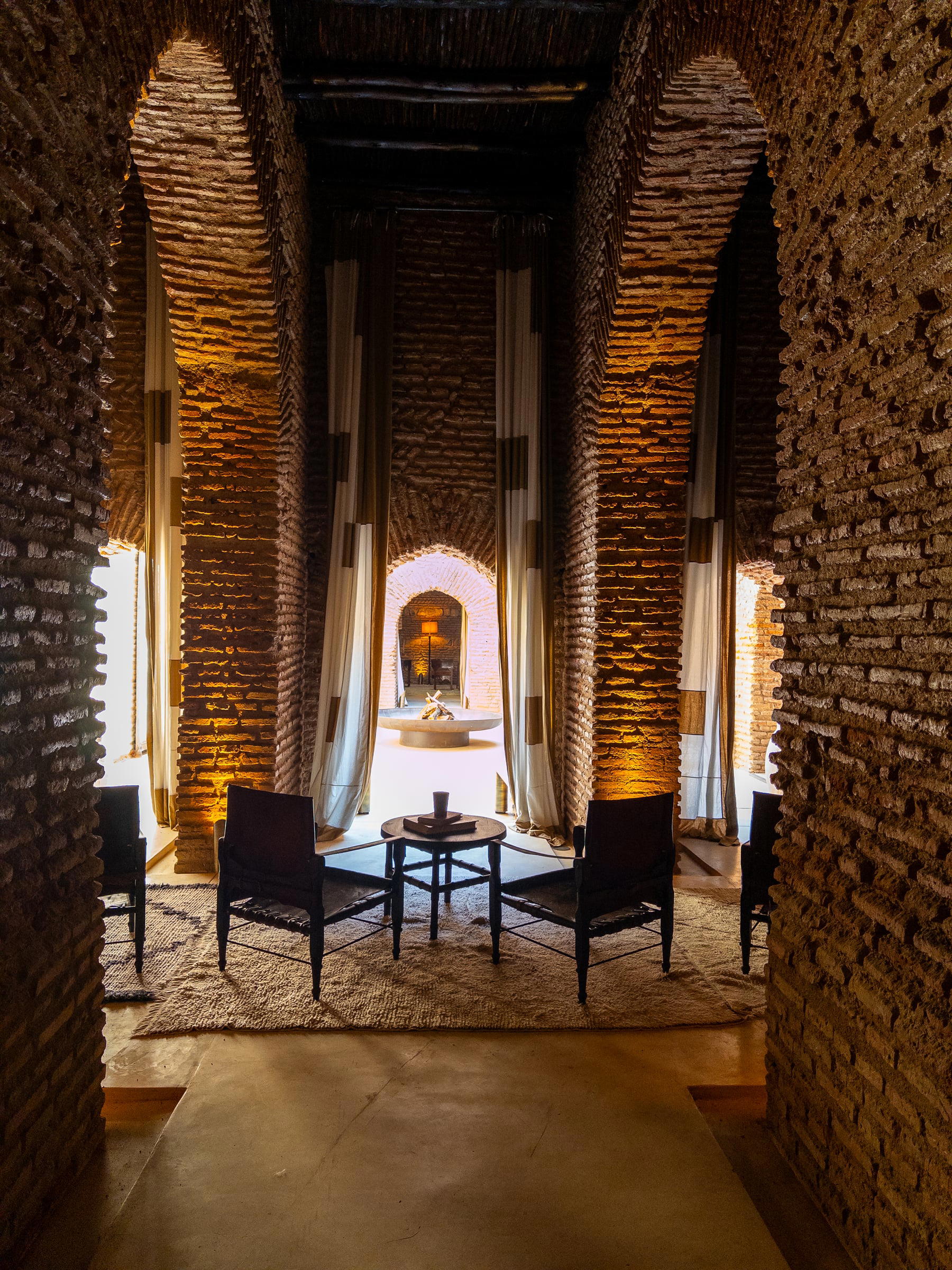
Deep in the medina, Al Misbah fills a restored monument whose stones date back to the years after the fall of the Almoravids, rediscovered only in 2019. A courtyard of ancient stone and soft light, antiques and period pieces, and the noise of the lanes left outside. The kitchen joins Moroccan tradition and contemporary creativity, plated as gastronomy, and the alcohol-free drinks list works ancestral Moroccan infusions. Quieter at lunch, candlelit and romantic at night, with formal service.

Since 1998, in a historic riad on Rue Dar El Bacha, tables have been set around a zellige pool fed by a stone fountain, among orange trees and palms; inside, gilded salons. The kitchen was among the first in Marrakech to modernise Moroccan cooking: ancestral recipes in smaller, tasting-style portions, flavours left fully Moroccan. The dégustation menu runs from warm and cold starters through pastilla, tagines and couscous to spiced desserts. Musicians play by the pool in warmer months.
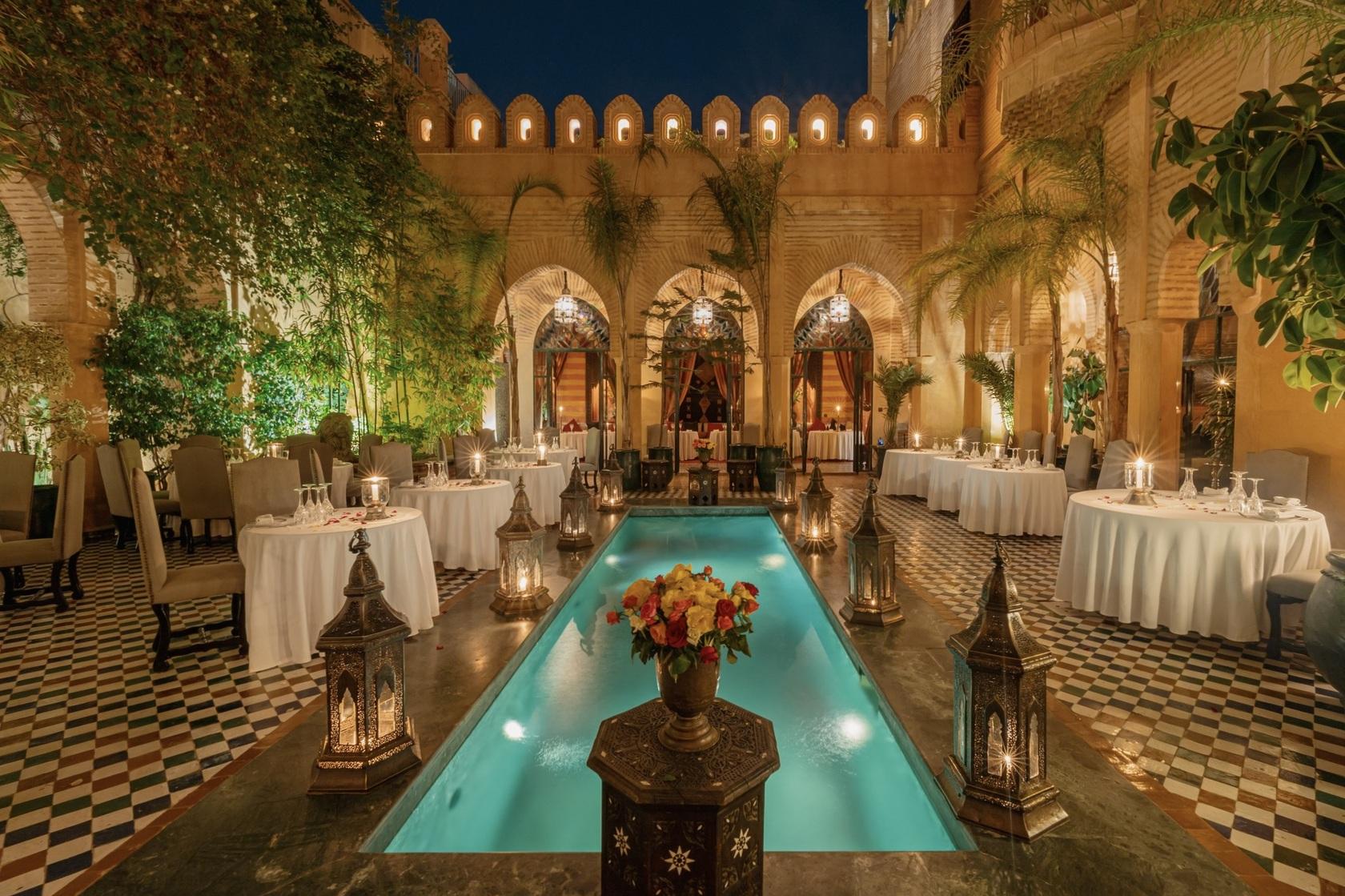
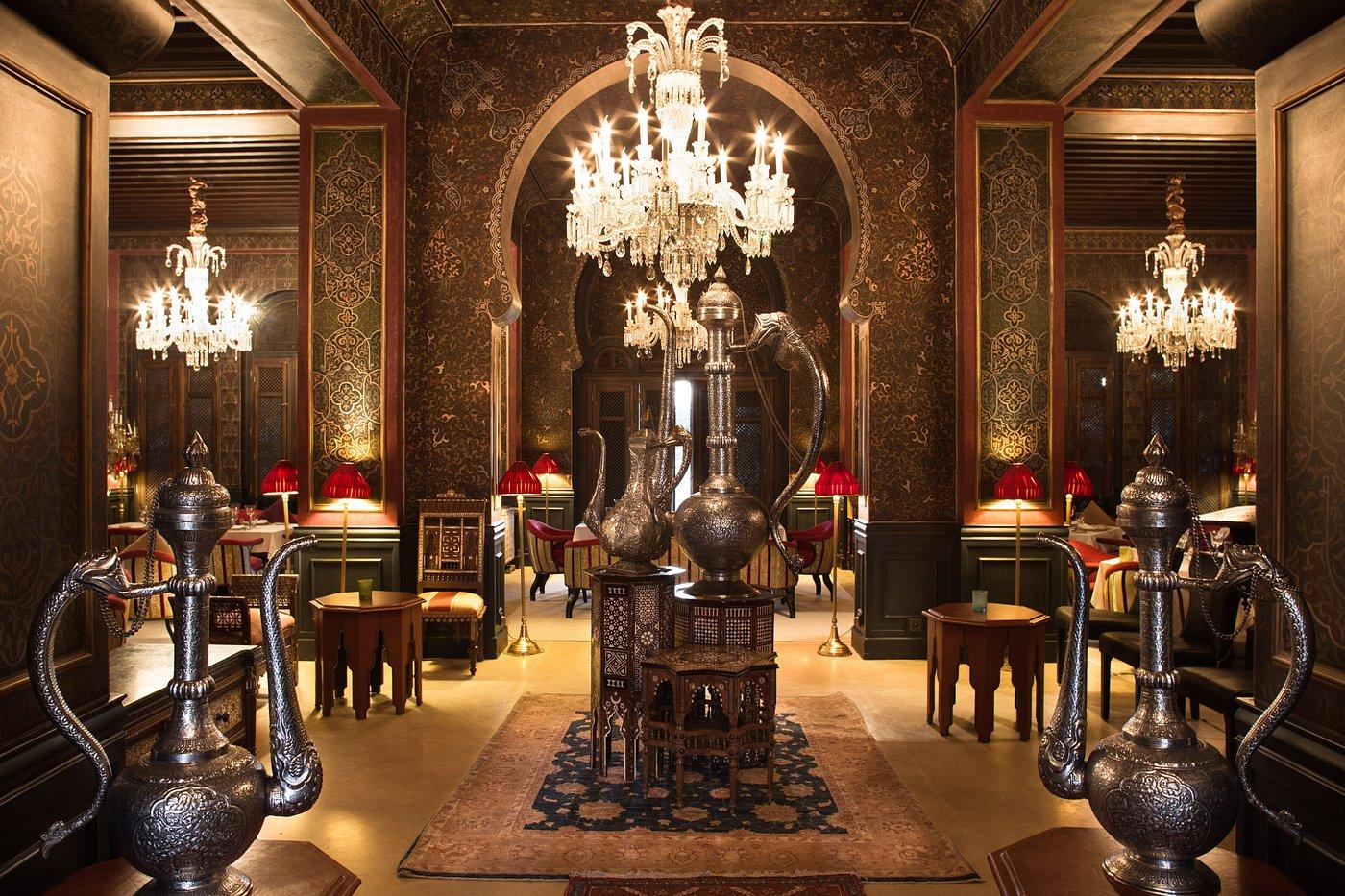
Behind an unmarked door in Bab Doukkala, an 18th-century riad of zellige arches, tadelakt walls, cedar ceilings and mirrors, more stage set than dining room. The evening follows a ritual: drinks on the rooftop facing the Koutoubia, then down candlelit corridors to tables laid with rose petals for a traditional diffa of salads, briouates, pastilla, tagines, couscous and honeyed pastries, wine included, with Gnawa and Andalusian musicians between courses. Family-run since the 1980s.
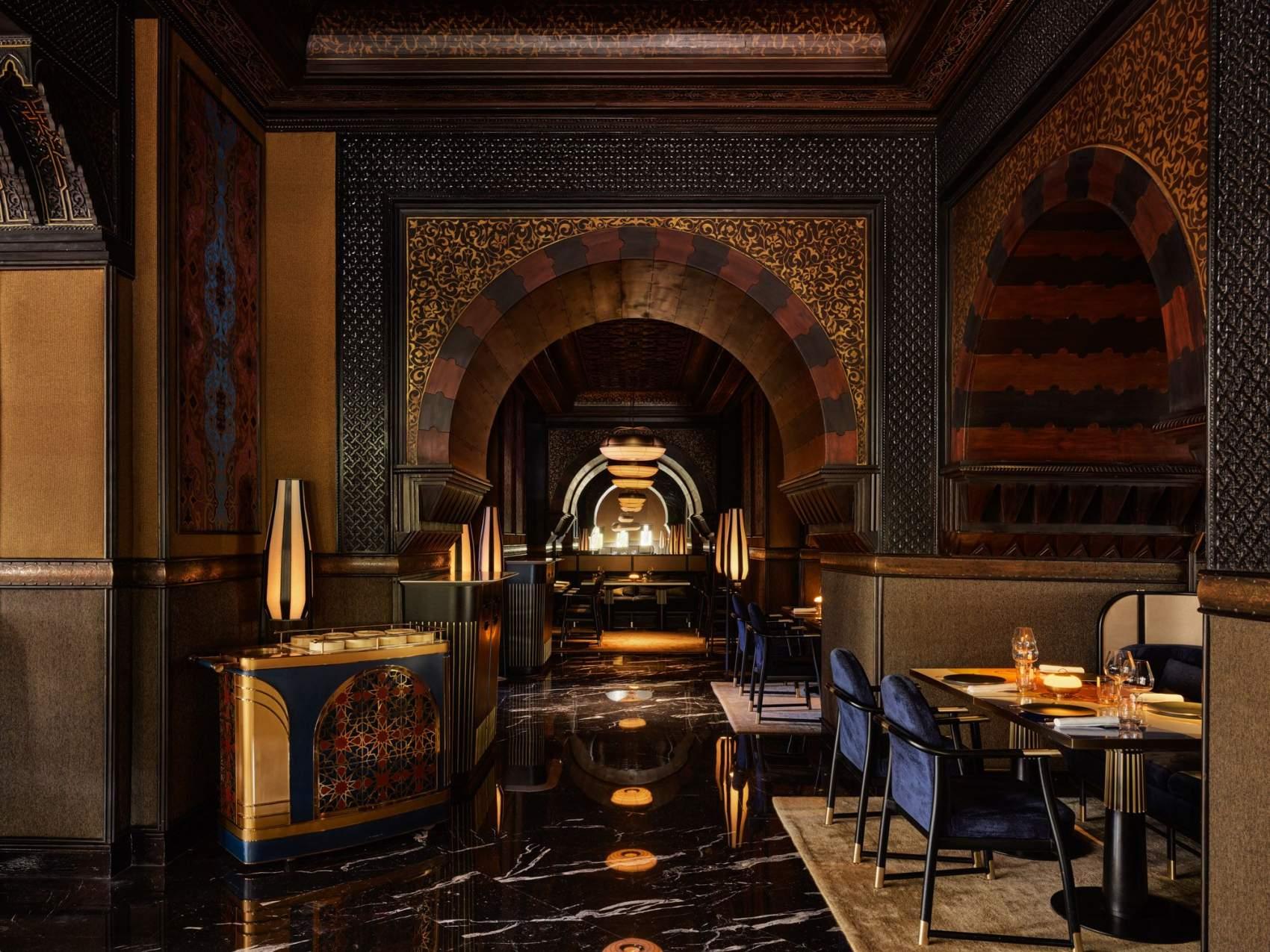
Inside La Mamounia, Patrick Jouin and Sanjit Manku turned the former Italian dining room into a more intimate, warmer space: the Moroccan detailing kept intact, pale wood against deep indigo. The menu by Jean-Georges Vongerichten travels across Japan, China, Indonesia, Thailand, Vietnam and India. There is a terrace, and elegant dress is expected.

At La Mamounia, a room redesigned by Patrick Jouin and Sanjit Manku as a light-filled Roman trattoria: frescoes of playful cats, almond green furniture, tall windows onto the gardens, a wood-fired oven and an open kitchen at the centre. Since September 2025 Simone Zanoni, who grew up on a farm near Lake Garda, leads an Italian menu with southern accents: pizzas, fresh pasta, seasonal risotto, antipasti with vegetables from the hotel garden, spiny lobster, osso buco. Desserts by Pierre Hermé, in a looser register than the hotel's other tables.
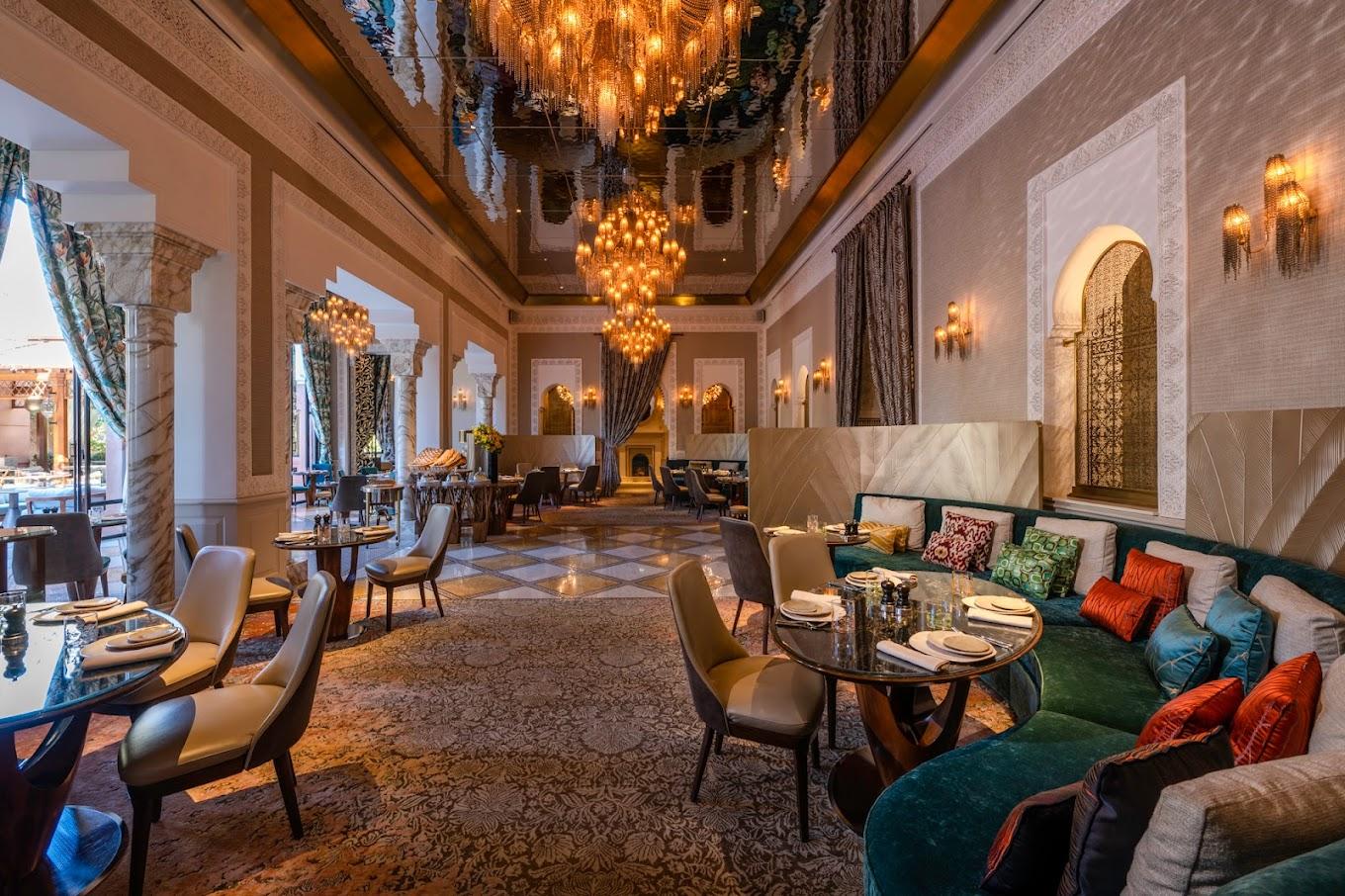
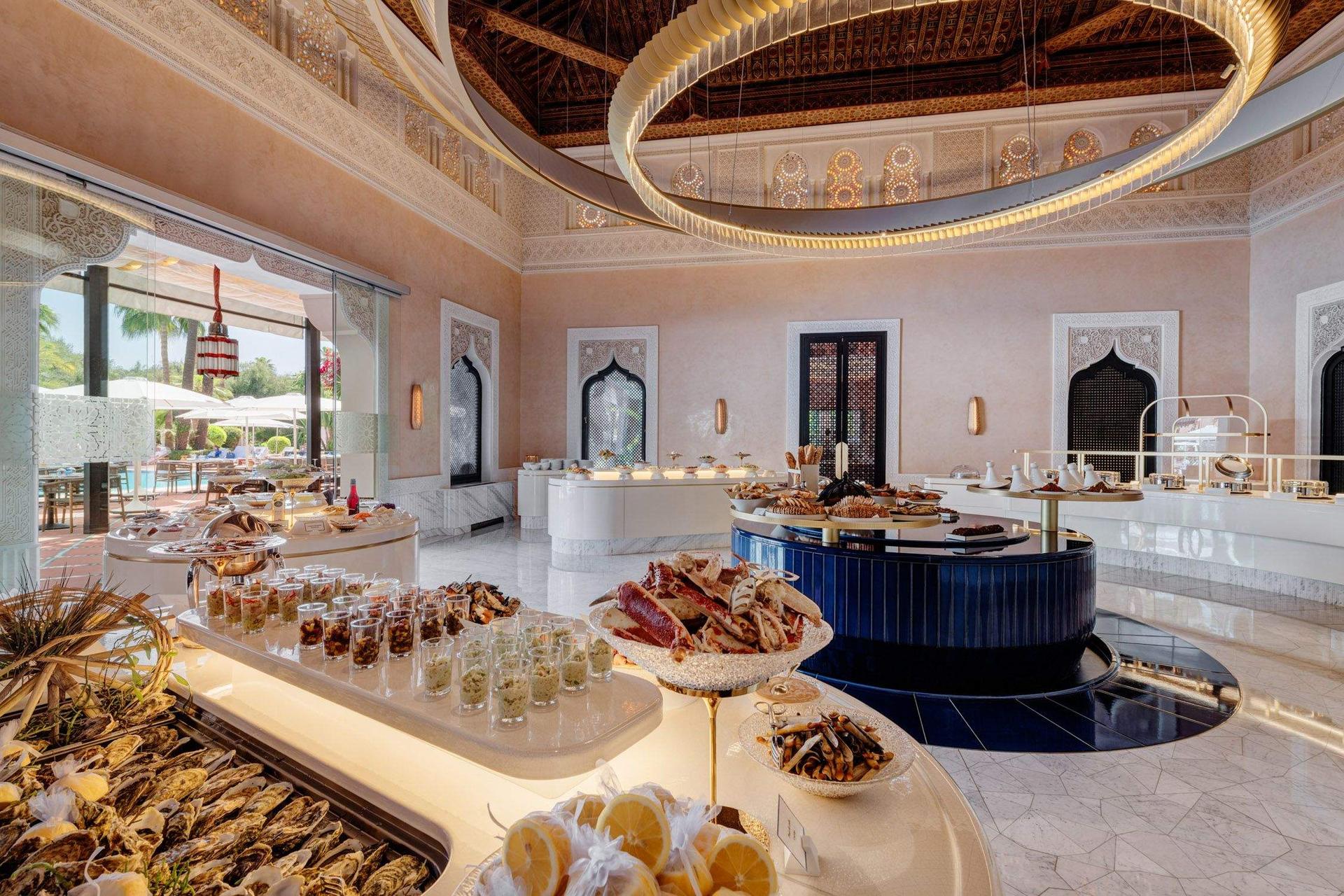
The main dining room of the Royal Mansour, reinvented by Hélène Darroze in the spirit of the great Parisian brasseries: an opulent room and a sunny terrace. Service is part of the show, with tableside carving, a seafood bar and a bread trolley. Brasserie classics meet Moroccan produce: Oualidia oysters, Béni Mellal lamb, Agadir sea bass in a salt crust. Open from breakfast to dinner, with Hélène Darroze's brunch on Sundays.
Hôtel Royal Mansour, Rue Abou Abbas El Sebti, Marrakech 40000, Morocco
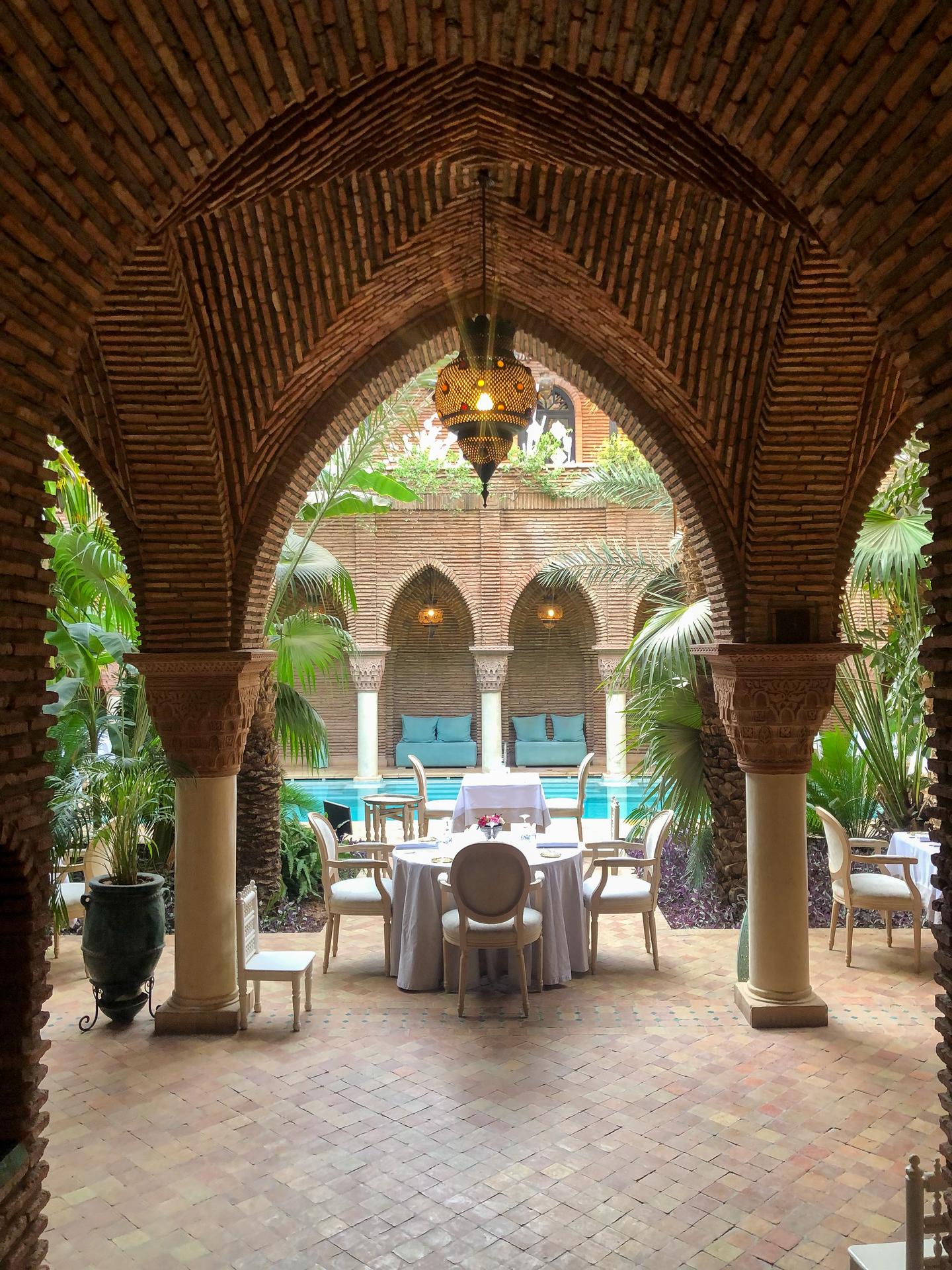
The evening restaurant of La Sultana, five riads in the Kasbah restored from a centuries-old royal granary. Dinner is served in the courtyard around the heated pool, by candlelight, among the marble arches. Two tracks: a Moroccan tasting menu and a French-accented seasonal menu, both with vegetables from the hotel's organic garden in Oualidia, saffron from Taliouine, argan oil from the Souss. Bread baked in house and a cellar of over three thousand bottles.

The rooftop of La Sultana in the Kasbah, among citrus trees, with the green tiles of the Moulay El Yazid Mosque close by, the Koutoubia to the north and the Atlas on clear days. Lunch follows two menus: a market menu built on organic vegetables from Oualidia and heritage spices, and a street food menu of charcoal-grilled fish and meat, vegetarian couscous and babbouche, snails in spiced broth as the neighbourhood makes them. A lunch for eating slowly, with a second pot of mint tea.
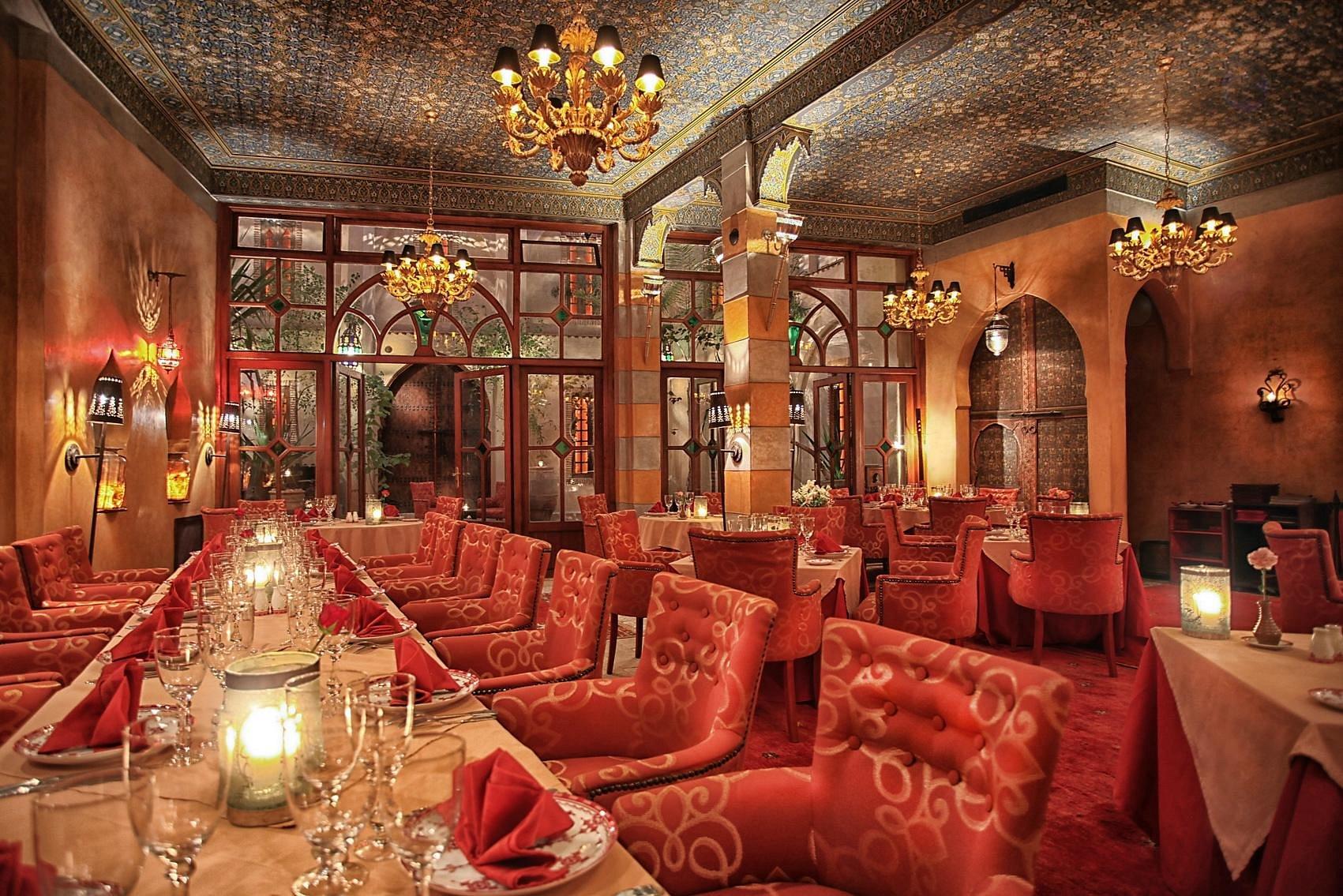
The story began in the 1940s, when two French women opened what became the medina's first restaurant for foreigners, and a dada sent by the Pasha taught them Moroccan cooking. Today antique palace doors, a hand-painted zouaké ceiling and a stone fountain frame a menu that is exclusively Moroccan, faithful to the repertoire that made the house known. Each evening a duo of Arab-Andalusian musicians plays oud and guitar, and before dinner the 1930s-style Piano Bar has jazz.
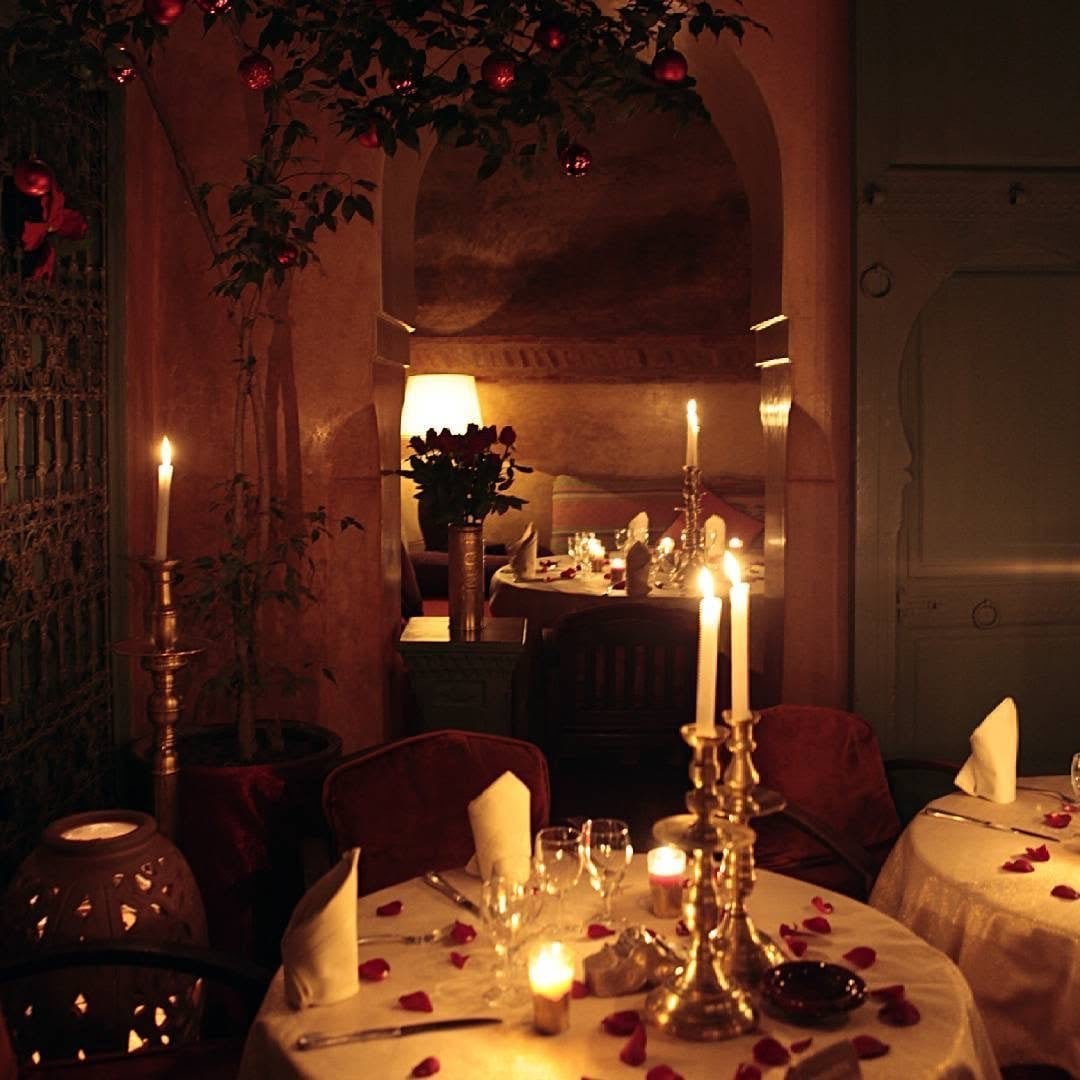
Near Bab Ksour, an old house serves a single set menu: a diffa, the Moroccan feast with roots in the Abbasid and Andalusian courts, course after course, more than most people can eat. Small salads, pastilla, tagine, couscous, with aperitif and wine included. Guests sit on two levels around a courtyard of white cloths, brass candelabra and rose petals, with Gnawa musicians, and the fireplaces are lit in winter. Christine Rio welcomes the guests. Dinner only.
Derb Abdellah Ben Hessein , R'Mila Bab Ksour, Medina, J2G4+JX4, Marrakech 40000, Morocco
Over €100
Three tables at the top of the Medina: La Grande Table Marocaine and Sesamo at the Royal Mansour, and Le Marocain at La Mamounia. Average price per person for dinner, drinks excluded.
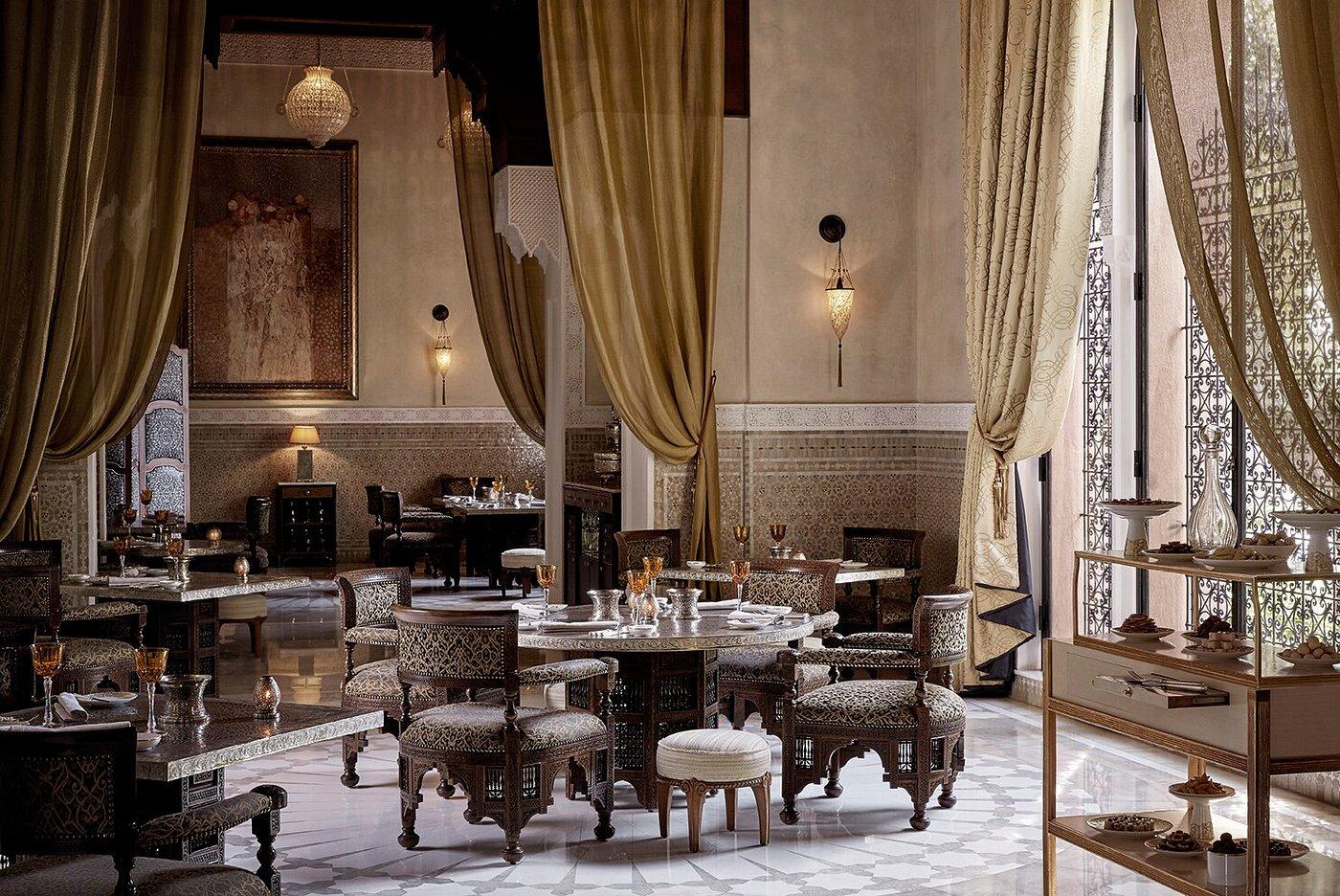
Reached through the Blue Patio of the Royal Mansour and a heavy brass door: high ceilings, filigree metalwork, oud and lute in the background, staff in ceremonial caftans. The meal begins with milk and dates and hands washed in orange blossom water. Hélène Darroze and Moroccan chef Karim Ben Baba collect recipes across the country's regions and refine them: sh'hiwates, pigeon pastilla with ras el hanout, a Berber tajine with chestnuts and Atlas truffle, lamb méchoui for two. Couscous at lunch on Fridays.
Hôtel Royal Mansour, Rue Abou Abbas El Sebti, Marrakech 40000, Morocco
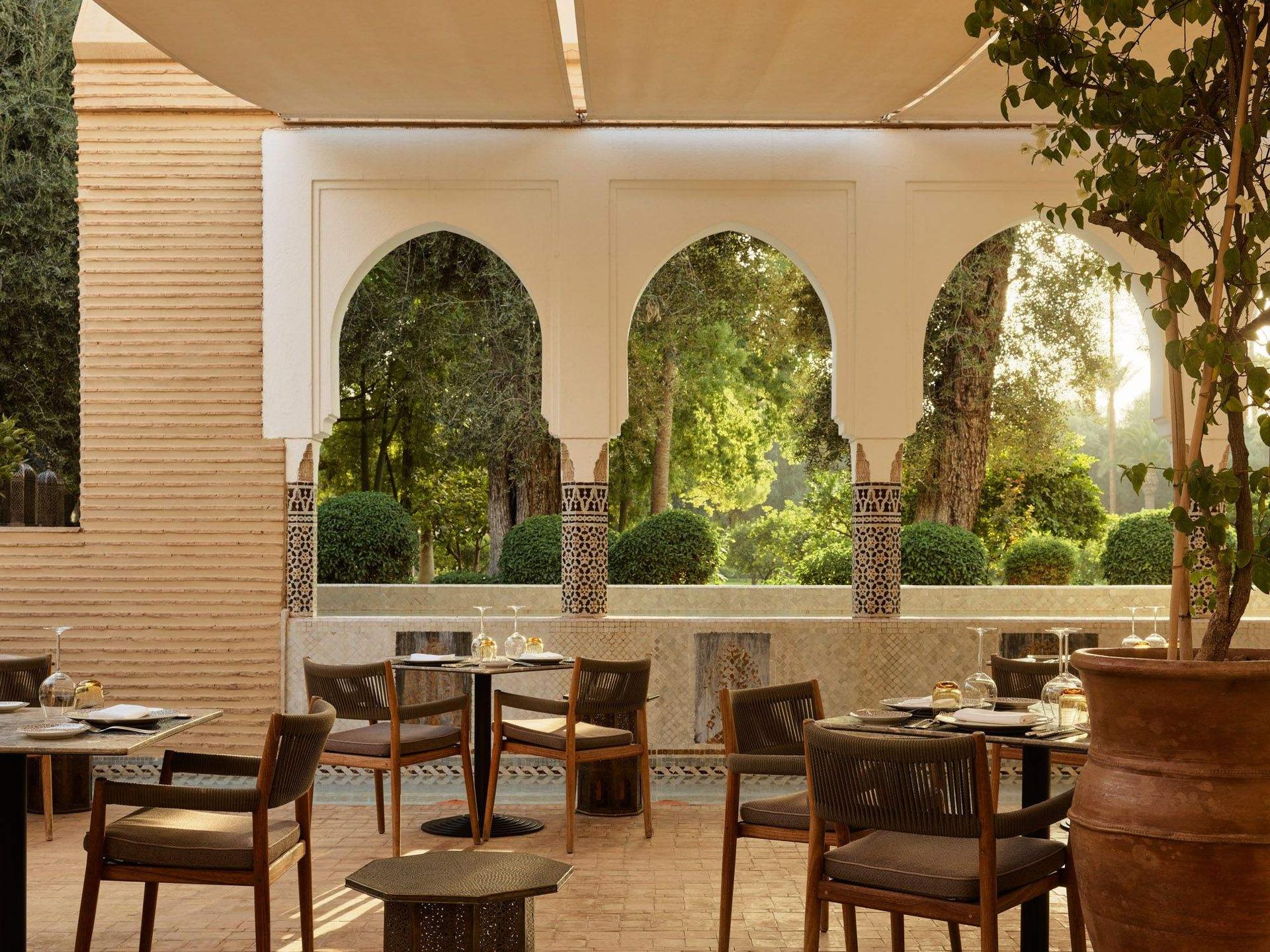
A three-storey riad deep in La Mamounia's gardens, reached on a gravel path under palms and orange trees lit by lanterns. Inside, carved cedar, zellige, arabesque plaster and velvet alcoves around a patio with a lily pond, with a trio of violin and lute. Chef Rachid Agouray has led the kitchen for decades: harira and dates to open, a salad of fourteen components, then classic tagines, pastillas and couscous, or a contemporary menu with lobster pastilla. Open every evening.
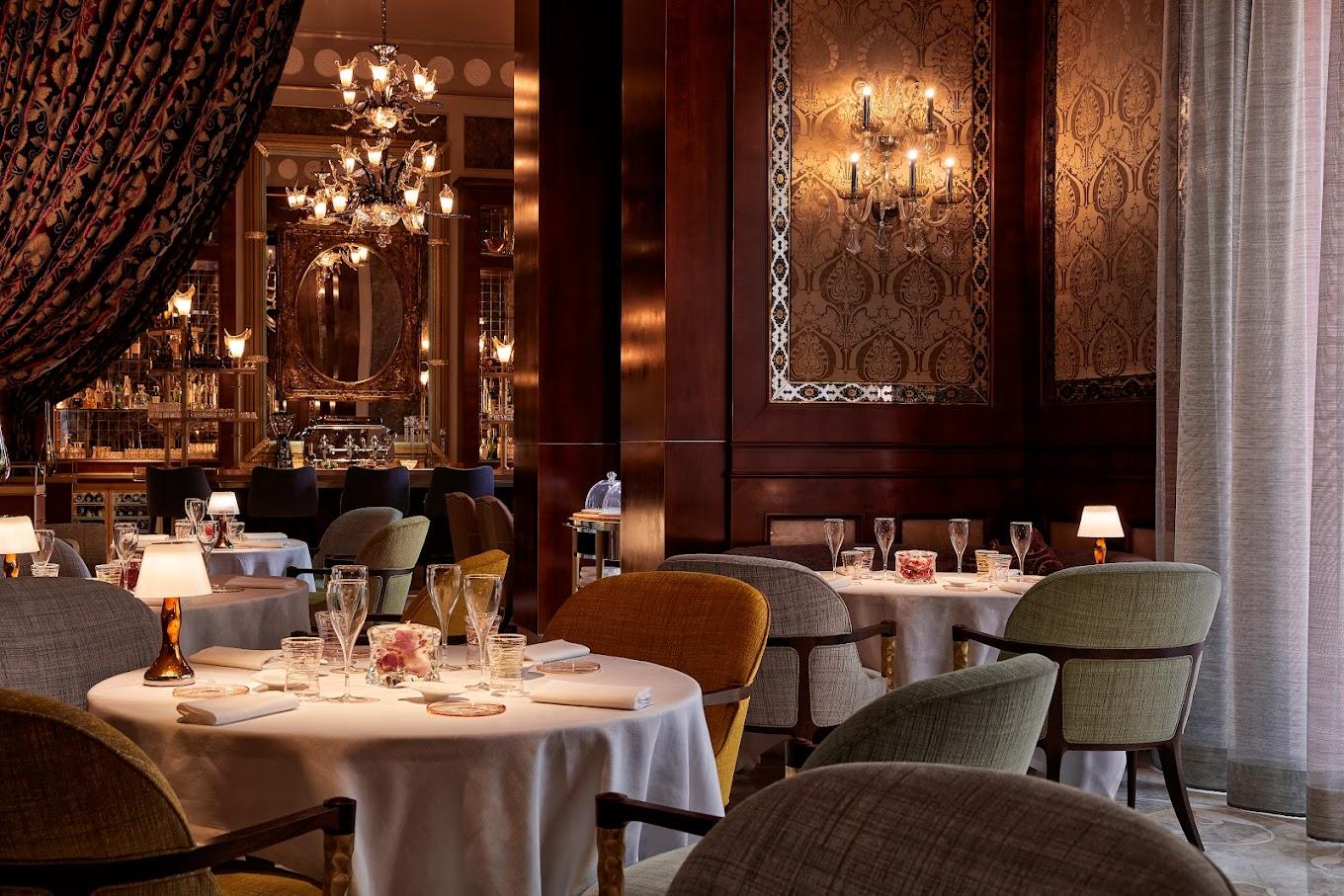
The Italian restaurant of the Royal Mansour, conceived by Massimiliano and Raffaele Alajmo and run day to day by Riccardo Barni. Murano glass, wall hangings and greenery recall a Venetian palazzo, and the terrace is the seat to ask for at dinner. The Cappuccino Majorelle, squid ink ragù under a blue potato cream, is the signature; spaghettoni with bottarga, black lemon and incense and Neapolitan pizzas follow, with tiramisu to finish. Three tasting menus, and on Sundays Il pranzo della nonna, an Italian family lunch.
You may also like…