EAT & DRINK
Traditional Food in Marrakech: Sixteen Dishes and the Customs Behind Them
A guide to Moroccan cooking as this city eats it, from the sealed clay urn buried in hammam embers to the last glass of tea poured from a height.
Timence Guide Editors · 7 August 2026
An unglazed clay urn was bought from a potter in the morning, filled at the butcher's with beef shank, garlic, preserved lemon, cumin, saffron and a spoon of fermented smen, sealed with parchment and carried through the medina to the furnace room that heated the neighbourhood hammam. The oven man buried it in the embers. Its owner went back to work and collected it when the day was done.
That urn is a tanjia, and it belongs to this city alone. Most of the tanjia eaten in Marrakech now comes out of a restaurant kitchen, spiced more heavily, sometimes finished with dried fruit, with rows of urns stacked by the door where the street can see them. The version cooked in a hammam furnace still exists, and it is the one fewer people now make.
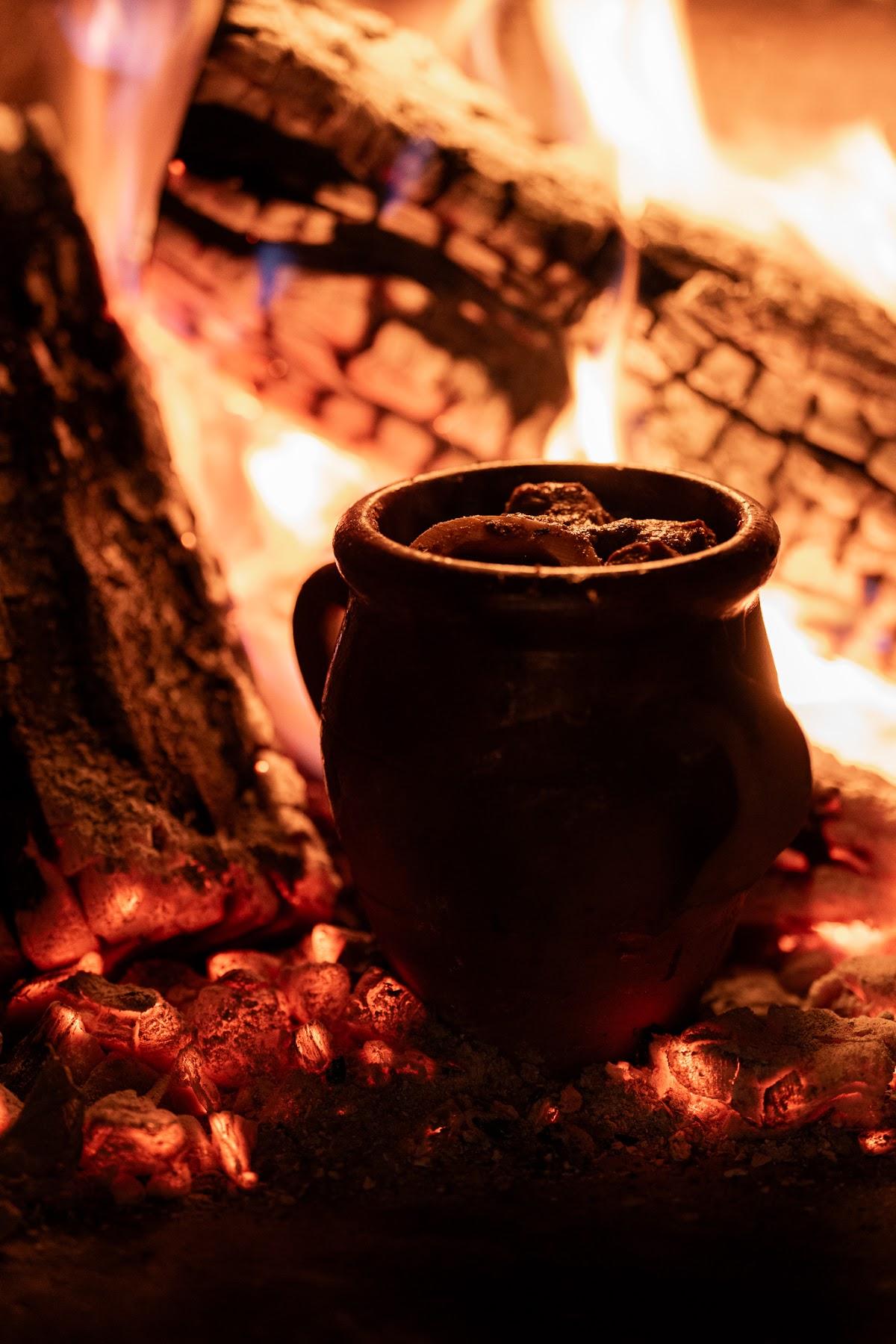
Most traditional food in Marrakech is shared with the rest of Morocco: the couscous, the tagines, the pastilla that Fez claims as its own. What Marrakech contributes is a way of cooking built on shared fire. Houses in the medina were packed tight, water was scarce and fuel was expensive, so the neighbourhood pooled its ovens and its baths, and the dishes shaped themselves around one fire.
Sixteen dishes follow, in the order the day serves them: what comes off a griddle first thing, what is carried to the neighbourhood oven, what covers a table at lunch, what appears on the square after dark, and the glass that ends everything.
The Breads of the Morning
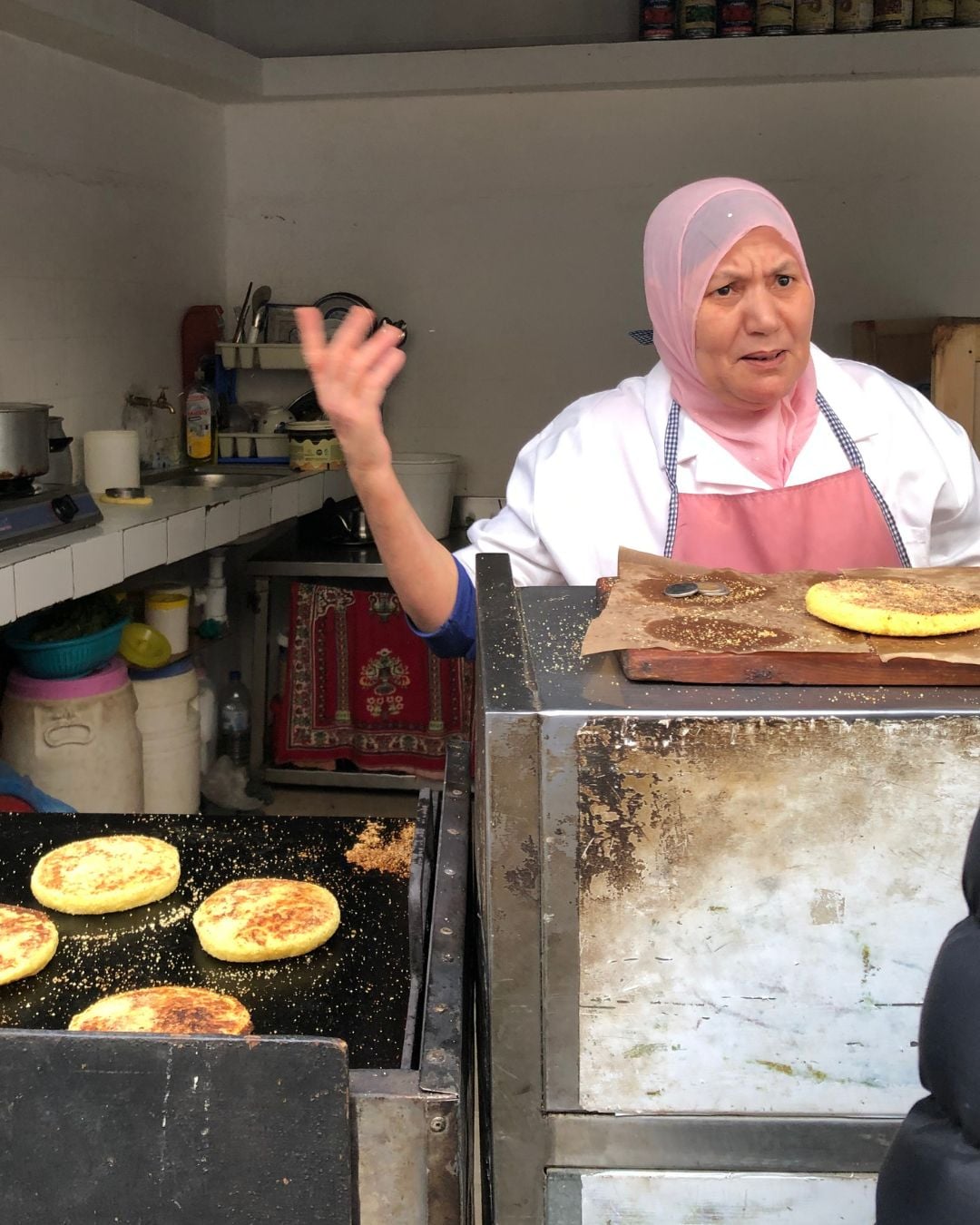
Four things come off a griddle or out of a fryer before the day starts, and they are not interchangeable. Msemen is laminated: dough stretched thin, smeared with butter and semolina, folded into a square and cooked until the layers separate. Baghrir is poured as a yeasted batter and cooked on one side only, so the surface opens into a thousand holes that hold melted butter and honey.
Harcha is coarse semolina pressed into a thick disc and rolled in more semolina before it hits the plate, crumbly and plain. Khadija cooks hers at a stall with the shutter rolled up, turning the discs on a black griddle dusted with semolina and stacking the finished ones on a wooden board at the counter. Sfenj are the fourth, ring doughnuts fried and sold hot, threaded onto a loop of palm cord to carry home.
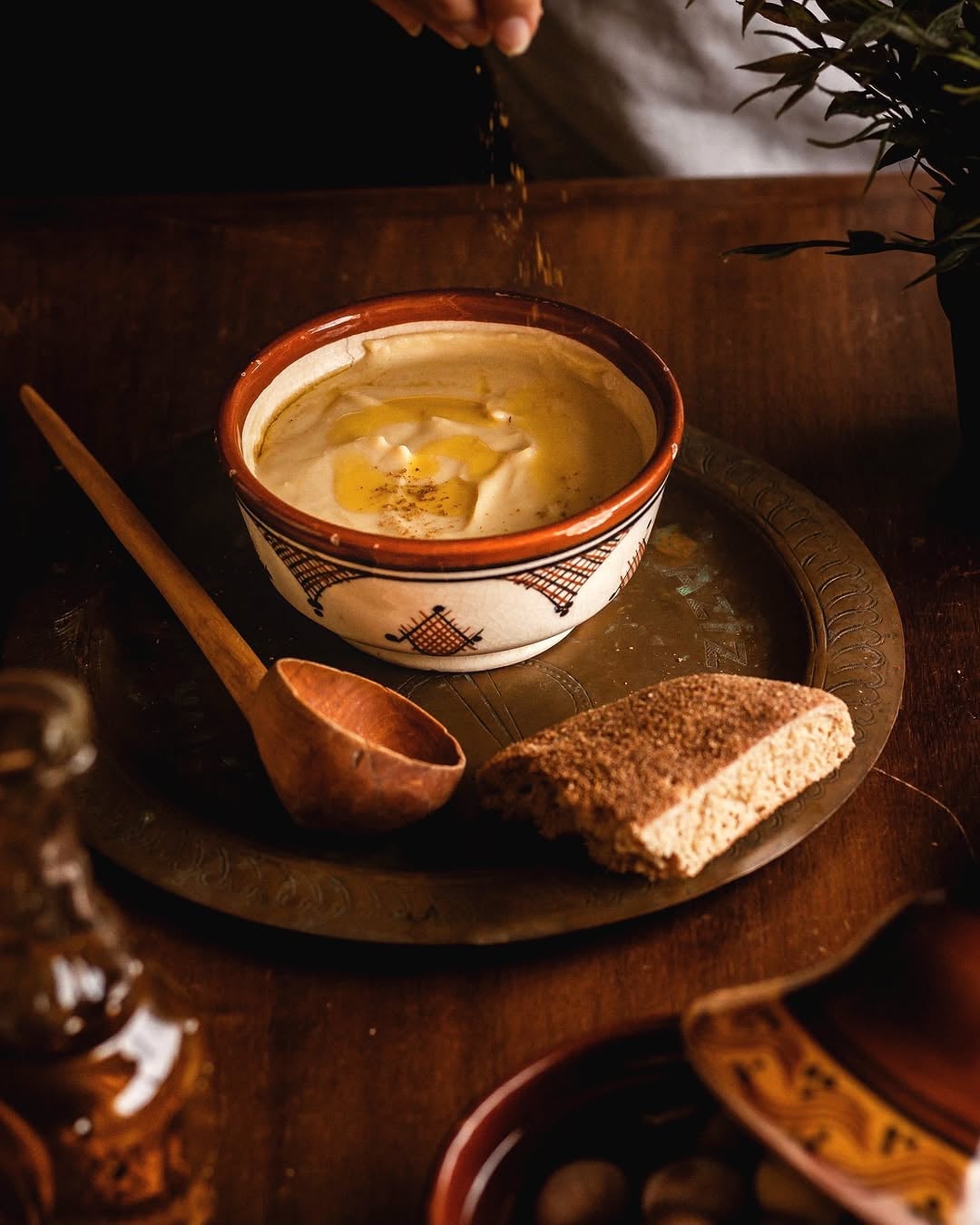
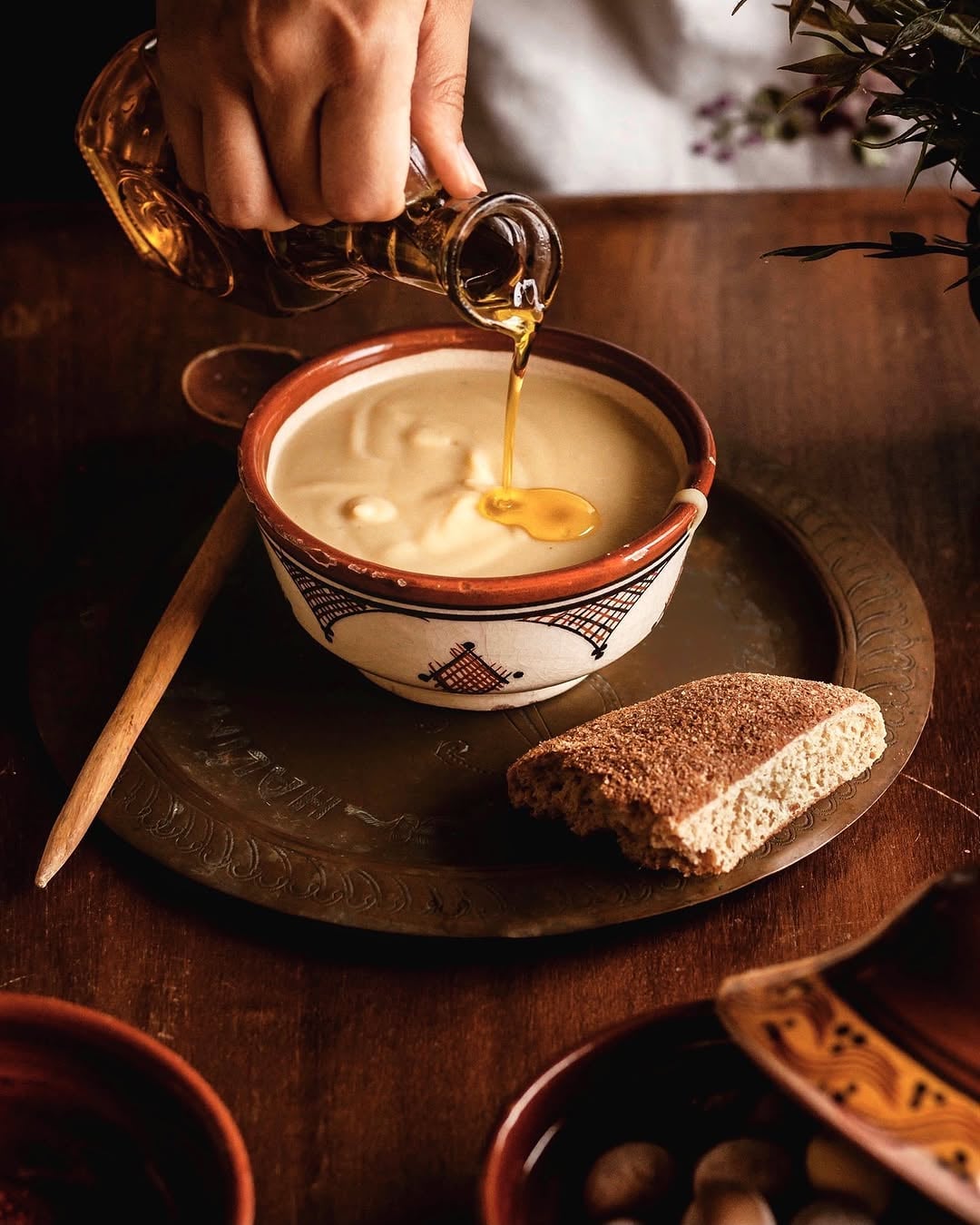
Bissara
Dried split fava beans are boiled soft with garlic and pureed, then finished in the bowl with olive oil, cumin and a dusting of paprika. It is sold in the morning from large metal pots near markets and transport stops, ladled thick and eaten with bread, and it is rarely found in a café. Cheap, filling and warming, it belongs to the cold months and thins out of the streets when the mornings soften.
Khobz and the Neighbourhood Oven
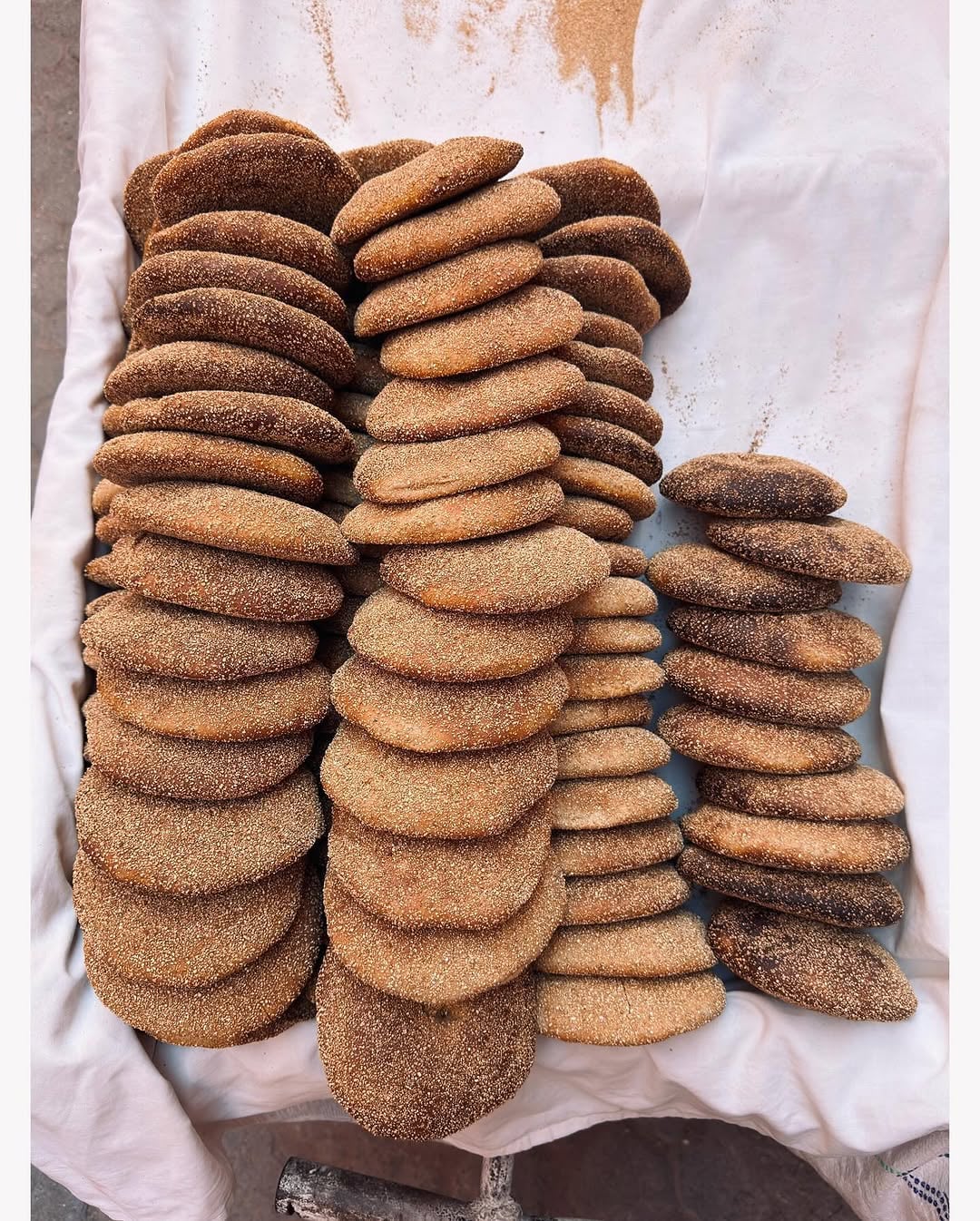
Round loaves of khobz are shaped at home and carried on wooden trays to the ferran, the communal oven, where the man who works the fire stands in a pit and moves the trays with a long wooden paddle. Bread is not a side here, it is the cutlery. He knows which tray belongs to which house, and which part of the brick-lined oven each thing needs. Pastries, meat and whole tagines go in beside the bread, and each comes back to the house it came from.
Moroccan Cooked Salads
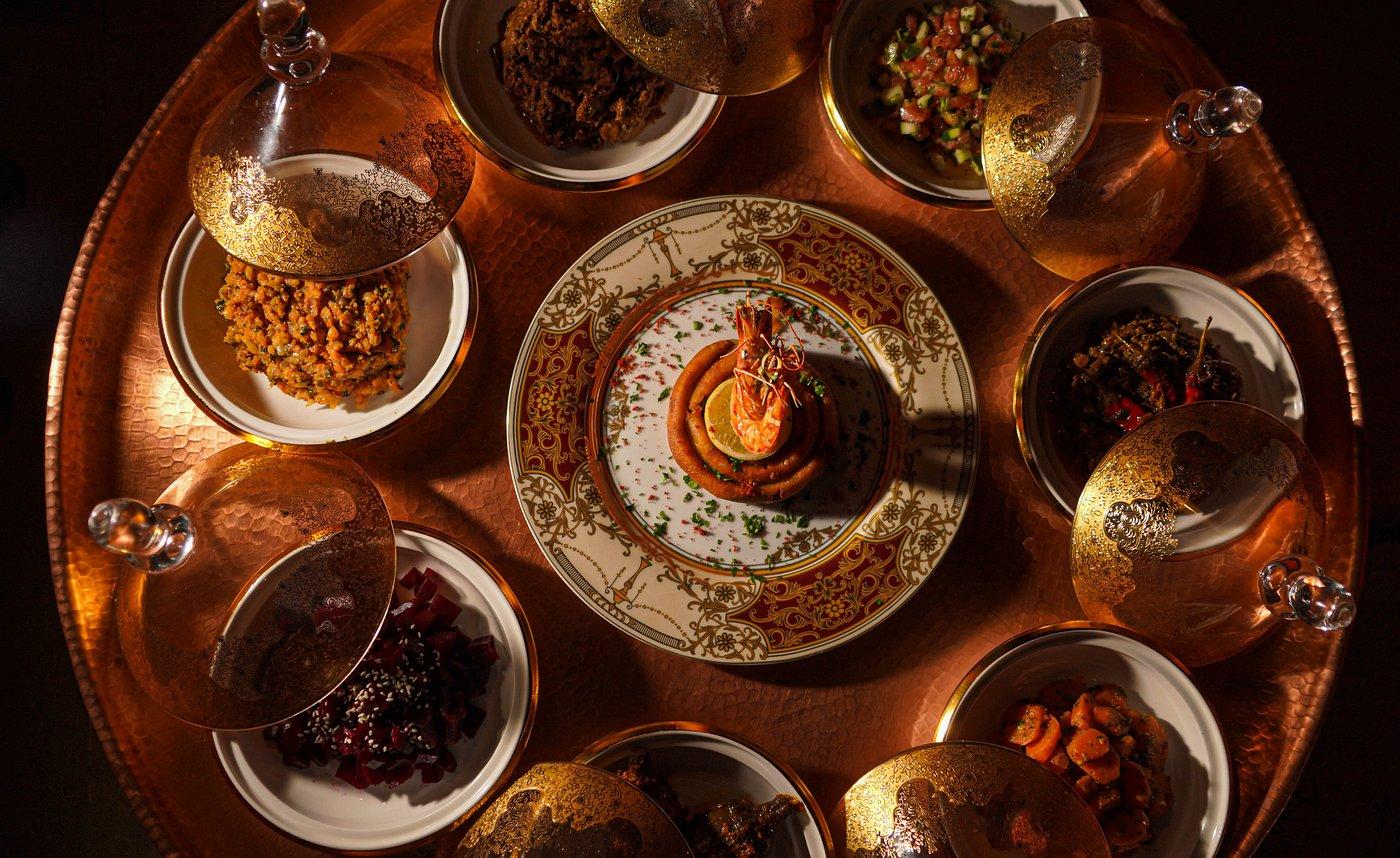
Small dishes cover the table before anything else arrives, and they are salads only by courtesy: most of them are cooked. Zaalouk is aubergine and tomato broken down with garlic, olive oil, cumin and paprika until it holds together like a spread. Taktouka is its pepper cousin, tomatoes and green peppers reduced and sharpened with toasted paprika. Beetroot with onion and herbs, carrots with cumin, marinated olives, all of it served cold or at room temperature and eaten with torn bread. Nobody portions them. They sit in the middle and everyone reaches.
Couscous
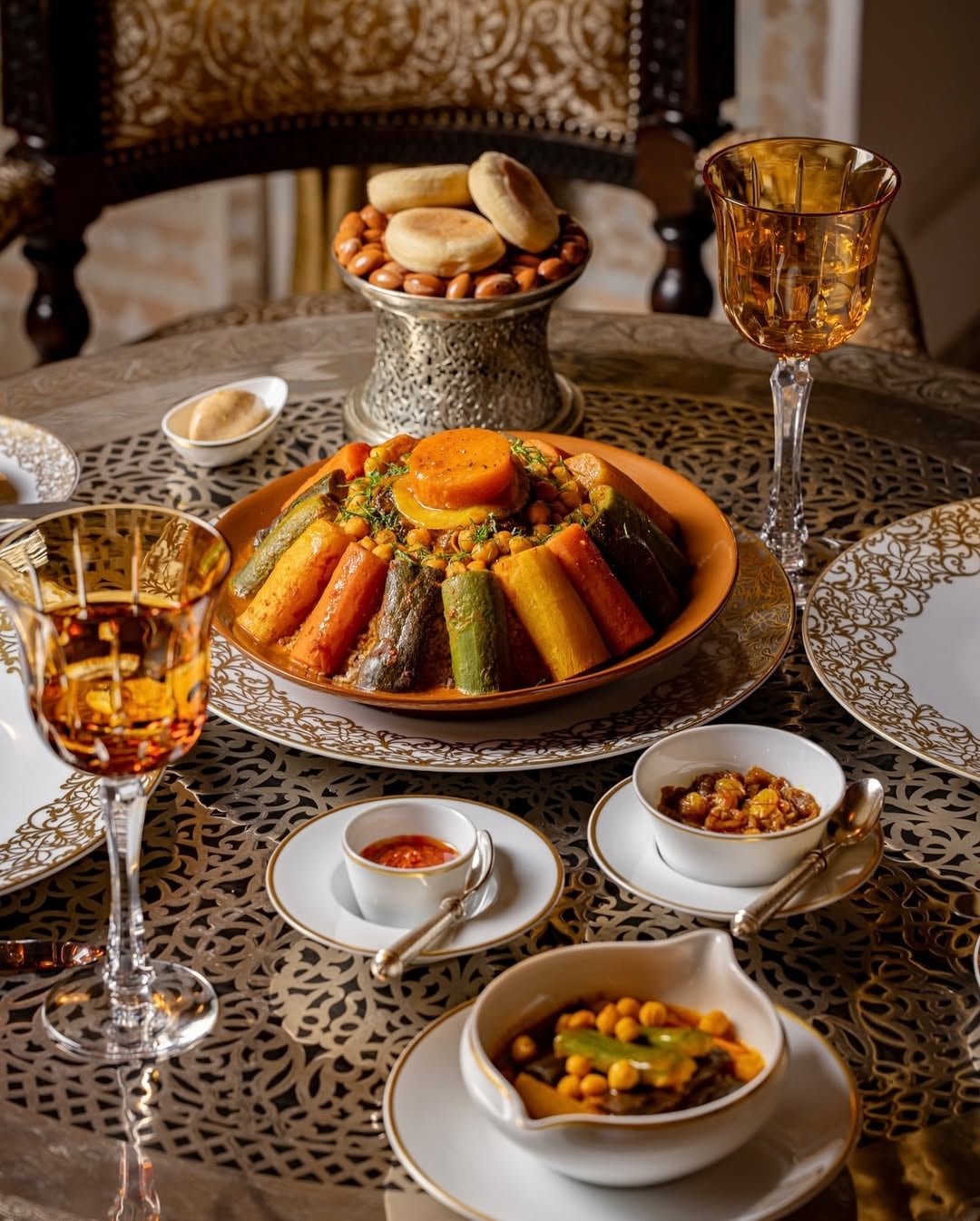
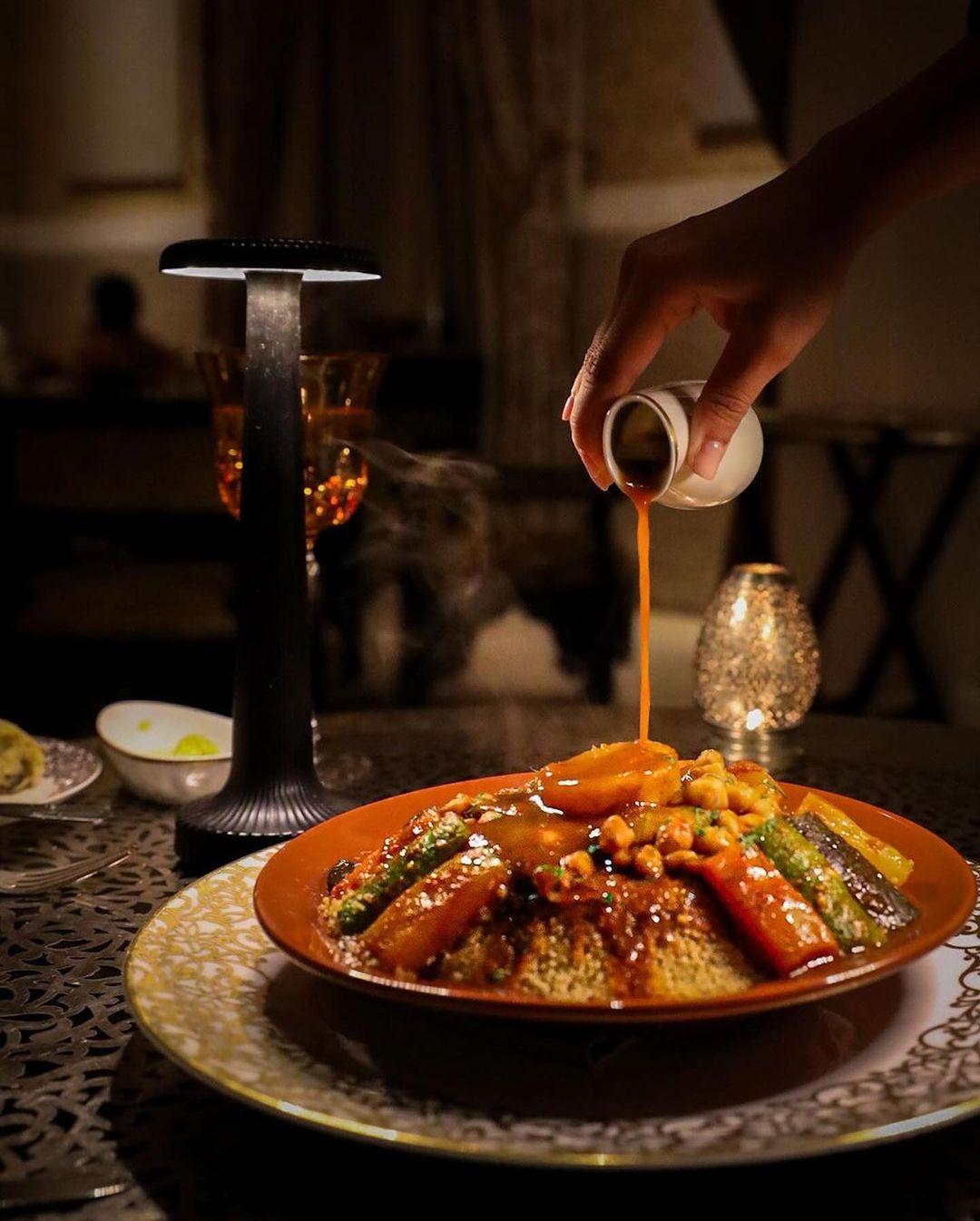
Semolina is moistened, rolled between the palms until it grains, then steamed over the broth beneath it, lifted out, raked, moistened again and returned, three times or more before it is light enough. It arrives on Friday, after midday prayer, as one mounded platter for the whole family, often crowned with tfaya, onions cooked down with raisins, cinnamon and honey, or built on the seven vegetables. UNESCO inscribed the knowledge and practice of couscous in 2020, on a joint application by Morocco, Algeria, Tunisia and Mauritania. Several kitchens in town cook it on Friday and on no other day, which is why the best Friday couscous in Marrakech is a short and well known list.
Tagine
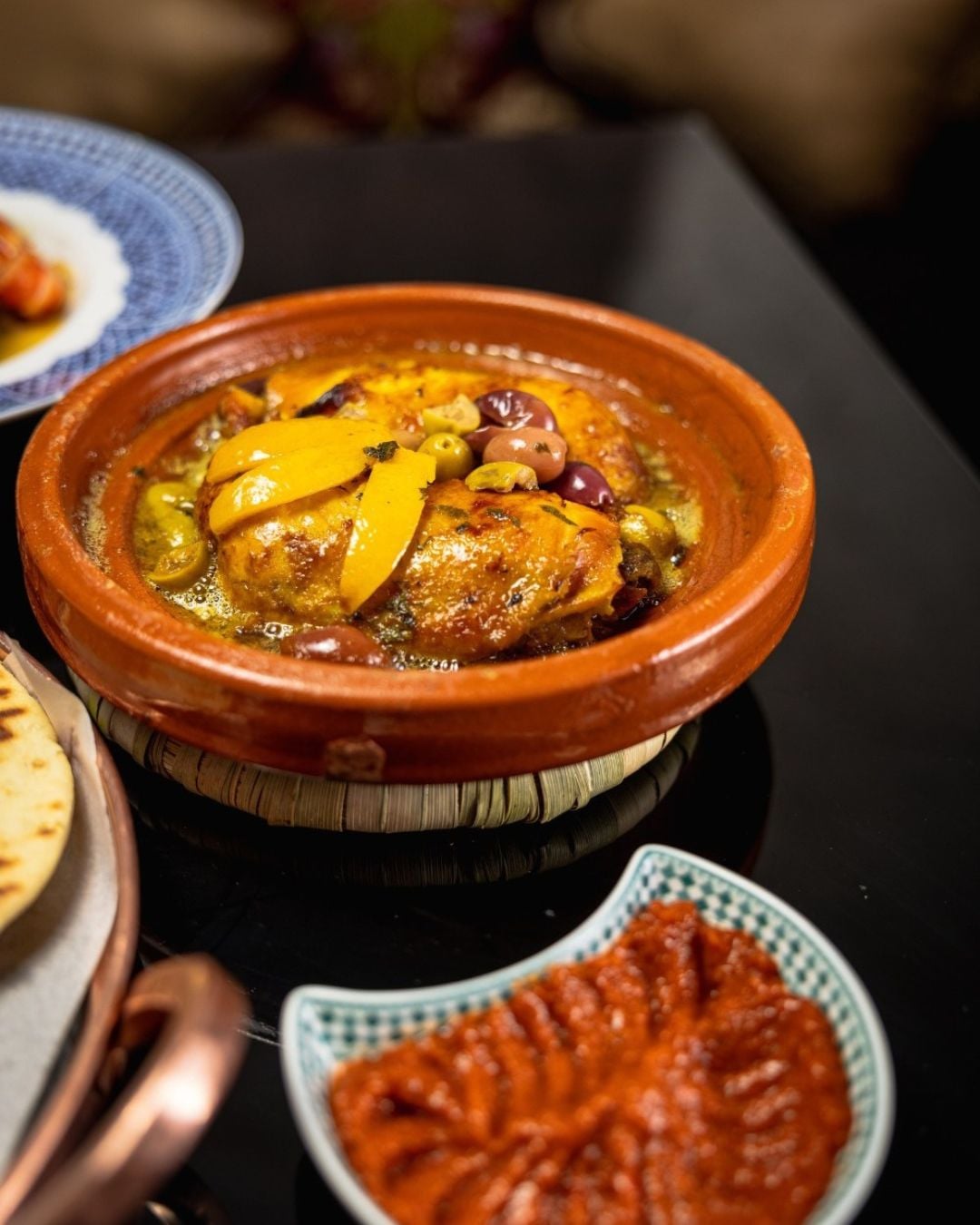
A shallow clay dish with a conical lid traps the rising steam, returns it to the base, and lets a tough cut cook for hours on very little fuel. The word names the pot before it names the food. Amazigh in origin, it is the most portable idea in Moroccan cooking and the reason a kitchen needs no oven: lamb with prunes and almonds, chicken with preserved lemon and green olives, kefta with eggs cracked into the sauce at the last minute, vegetables alone in the leaner houses. The lid comes off at the table. That is the whole event.
Tanjia
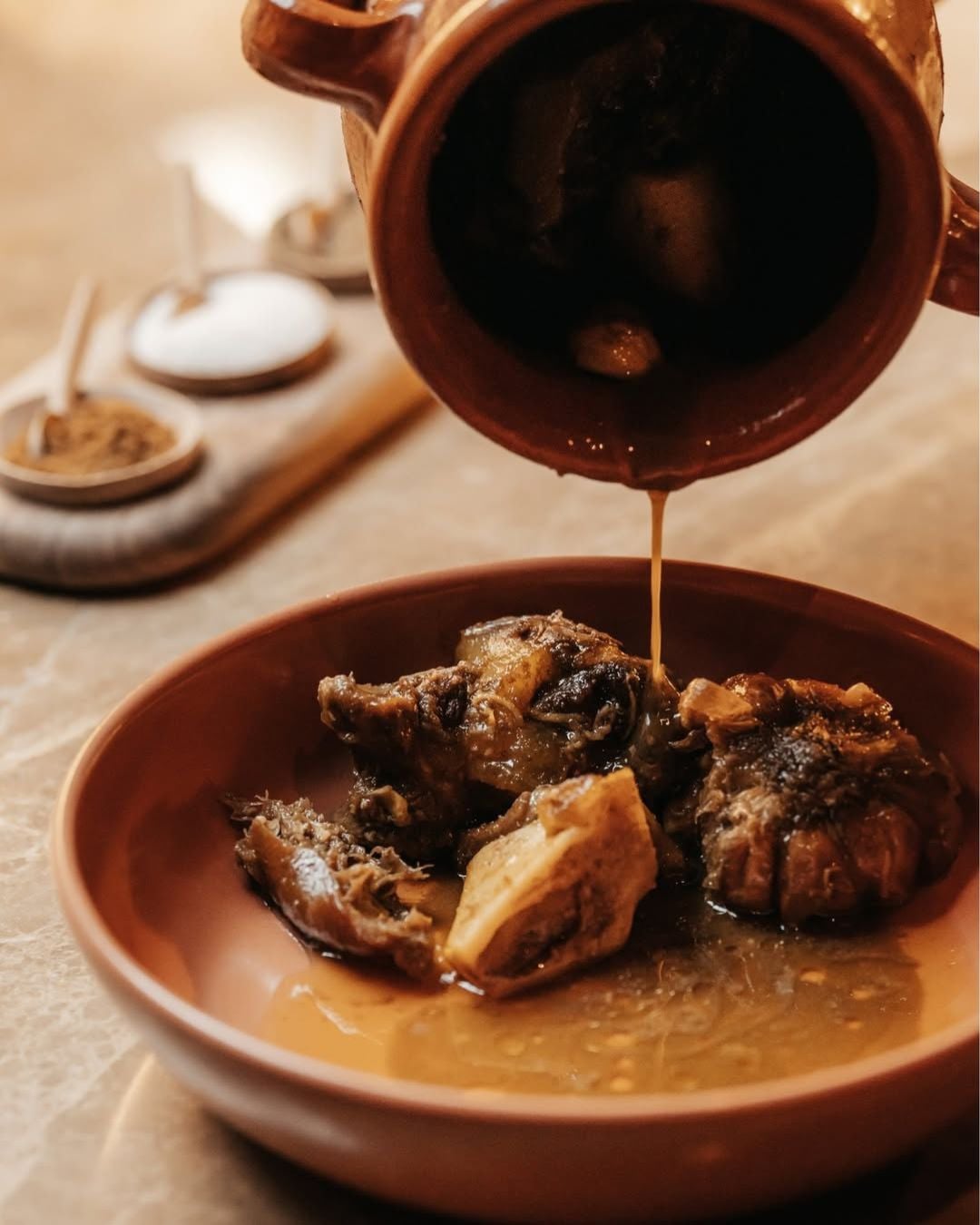
Beef shank, garlic, preserved lemon, cumin, saffron, olive oil and smen go into the urn, and nothing else: no vegetables, no stock, no browning. Sealed and left in low, steady heat, it braises in its own liquid and comes out unctuous, peppery and citric, with marrow slipping from the bone.
By the seventeenth century the dish was established enough to appear in the writing of the scholar Abu Abdallah al-Marghiti al-Susi al-Marrakushi. Its origins are working and male: artisans in the souks assembled it in minutes, left it with the furnace man, and collected it when the day's work was done.
Rfissa
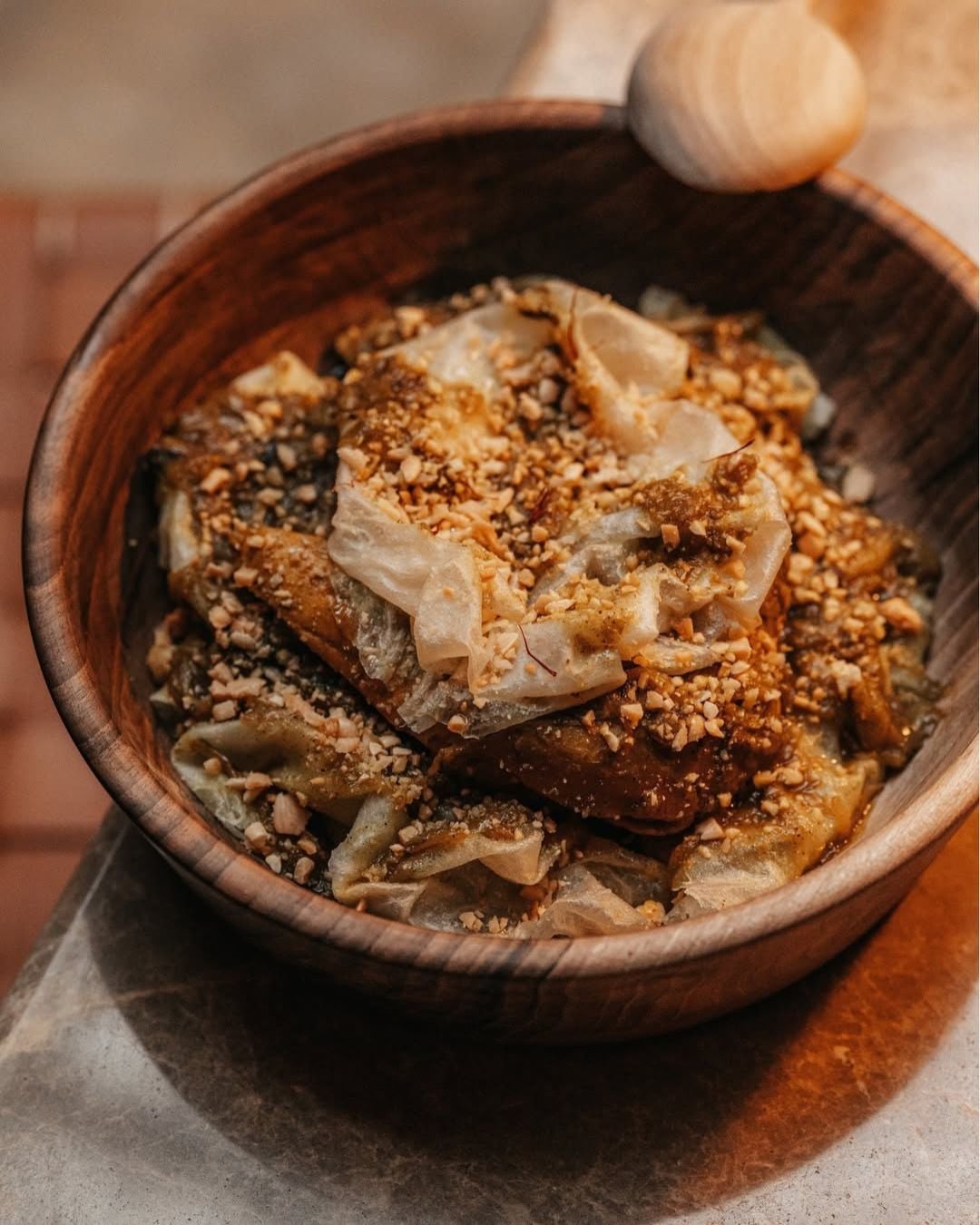
Chicken and lentils are cooked in a broth loaded with ras el hanout, saffron, smen and fenugreek seeds, then poured over torn msemen or trid, the thin pastry sheets that soak it up. The fenugreek is the point. The dish descends from tharid, the old Arab preparation of stew served over bread, and in Moroccan households it is made for a woman who has just given birth, by custom on the third day, because fenugreek is held to help a nursing mother. It is also cooked for celebrations and for honoured guests.
Mechoui
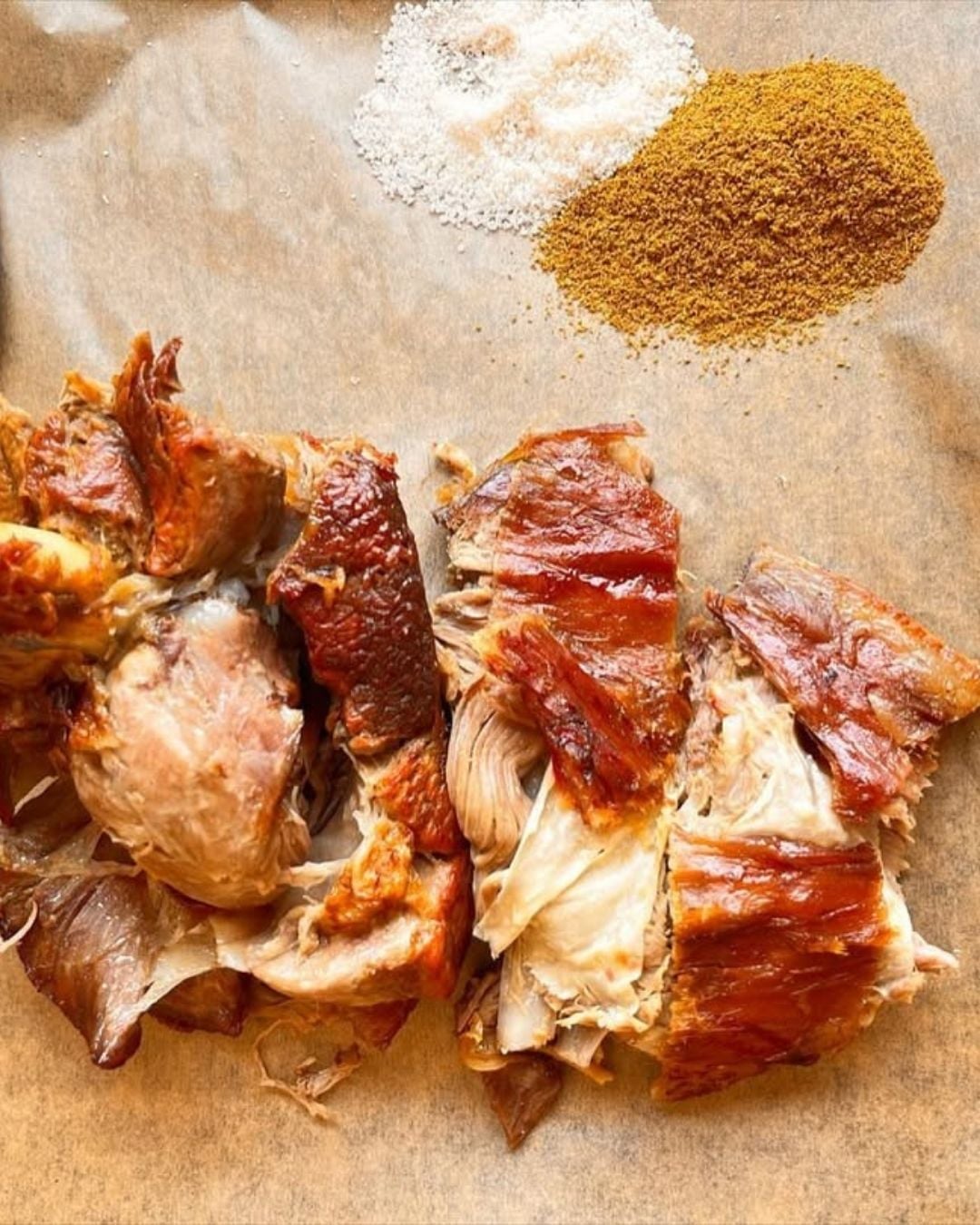
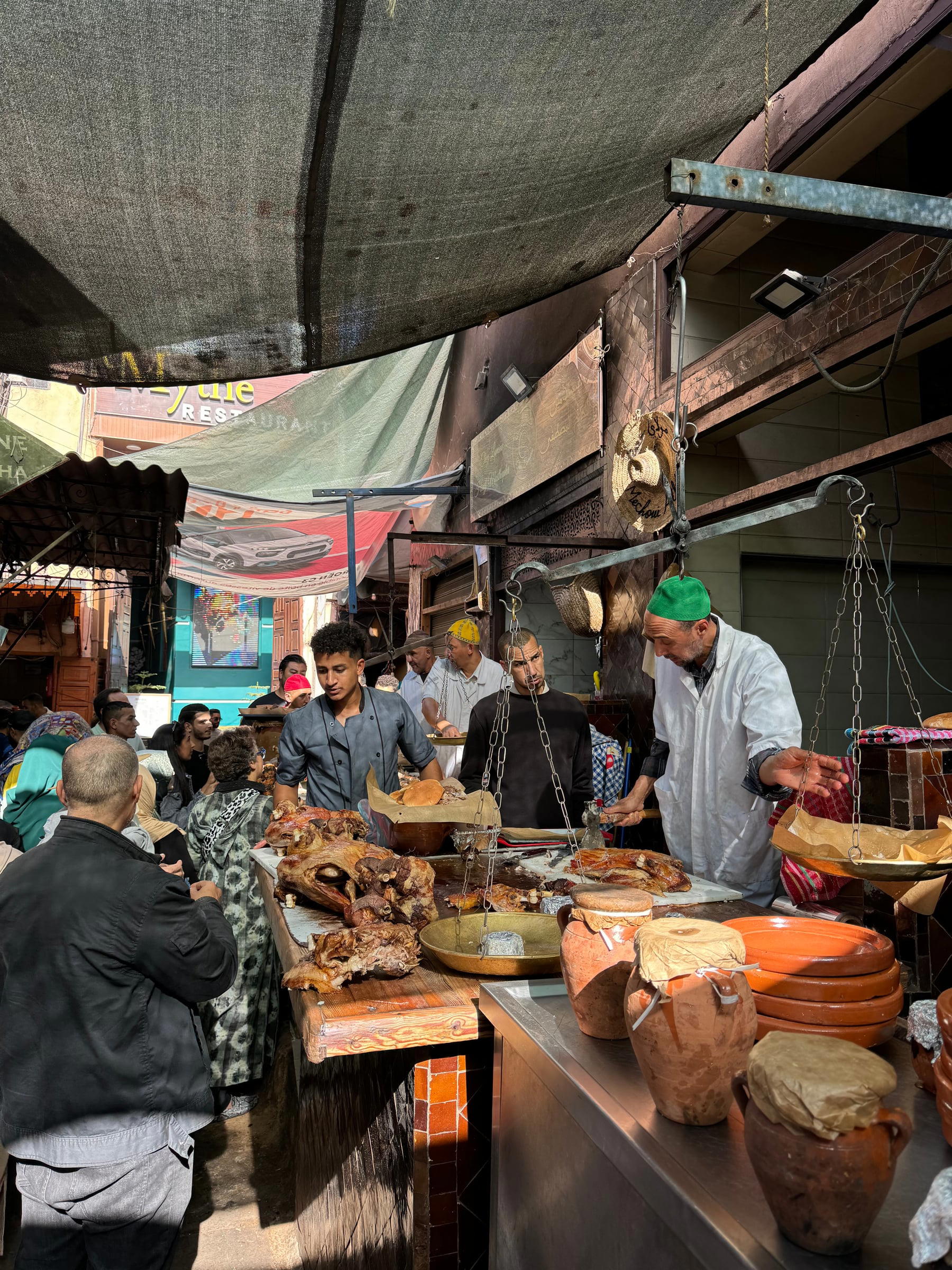
Whole lambs are lowered each morning into wood-fired pits dug beneath the shops of Souk Ablouh, the narrow lane running off the north side of Jemaa el Fna, and roasted for three to four hours until the meat leaves the bone under a thumb. It is sold by weight, cut onto paper, and seasoned with nothing but ground cumin and coarse salt, with torn khobz alongside. Outside the alley it is feast food, cooked for weddings and for Eid. When the day's lambs are gone, the shops are done.
Pastilla
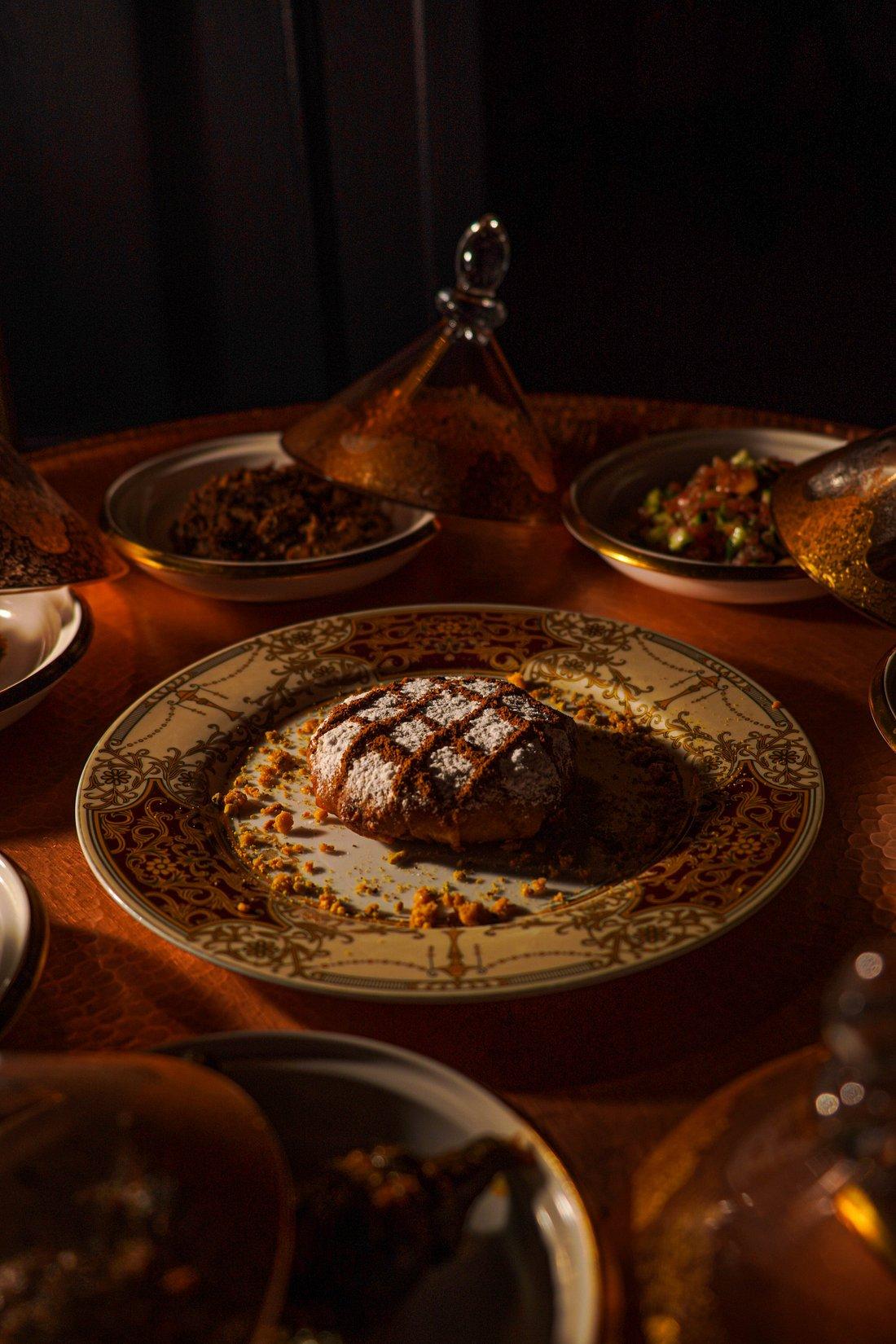
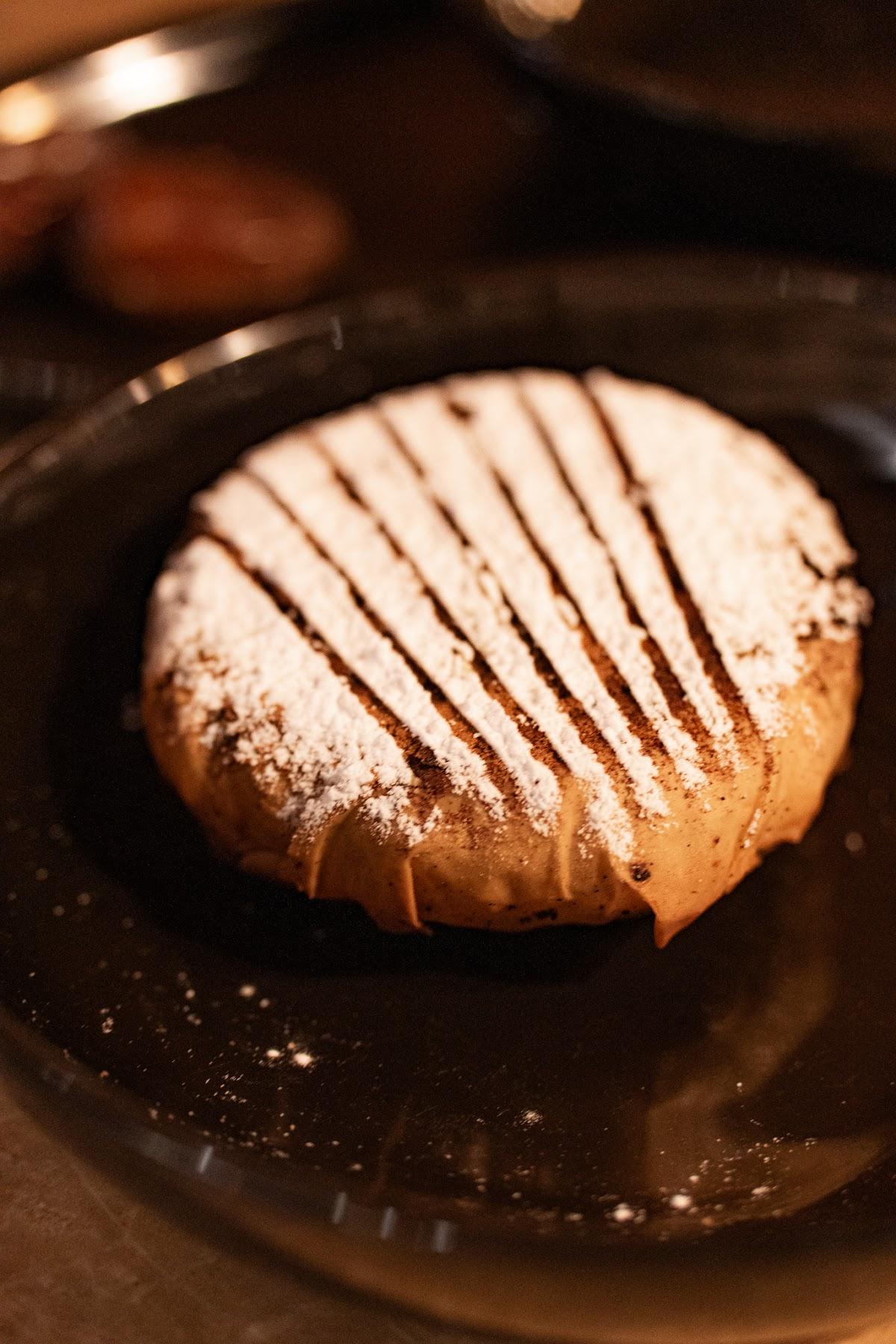
Warqa, the tissue-thin pastry whose name means leaf, is laid in overlapping circles and filled in strata: shredded pigeon slow-cooked with saffron, ginger and cinnamon, then eggs set in the reduced braising liquid, then sweetened ground almonds scented with orange blossom, the whole thing baked, dusted with icing sugar and crossed with lines of cinnamon. Its architecture is Andalusian, carried into Morocco by those expelled from Spain, and Fez is the city most closely associated with the pigeon original. Chicken versions are now more common. Both are served near the start of a formal meal, which surprises anyone reading the sugar as dessert. The milk version, called ktefa or jawhara, layers the same crisp warqa with sweetened milk and almonds, and it is dessert, served at weddings.
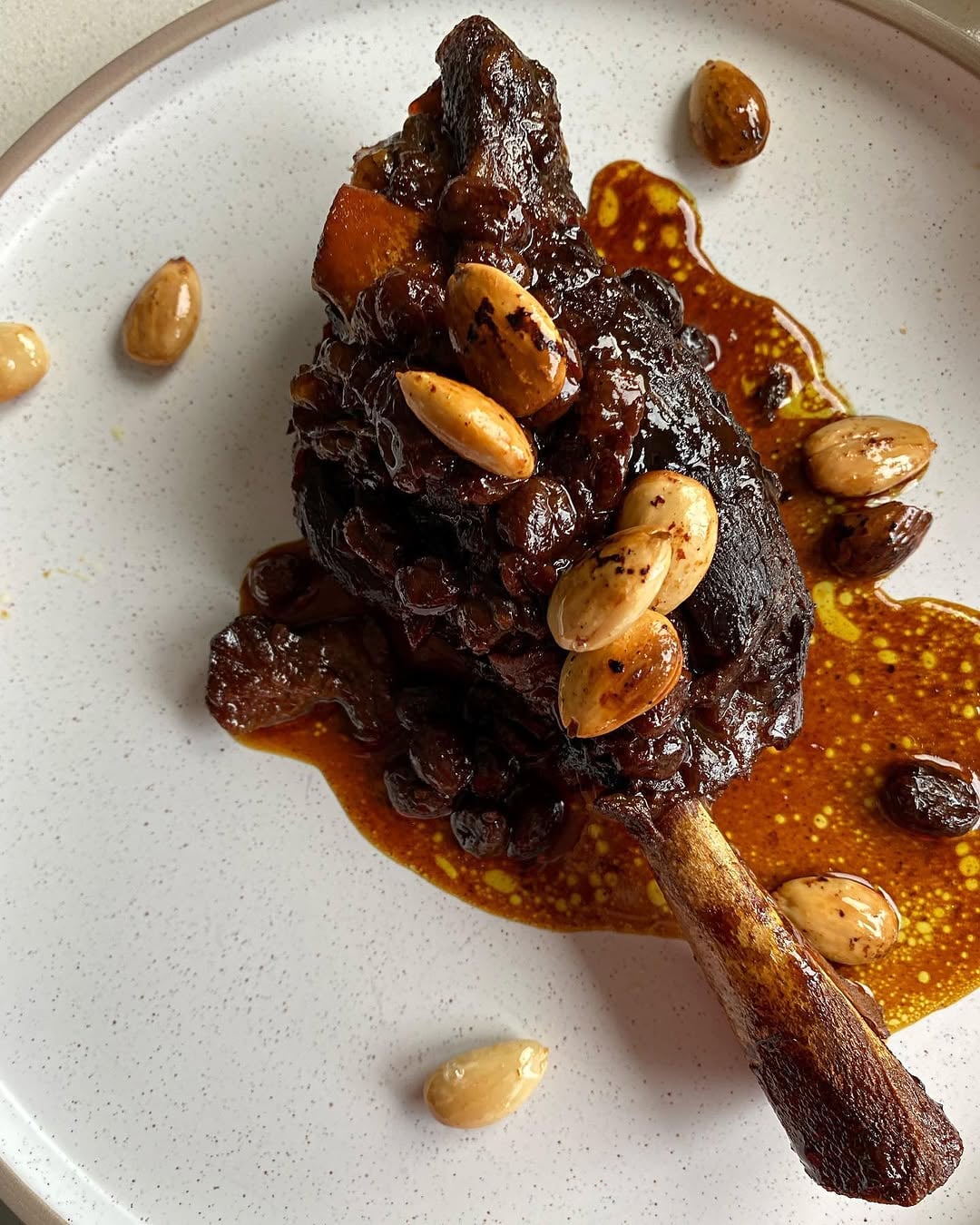
Mrouzia
Lamb is cooked down with raisins, almonds and honey until the sauce turns dark and sticky, carrying a heavy dose of ras el hanout, the blend whose name means head of the shop and whose composition is fixed by nobody: every spice merchant grinds his own, from a dozen components to several dozen. Mrouzia belongs to Eid al-Adha, when a household has more meat than it can eat fresh and the sugar does the preserving.
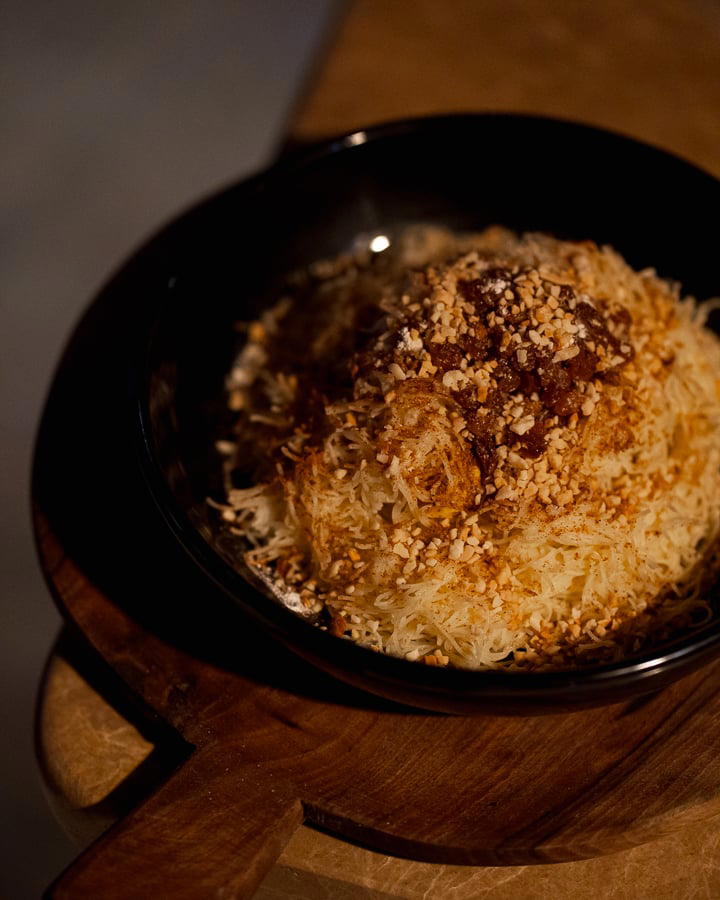
Seffa Medfouna
Medfouna means buried. Vermicelli or fine couscous is steamed three or four times until silky, then heaped into a dome over chicken or lamb cooked with ginger, turmeric, saffron and onion, and finished with icing sugar, dark lines of cinnamon, ground almonds and raisins. Guests see a sweet white mound and nothing else until a spoon goes in. It is wedding food, carried in whole and opened in front of the table.
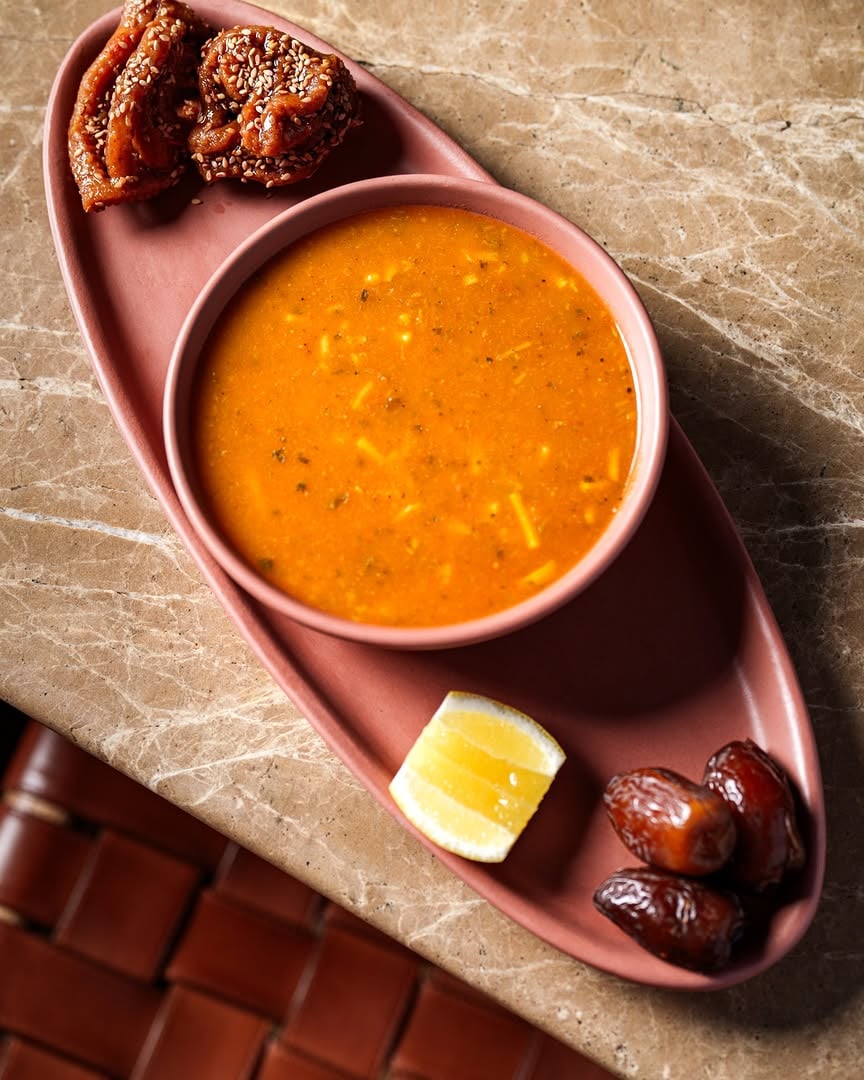
Harira
Tomato, lentils, chickpeas, celery and coriander simmer with a little meat, and at the end a slurry of flour and water called tedouira is stirred through and thickens the pot. The name comes from the word for silk, which is a claim about texture. Harira breaks the fast at sunset through Ramadan, eaten with dates and honeyed chebakia, and it is ordinary evening food the rest of the year, sold from small kitchens and street pots when the nights turn cold.
Babbouche
Marrakchis eat snails after dark, standing at a cart or sitting on a stool at the edge of the square, and the stalls work hardest when the weather turns. Small land snails simmer in cauldrons of dark broth: thyme, aniseed, mint, liquorice root, gum arabic and a dozen more, bitter and faintly medicinal, every vendor guarding a different combination. The snails are picked out one at a time with a toothpick. The broth, held to settle the stomach and warm the body, is drunk from the bowl at the end, and it is the part the regulars come for.
The Pastries of Occasion
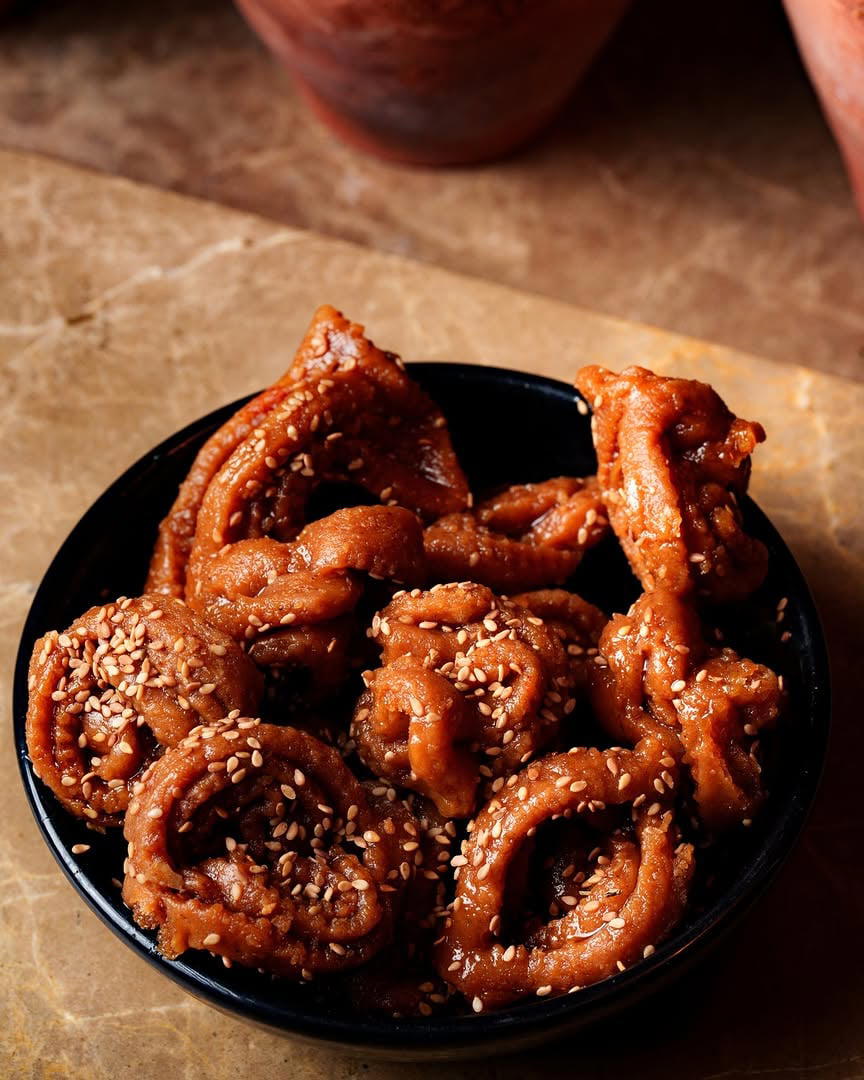
Moroccan pastry runs to dozens of forms, and three of them are tied to a specific occasion. Chebakia is sesame and anise dough cut, folded into a rosette, fried and dropped hot into warm honey, and it exists for Ramadan, made in quantity in the weeks before the month begins and eaten beside harira. Sellou never sees an oven: browned flour, ground almonds, sesame and warm spices pressed into a dense sweet given to new mothers and prepared for weddings and births. Kaab el ghzal are the formal ones, crescents of thin pastry around almond paste scented with orange blossom, served to guests of honour and at the close of a proper meal.
Atay
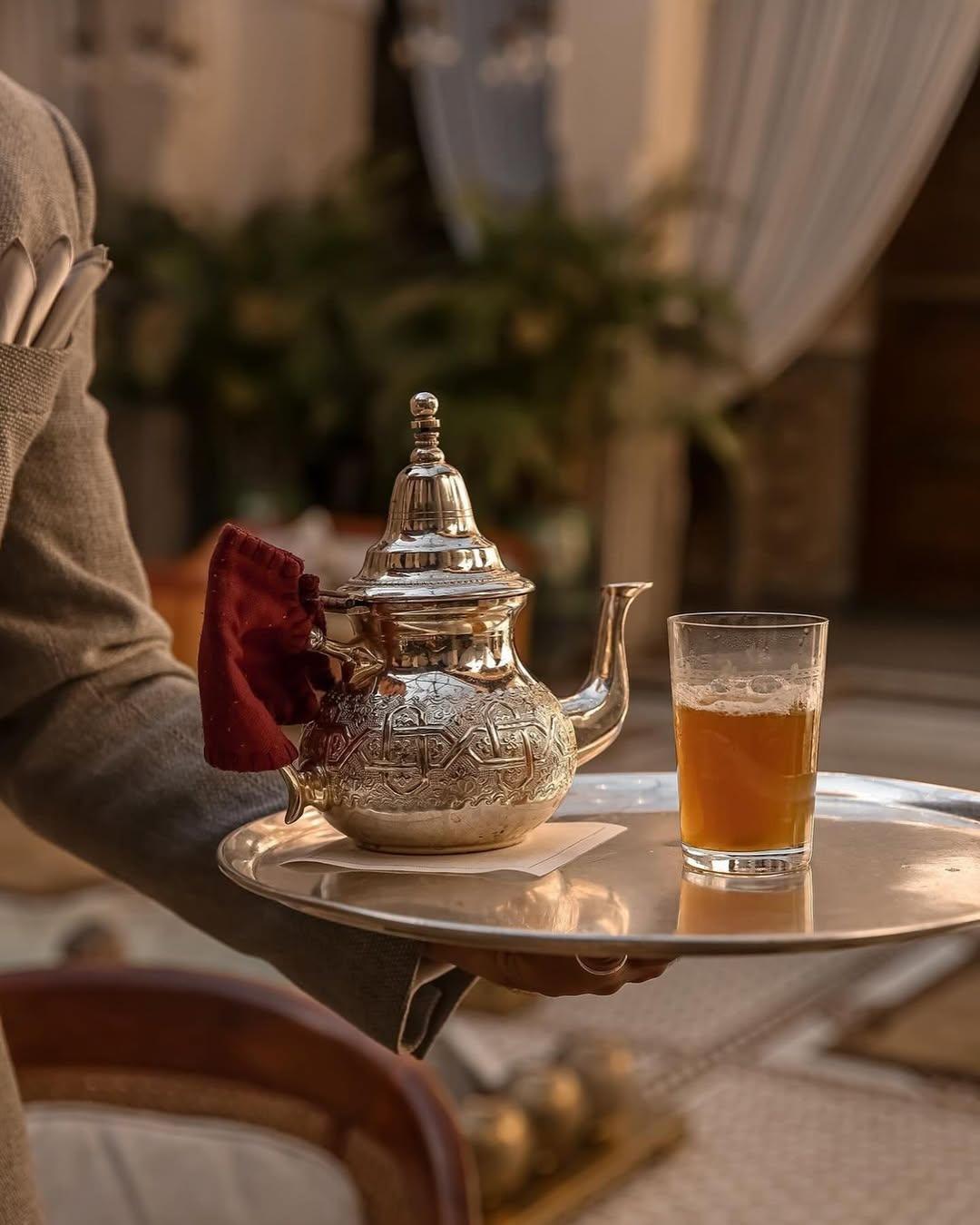
Gunpowder green tea, tightly rolled leaves that unfurl in the pot, is brewed with a large bunch of nana spearmint and a great deal of sugar. The pour matters as much as the brew: the pot is raised high above the glass so the stream aerates and raises a head of foam, and the higher the pour, the more respect it signals. Three glasses come from the same leaves, each stronger than the last. It arrives when you enter a shop, when a price is being discussed, and when a meal ends, and nobody asks first.
Where These Dishes Are Cooked
The Small Rooms
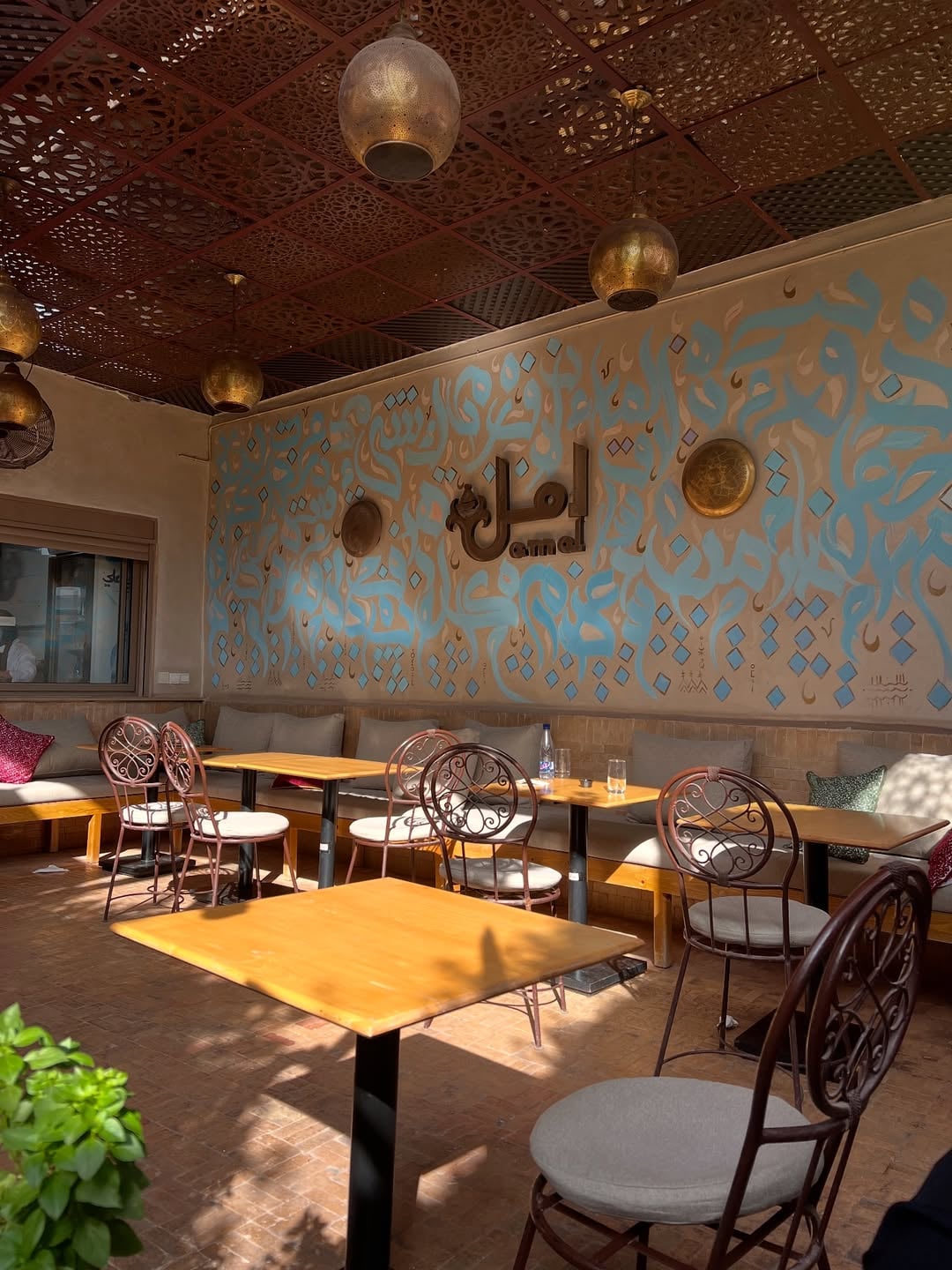
Chez Lamine Hadj Mustapha has stood at the entrance to Mechoui Alley since 1965 and is the original the other lamb stalls gathered around: mechoui from the pit below the counter, tangia from the hammam embers, basic tables and fast service. Naima Couscous holds six tables near Medersa Ben Youssef, with no sign and no menu, and puts one bowl in the middle of the table; when the pot empties, the day is over. Amal, whose name means hope, is a non-profit in a Gueliz villa garden where disadvantaged women train professionally in the kitchen, more than three hundred of them since 2012, and where the Friday couscous regularly sells out before the afternoon is done.
The Gueliz Kitchens
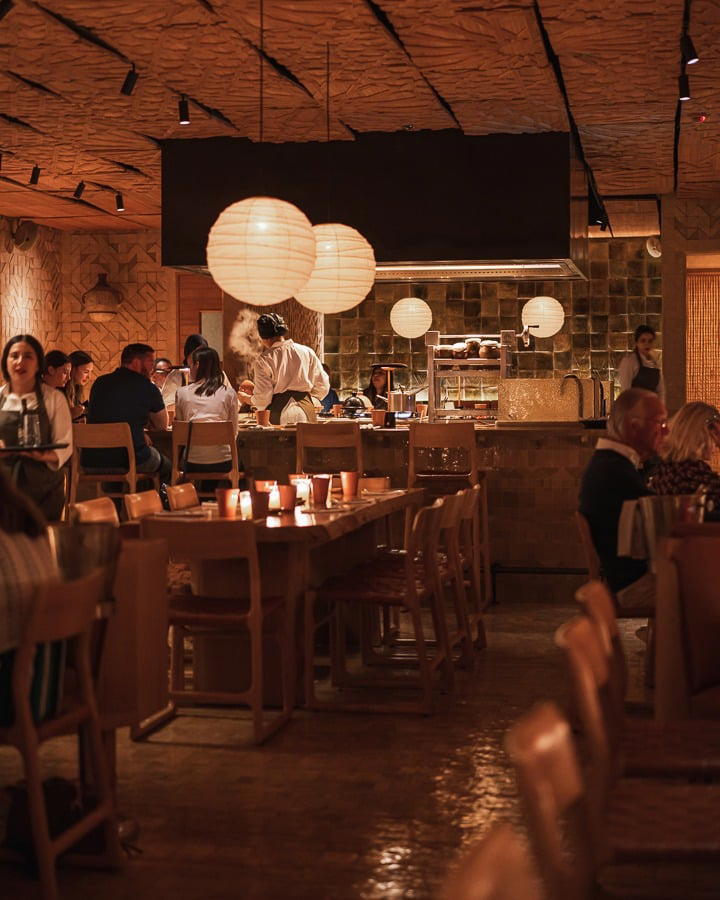
Al Fassia Gueliz has been on Boulevard Mohamed Zerktouni since the 1980s, run entirely by women from the stove to the dining room, with tagines, pastillas and slow-cooked lamb held to a standard that has not moved. At Sahbi Sahbi, Helena Paraboschi and Pierre Pirajean inverted the usual arrangement: the kitchen, in Morocco a closed room governed by the dadas who carry the recipes down the generations, sits open at the centre of the dining room, ringed by a horseshoe counter. The team is all female, the menu is a single page of home cooking, and the couscous is served at lunch on Fridays and on no other day.
The Palace Tables
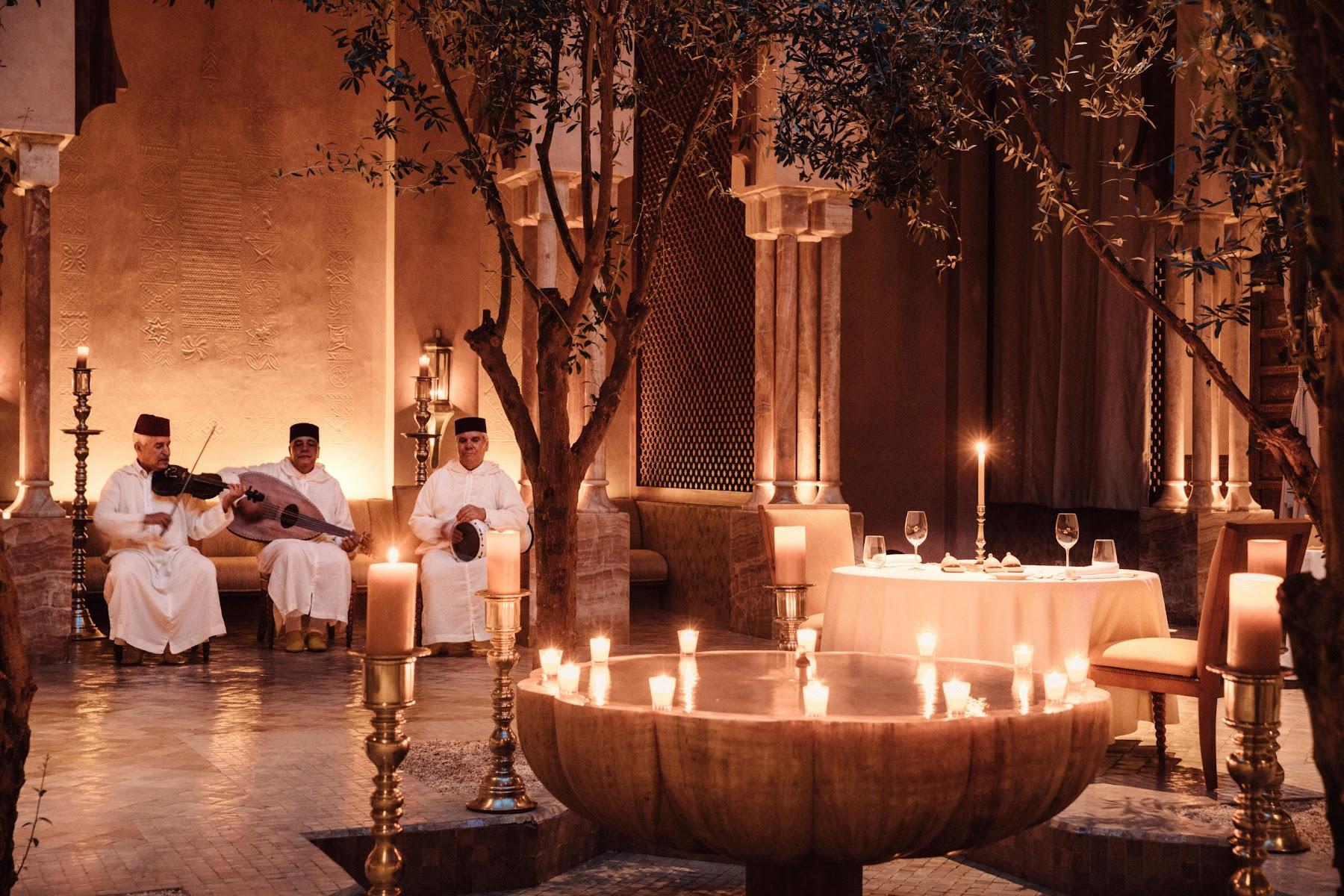
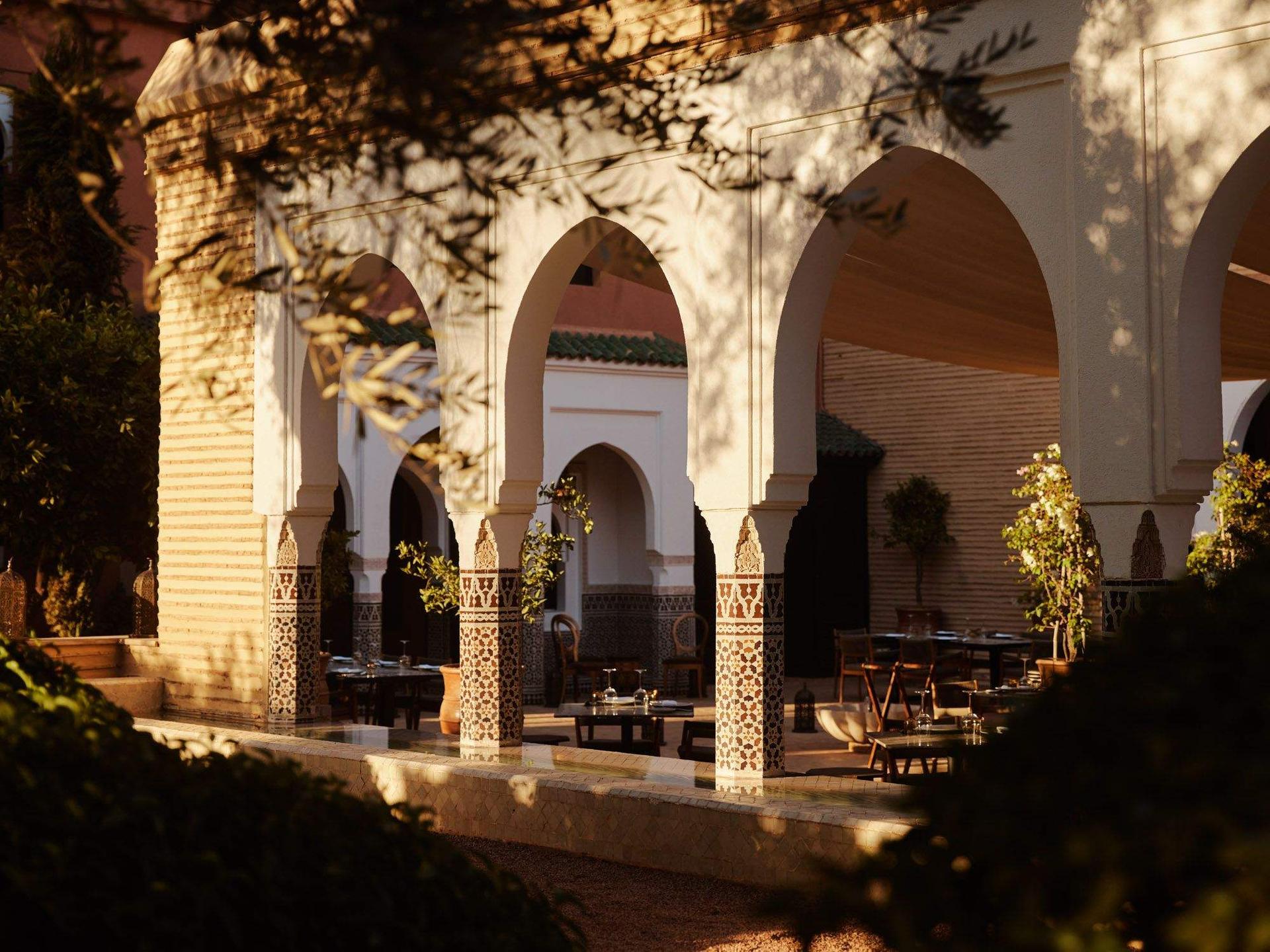
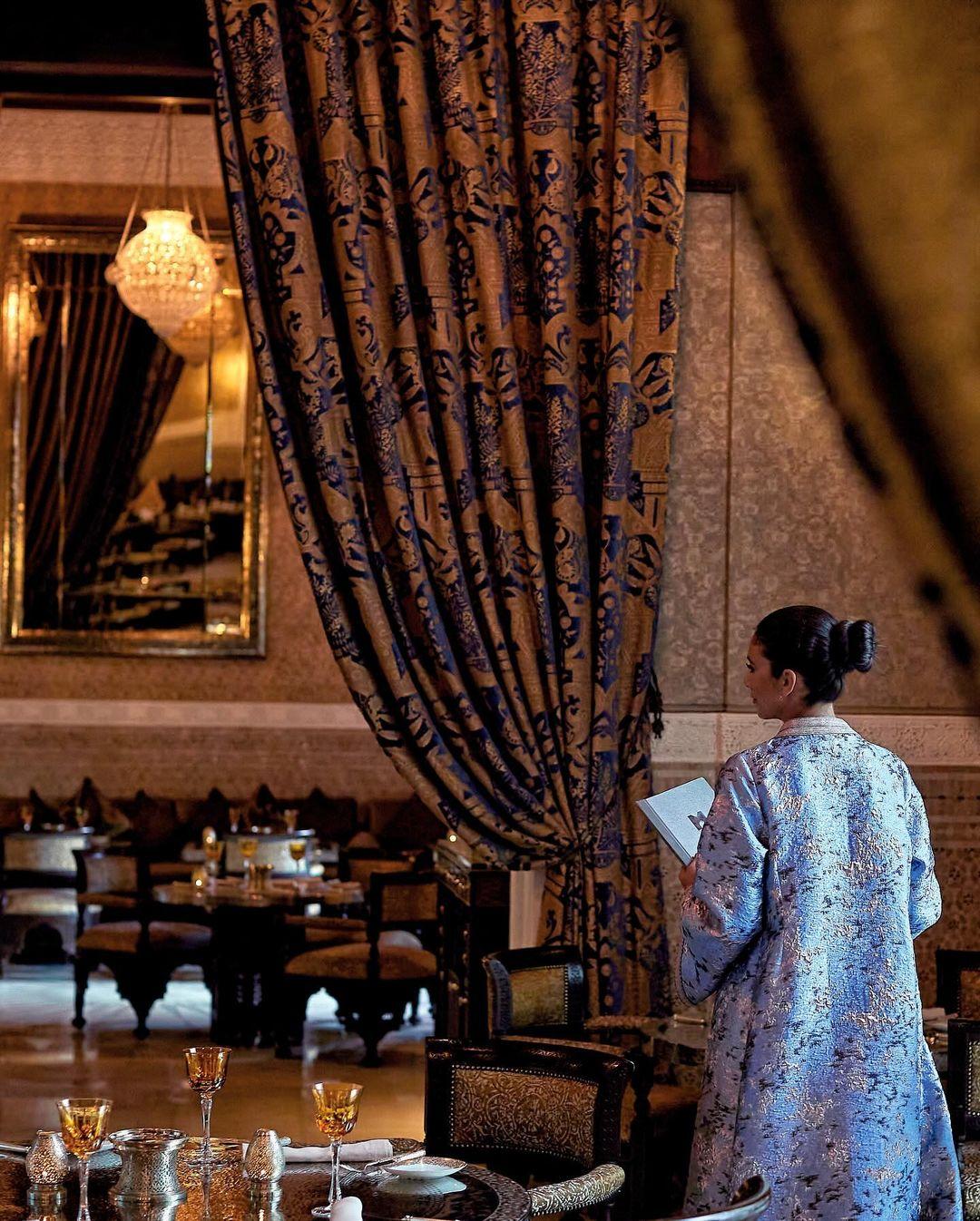
La Grande Table Marocaine at the Royal Mansour cooks ancestral recipes with modern technique in a ceremonial room with live oud. Le Marocain occupies a three-storey riad deep in La Mamounia's gardens, where Rachid Agouray has run the kitchen for more than twenty-five years and the Moroccan salad arrives in fourteen components. Assyl at the Selman, on the Route d'Amizmiz, serves pastillas, slow-built tagines and couscous in a gilded room whose terrace looks over the paddocks where the hotel raises Arabian horses, and its kitchen too is run entirely by women working in the dada tradition. The Moroccan at Amanjena serves tagines, mechoui and clay-cooked couscous in a candlelit courtyard under honey-coloured marble columns, with a trio playing oud and derbouka beside the fountain.
You may also like…