The Best Restaurants in Marrakech: Thirty-Seven Tables, Chosen for Culinary Excellence
Timence Guide Editors · Updated: 14 May 2026
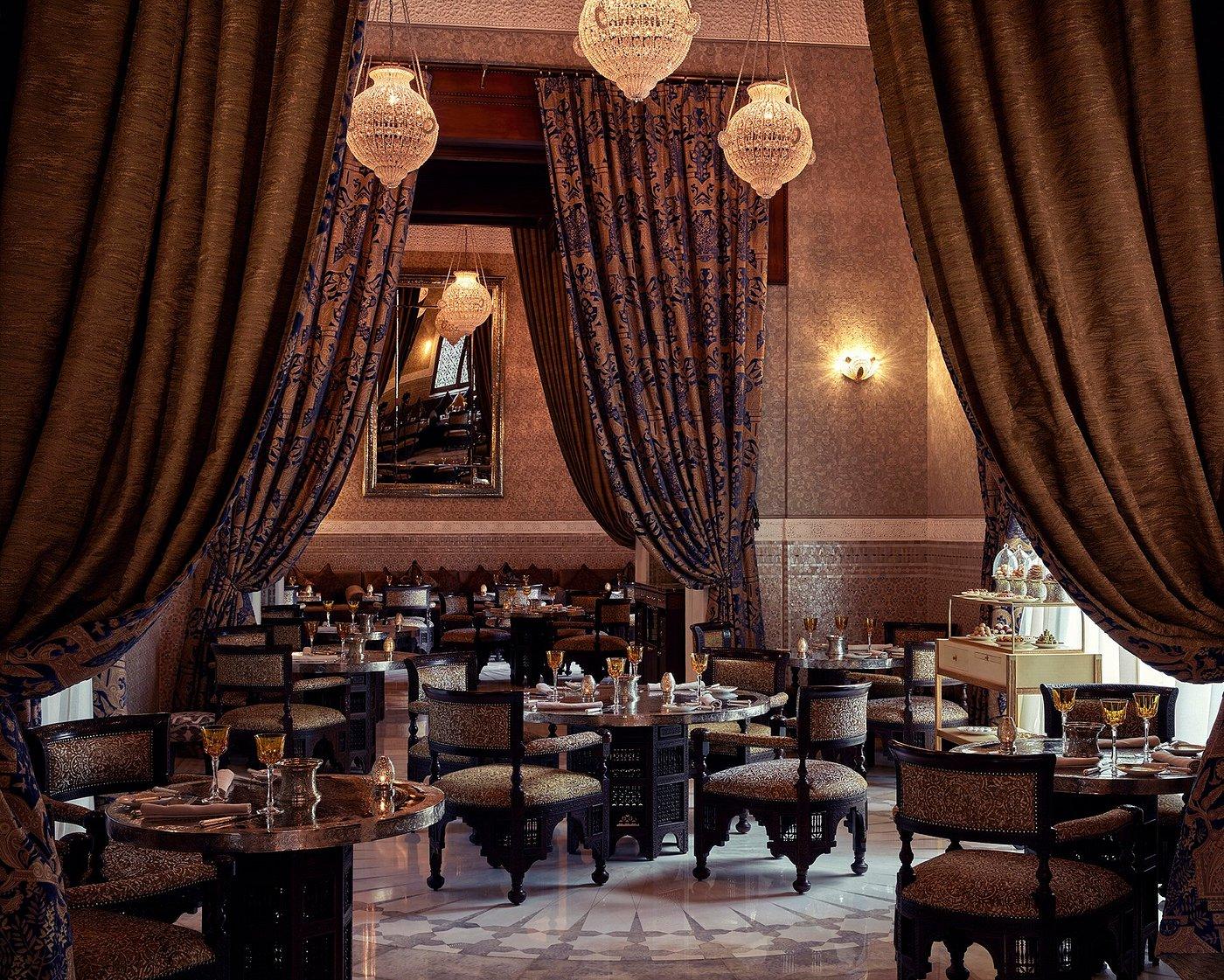
The best restaurants in Marrakech do not cluster in one neighbourhood and do not belong to one price point. They are spread across the medina, Gueliz, and the hotel estates south and east of the ramparts: from counters that open at noon and close when the food runs out, to rooms where a century of culinary tradition has been refined to the scale of a formal discipline. Moroccan cuisine remains the city's most compelling argument: mechoui from underground clay ovens, tangia slow-cooked in hammam embers, pastilla in its sweet-savoury register, the ten-salad opening that anchors the Fassi tradition. But the conversation has shifted. A generation of chefs is rebuilding the Moroccan table from the ground up: farm-first kitchens sourcing from permaculture farms, women-run brigades operating with technical precision, addresses that entered MENA's 50 Best within their first year of service. Alongside them, the city's international offer has deepened: Italian tables with Michelin lineage, Asian kitchens running from Cantonese sharing plates to Japanese-Peruvian precision, and French bistronomique addresses where Michelin-credentialed chefs have made Marrakech a serious stop on the European culinary circuit. This guide covers thirty-seven addresses selected for culinary excellence and organised by budget. The full map of forty-seven culinary experiences in Marrakech is available on the site. What holds constant across all five tiers is the criterion applied in selection: the kitchen must be the reason to go.
€
The tier where Marrakech eats for itself: cash counters and a non-profit training kitchen, no ceremony, no printed menu, no price that reflects anything other than the food itself. Under 20 euro per person, drinks excluded.
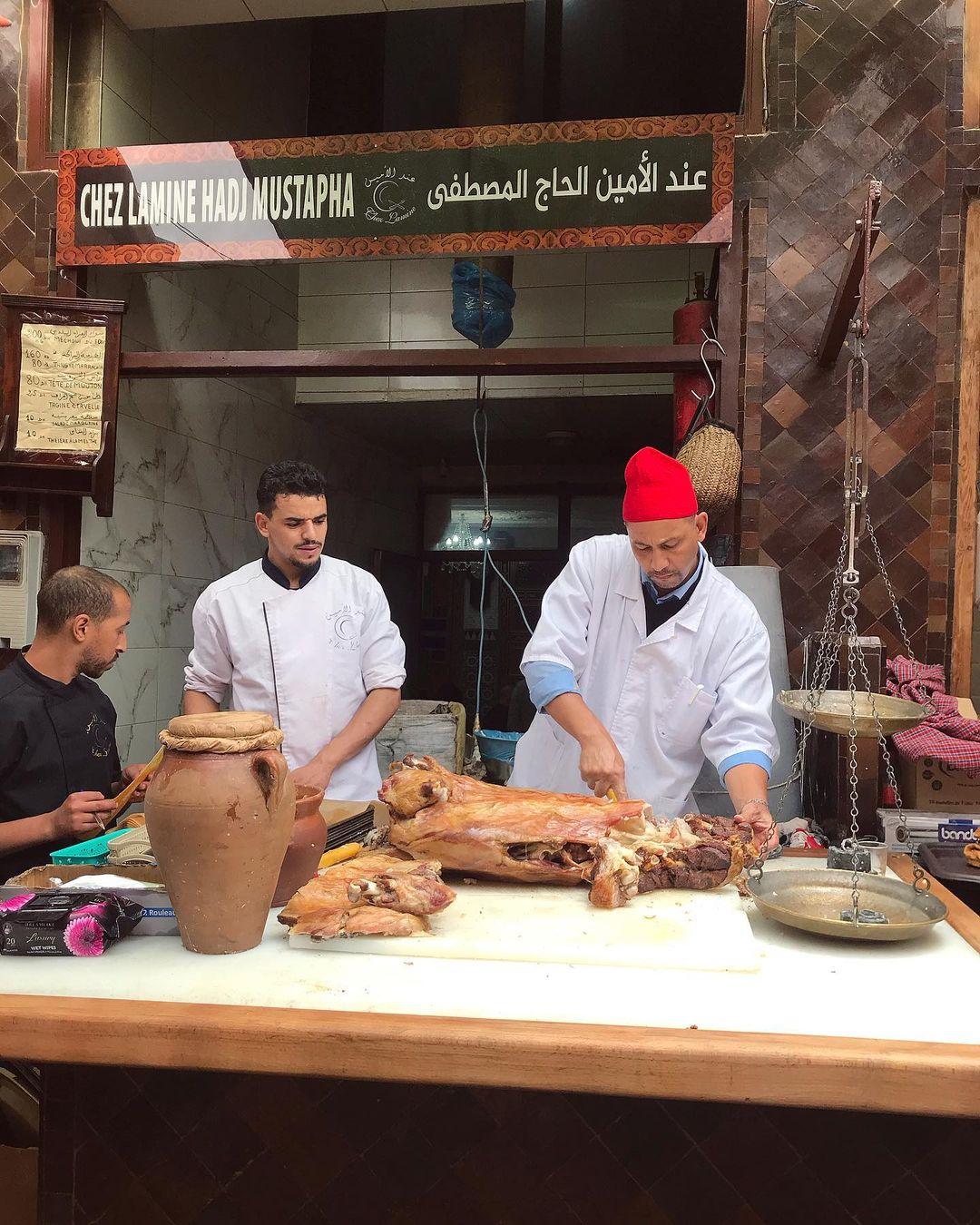
In the mechoui alley just off Jemaa el-Fna, Chez Lamine Hadj Mustapha has been roasting lamb in underground clay ovens since 1965. The format is unchanged: overnight roasting, service from noon, and a natural close when the meat is finished. Tangia marrakchia, slow-cooked in hammam embers, is the second speciality. No menu, no reservation, no ceremony. The rooftop terrace above the square adds context without altering what the address fundamentally is. What Chez Lamine represents is the oldest form of urban hospitality in Marrakech: a craft handed down across generations and offered at a price that reflects its origins rather than its rarity. Arrive before 1pm.
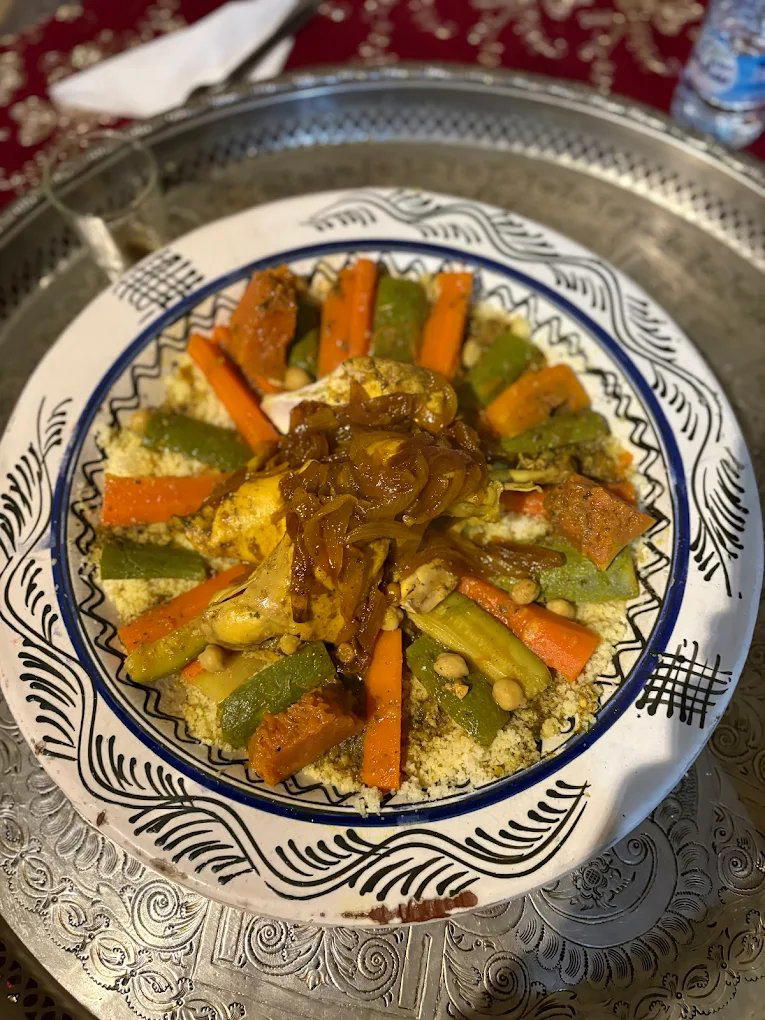
A small Moroccan canteen on Rue Azbezt in the medina, Naima operates with the directness of a kitchen that has nothing to prove. The menu turns on Moroccan staples prepared with the consistency of a place that cooks the same dishes every day for the same neighbourhood: harira, couscous, tagines that shift with the season and the market. There is no designed atmosphere and no tourist infrastructure. What Naima offers is proximity to the way a large part of the medina eats daily, at a price that makes that proximity unremarkable. For a visitor, the unremarkable is precisely the point.
Rue Azbezt, Marrakesh 40000, Marocco
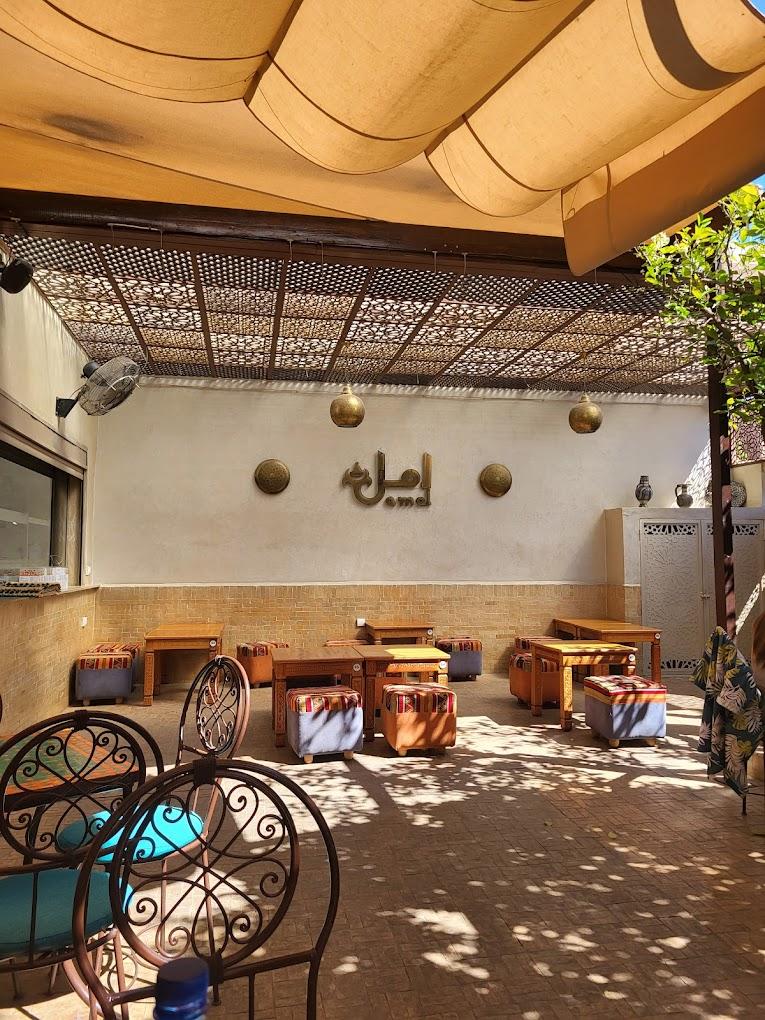
Amal means hope in Arabic, and the restaurant operates accordingly. Inside a villa with a shaded garden in Gueliz, it functions as a non-profit training center where women from disadvantaged backgrounds learn to cook and serve professionally. More than 300 women have passed through the program since 2012, and the kitchen they train in is the same one preparing the meal. The food is traditional Moroccan: slow-simmered tagines, salads with sharp layered spicing, and on Fridays a couscous that fills every table and often sells out before the afternoon is over. No design concept, no pretension. The transaction runs in both directions.
€€
Neighbourhood restaurants doing serious work at a price that keeps them part of daily life rather than destination dining: brasseries, medina rooftops, and wine-focused bistros where the kitchen earns the visit. Between 20 and 50 euro per person, drinks excluded.
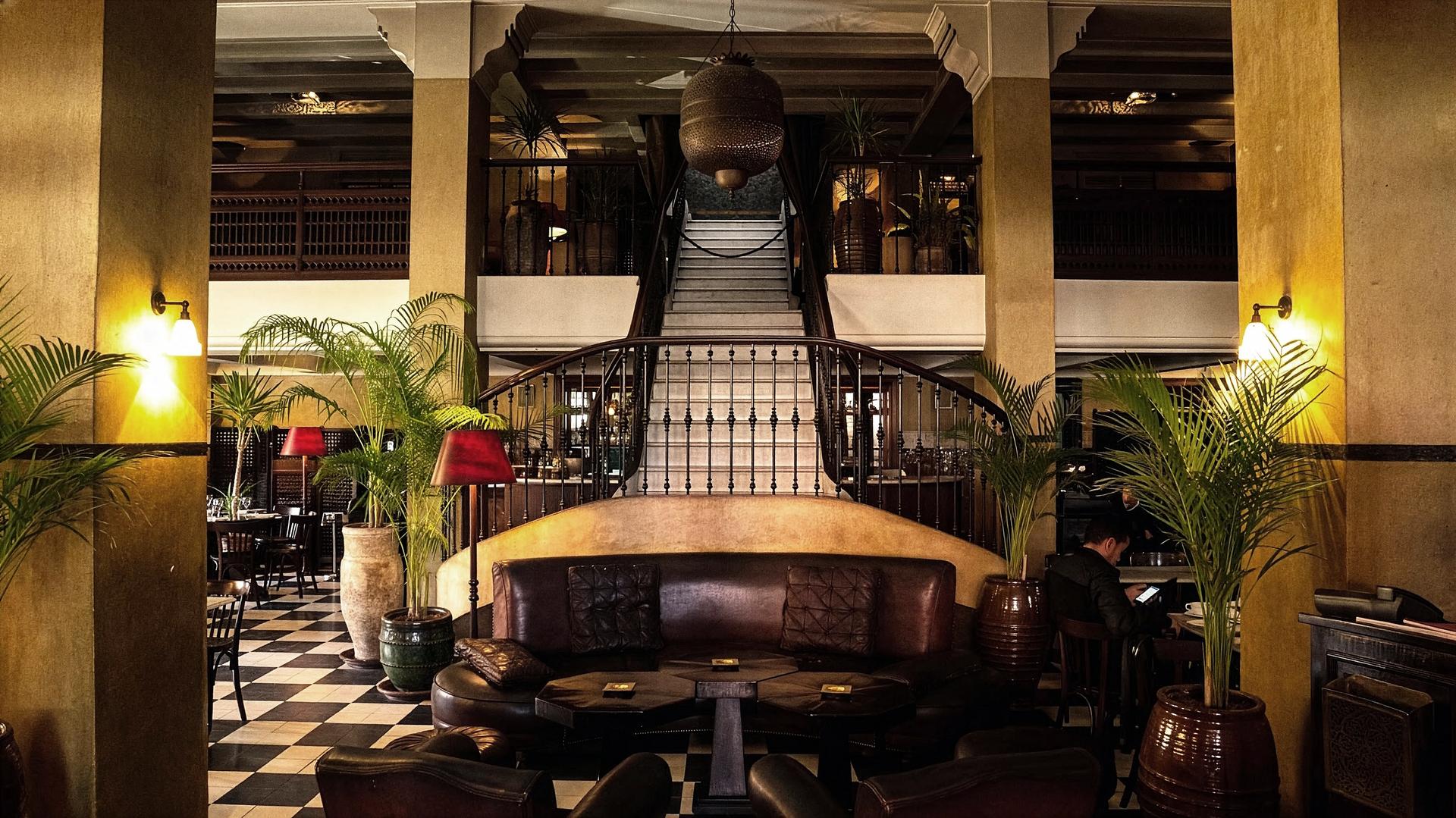
Built in 1925 as the first post office of the new Gueliz, the Grand Cafe de la Poste was restored by Studio KO with enough attention to the original fabric to keep what age had deposited in the mirrors, woodwork, and proportions. Chef Philippe Duranton works a French-Moroccan register that honours both sides: crab tian from Oualidia, kefta tagine with preserved lemon, monkfish skewers in curry, a Grand Marnier souffle that needs twenty minutes and is worth them. The wine list is among the most considered in the city. The address functions as a social institution as much as a restaurant. Long lunches, an unhurried floor, the afternoon light through the shutters: the pace is French in the best sense. Reservations are always recommended.
Angle Boulevard El Mansour Eddahbi et Avenue Imam، Marrakech 40000, Morocco
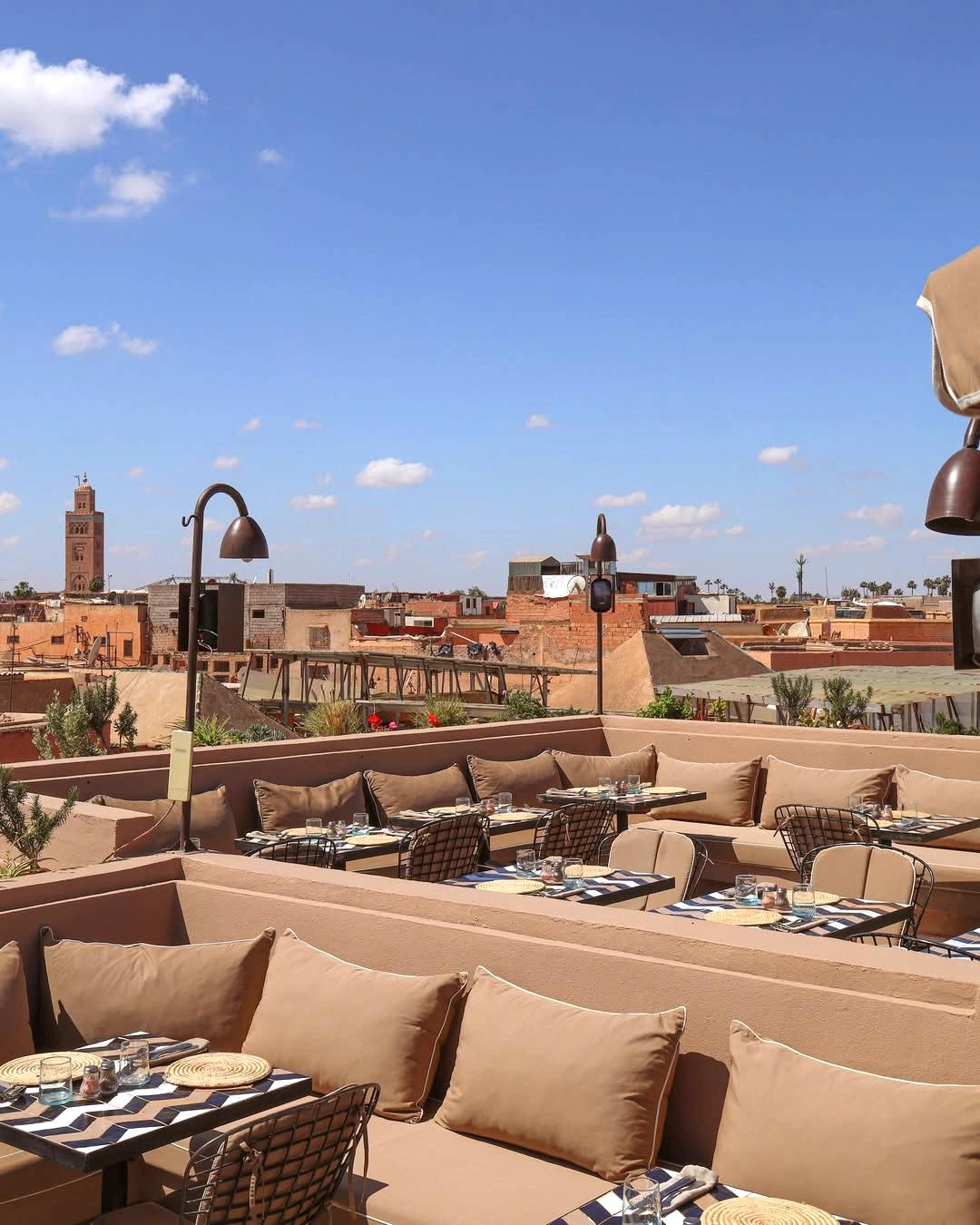
Above the spice souk at Rahba Kdima, Nomad opened in 2012 as one of the first medina addresses to apply a contemporary editorial lens to Moroccan ingredients without abandoning the sourcing logic of its location. Three floors, a rooftop with Koutoubia views, a menu that moves between Moroccan staples and Mediterranean borrowings: slow-cooked lamb shoulder, truffle briwat, chickpea fritters, roasted aubergine with harissa yoghurt. The kitchen is consistent, which is not guaranteed at every rooftop address in the medina. Nomad remains the reference for what the mid-range contemporary Moroccan register looks like when executed without compromise.
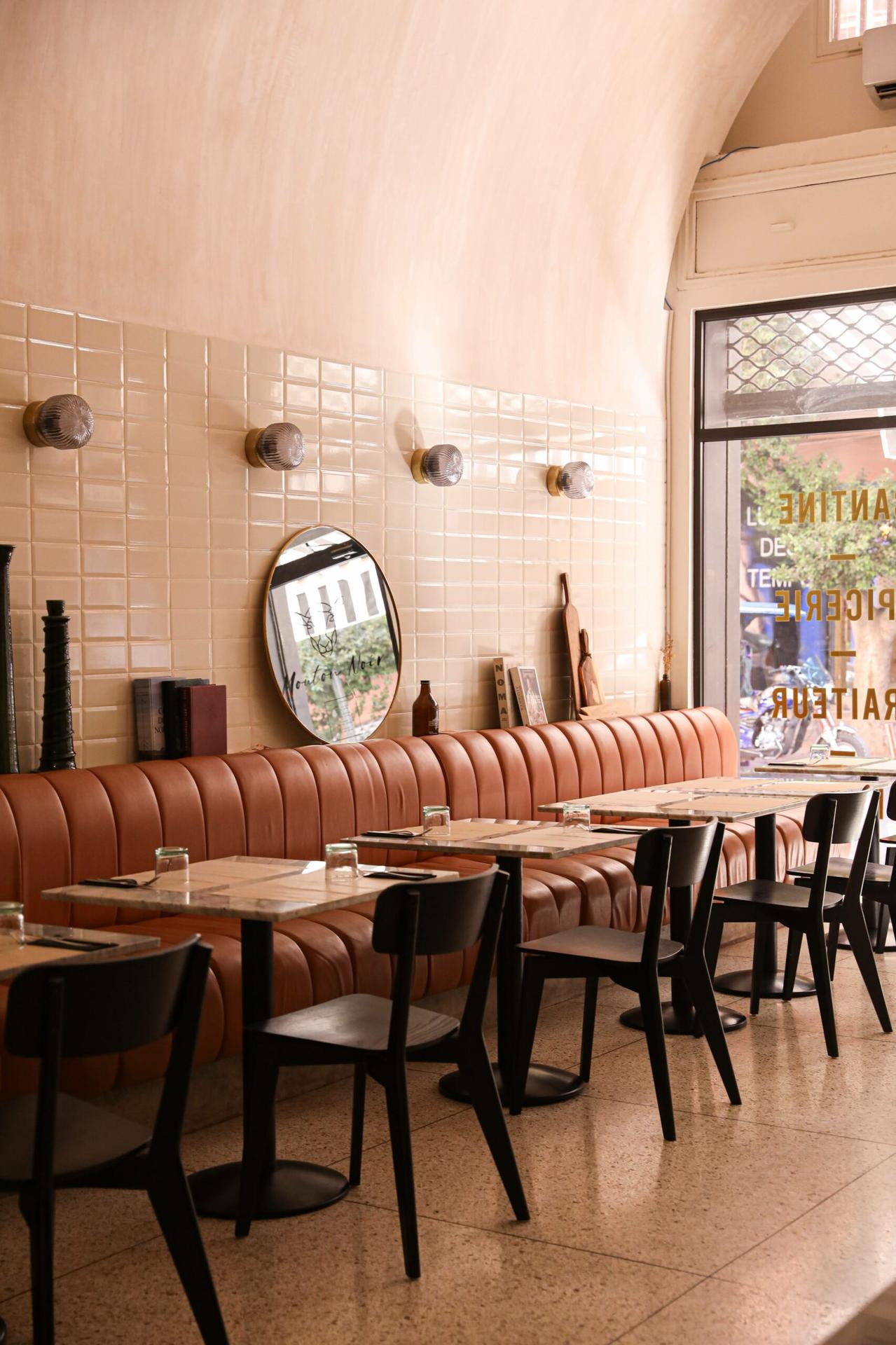
Founded in 2021 by Aniss Meski and Stacy O'Neill, a husband-and-wife team who brought Montreal's culinary sensibility to Gueliz, Cantine Mouton Noir arrived with a clear position: natural wines by the glass from a short considered list, a blackboard menu that changes with the market, no reservations, and a room small enough that the kitchen is always present in the experience. Meski trained in Montreal's kitchens before returning to Marrakech; the cooking reflects that formation. The 50 Best Discovery recognition arrived shortly after opening and reflected what the city's food community had already identified. The cooking is rooted in French bistro logic and open to wherever the produce leads: house-made terrines, seasonal gratins, dishes with a clear idea of what they are. No alcohol beyond the natural wine programme. The room fills quickly and does not take calls.
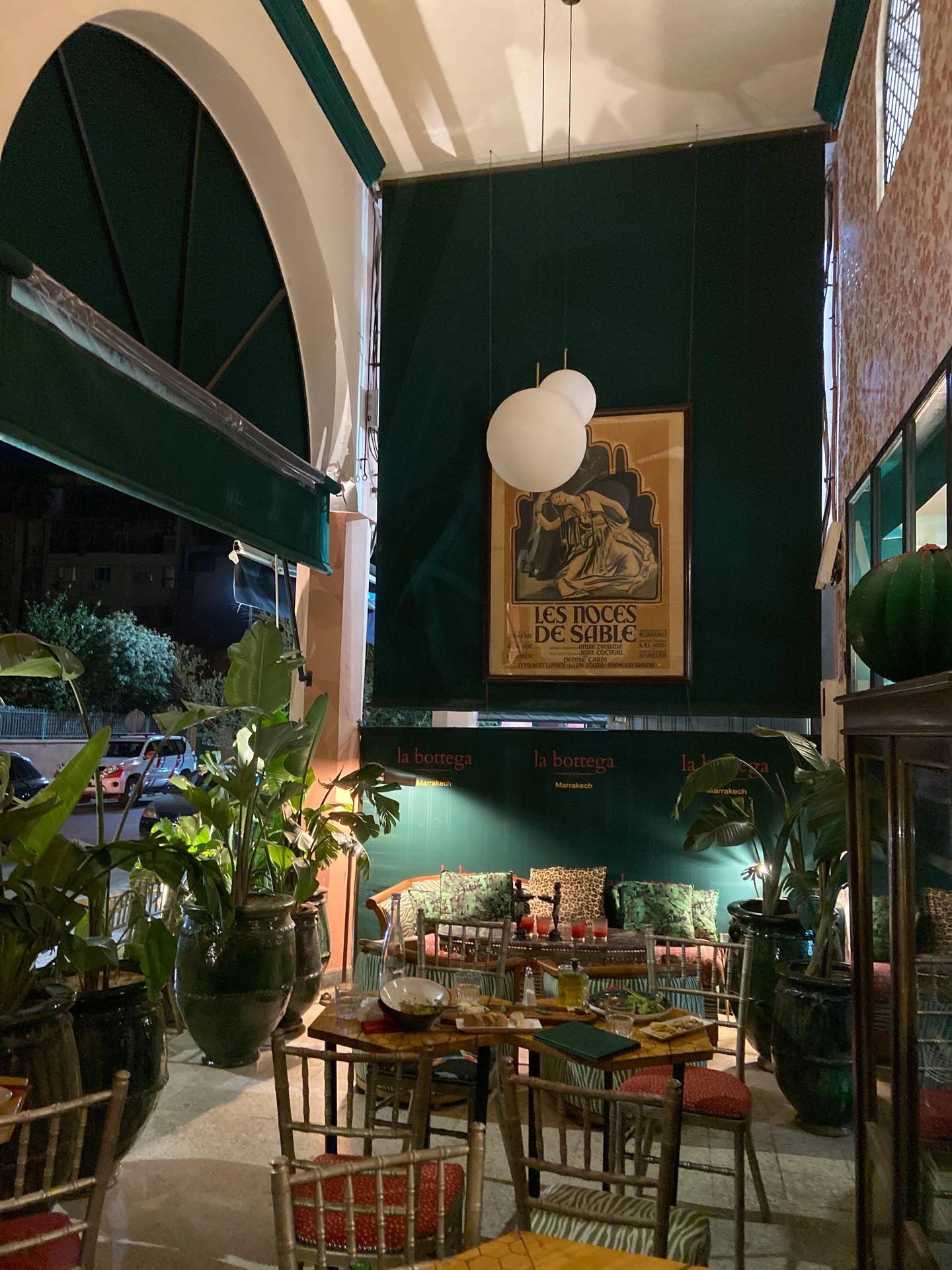
La Bottega occupies a ground-floor spot on Rue Imam Ali in Gueliz, opposite the Saints Martyrs church. The name means the shop in Italian, and the format follows: part restaurant, part epicerie fine, with shelves of imported Italian charcuterie, cheese, and dried pasta alongside the dining tables. Giancarlo Passaro and his partner Paolo run the place with personal warmth that makes the room feel like someone's home. The menu is traditional: burrata, stracciatella, bresaola, spaghetti with tomato, homemade ravioli with butter and sage, and a pasta selection that shifts through the week. Everything is made on-site; the house-churned gelato and the freshly made cakes are worth coming for on their own. No alcohol. For a neighbourhood Italian in Gueliz where the ingredients are real and the welcome is genuine, La Bottega is the benchmark.
€€€
The most active tier in Marrakech's current dining conversation: farm-to-table kitchens, French bistronomique tables, contemporary Moroccan, and international concepts with serious local sourcing. Between 50 and 100 euro per person, drinks excluded.
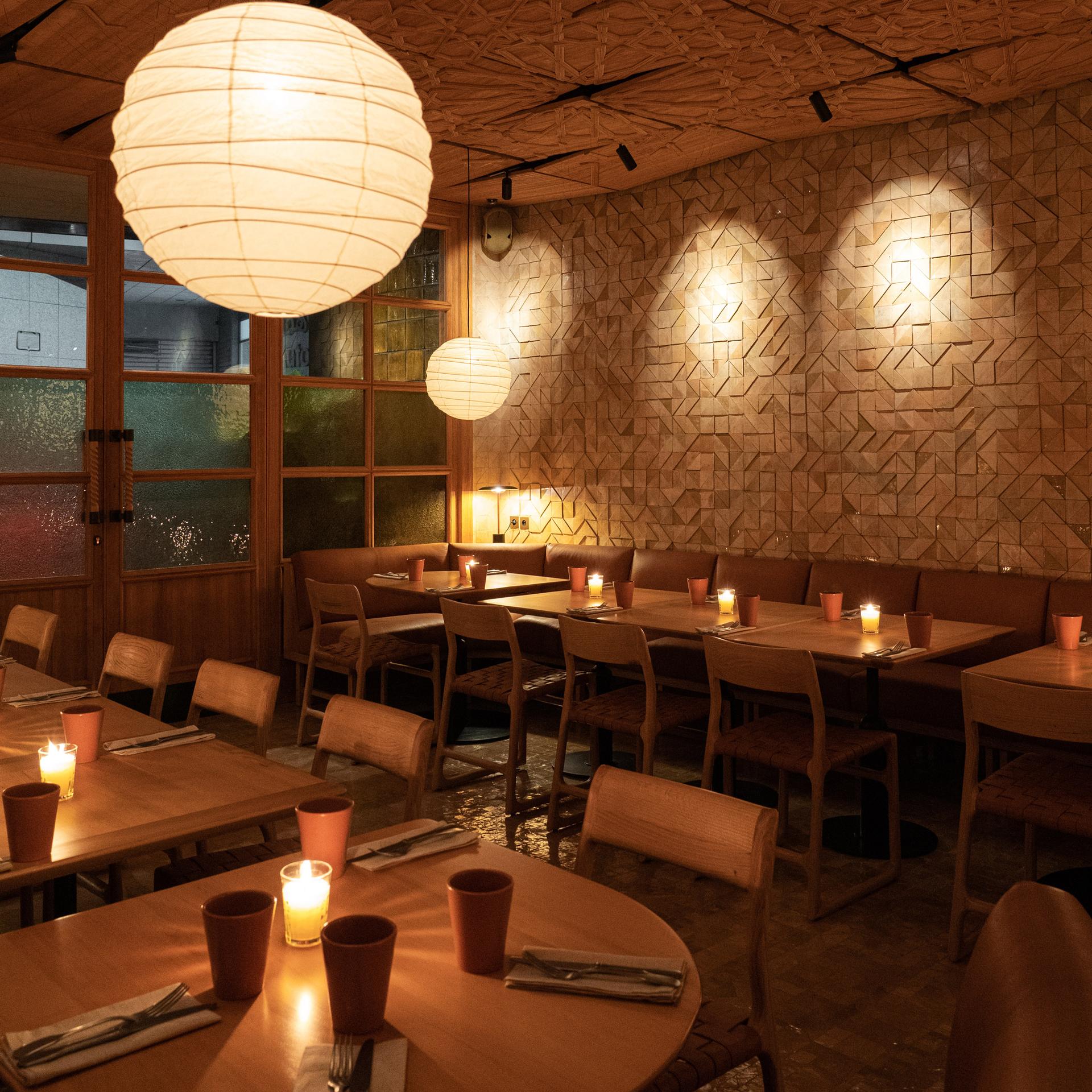
On Boulevard Mansour-Eddahbi in Gueliz, Sahbi Sahbi is a women-run restaurant in a Studio KO-designed space built around an open kitchen. The cooking is contemporary Moroccan with precision: dishes built from local produce, a menu that edits rather than accumulates, an attention to vegetables unusual at this price point in this city. The room is spare and deliberate, which means the kitchen carries the full weight of the experience. Reservations recommended.
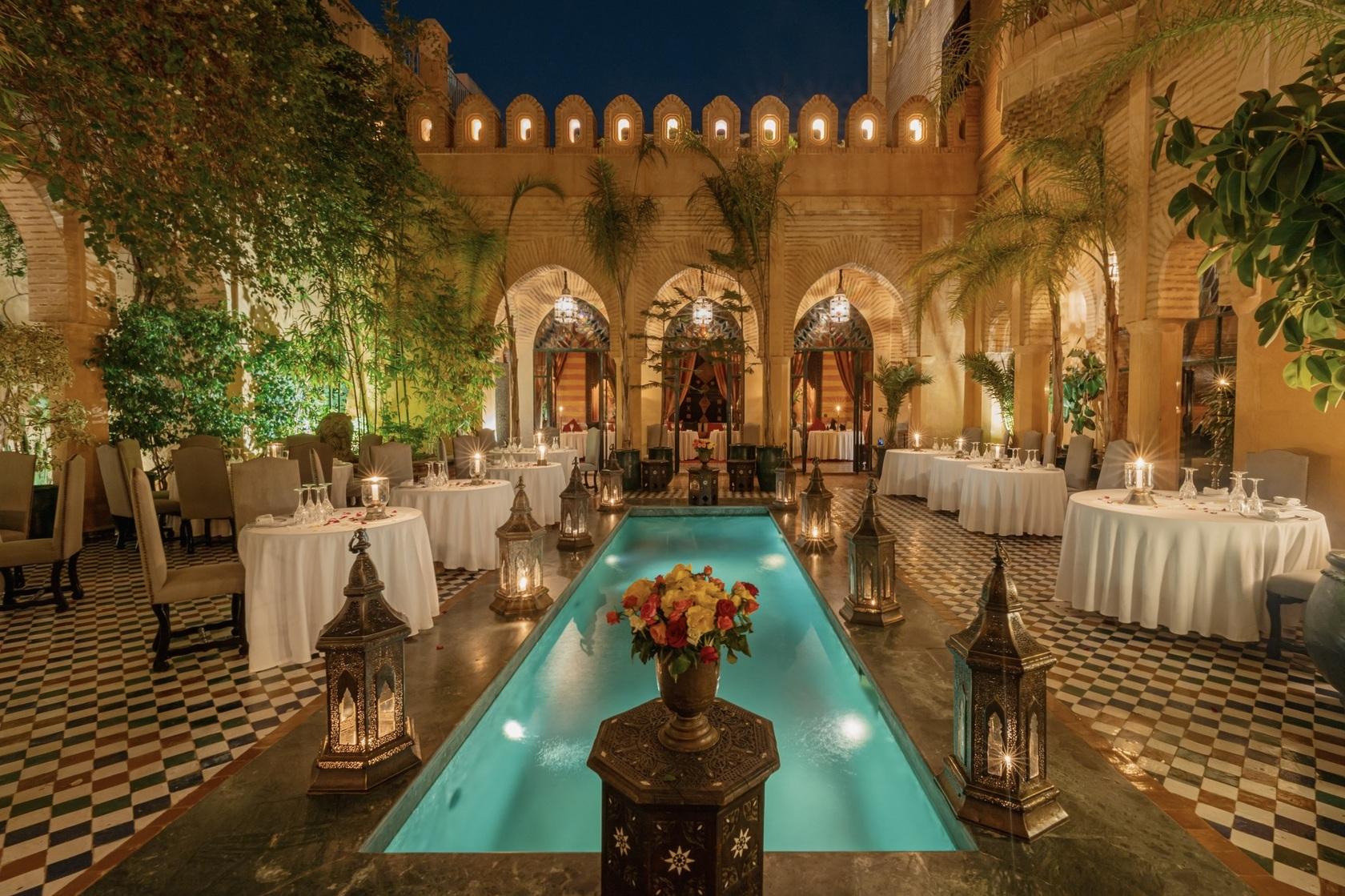
In a restored riad near Bab Doukkala, Dar Yacout has been the reference for the ceremonial Moroccan dinner since the 1980s. The interiors were designed by Bill Willis: carved plaster, zelliges, lantern-lit recesses, a visual vocabulary that has since been imitated without being equalled. The diffa, the full succession of salads, pastilla, tagine, couscous, mechoui, and pastries, unfolds to live Andalusian music on the rooftop terrace overlooking the Koutoubia. The address is a historical document as much as a restaurant, which makes it the right context for those seeking to understand the formal Moroccan table. The kitchen, directed by Mohamed Zkhiri, maintains the standards the room demands.
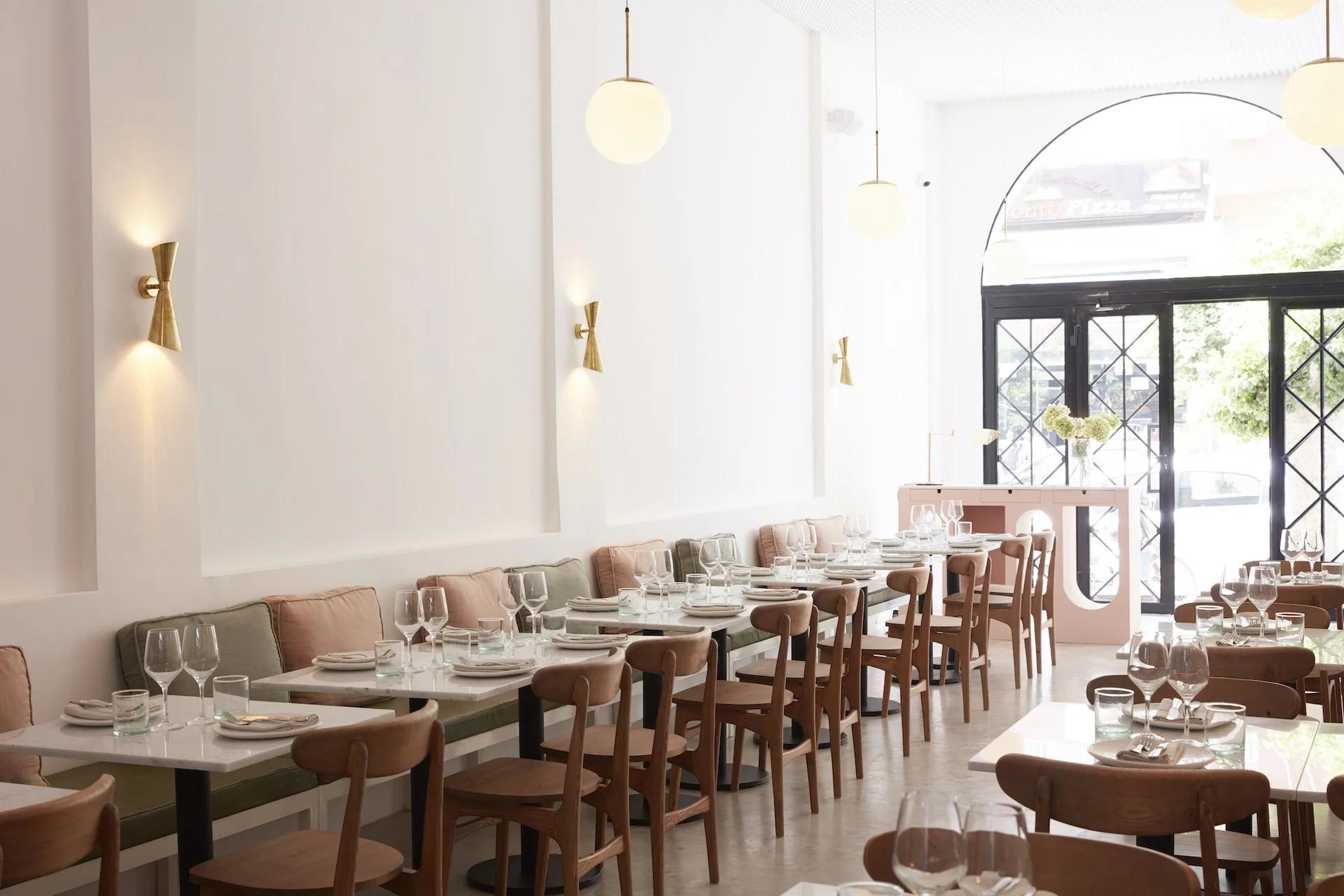
Named after Australia's international dialling code, Plus61 in Gueliz was founded by Cassandra Karinsky, Sebastian de Gzell, and chef Andrew Cibej on a clear premise: use what grows here, make what you need in-house, remove everything else. Bread, pasta, cheese, and yoghurt are produced daily in the kitchen workshop; suppliers are bio-organic farmers from the Marrakech region. The room was built with local artisans, in moss-green banquettes, blush marble, and brass sconces. The menu has no fixed logic beyond the produce: what the farm delivers with enough integrity to justify a plate. Ranked number 31 in MENA's 50 Best Restaurants 2026. Reservations are essential and open in advance.
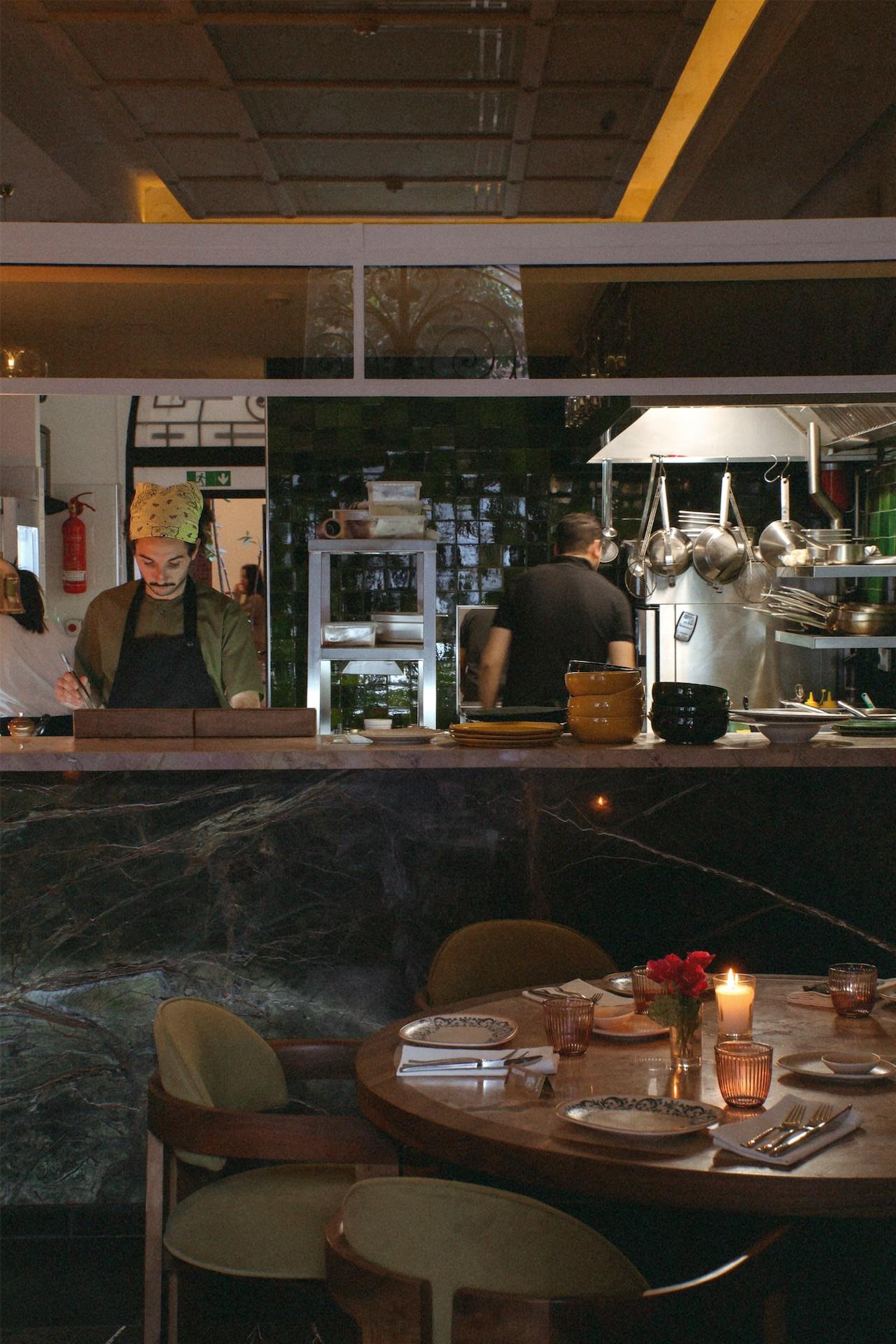
A farm-to-table restaurant in a renovated Art Deco arcade in Gueliz, Farmers is directed by chef Driss Alaoui, whose kitchen blends European technique with Moroccan terroir and builds seasonal menus from the harvest of the Sanctuary Slimane permaculture farm rather than from what can be sourced on demand. Opened in September 2024 and entered MENA's 50 Best at number 49 within its first year of operation. The constraint of farm-first cooking produces a specificity that shifts week to week and cannot be replicated elsewhere in the same form. The Art Deco space matches the kitchen's clarity of intent. Reservations need to be made well in advance.
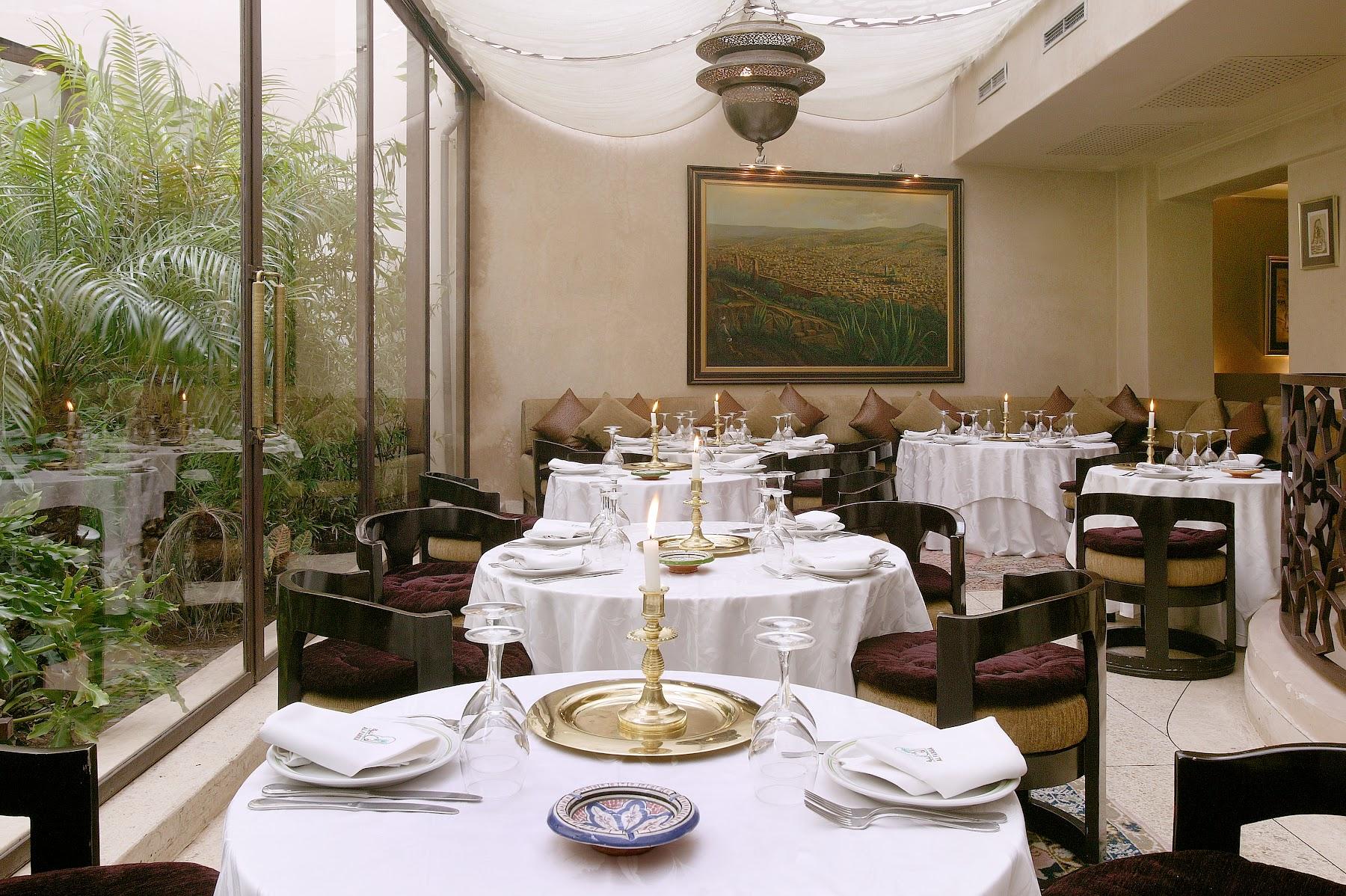
Al Fassia Gueliz has occupied its corner of Boulevard Mohamed Zerktouni for over thirty years, and its premise has not changed: an all-women kitchen and floor team, Fassi recipes from Fez cooked with the authority of those who own those recipes. The ten or more salads that open every meal are where the kitchen declares itself. Each is dressed, spiced, and composed differently; together they constitute a demonstration of a cuisine that operates with a logic most diners cannot fully map on a first visit. Then the pigeon pastilla, the slow lamb, the tagines balanced between sweet and acid through repetition rather than calculation. Al Fassia draws marrakchis alongside visitors, which remains the clearest evidence of what it is doing.
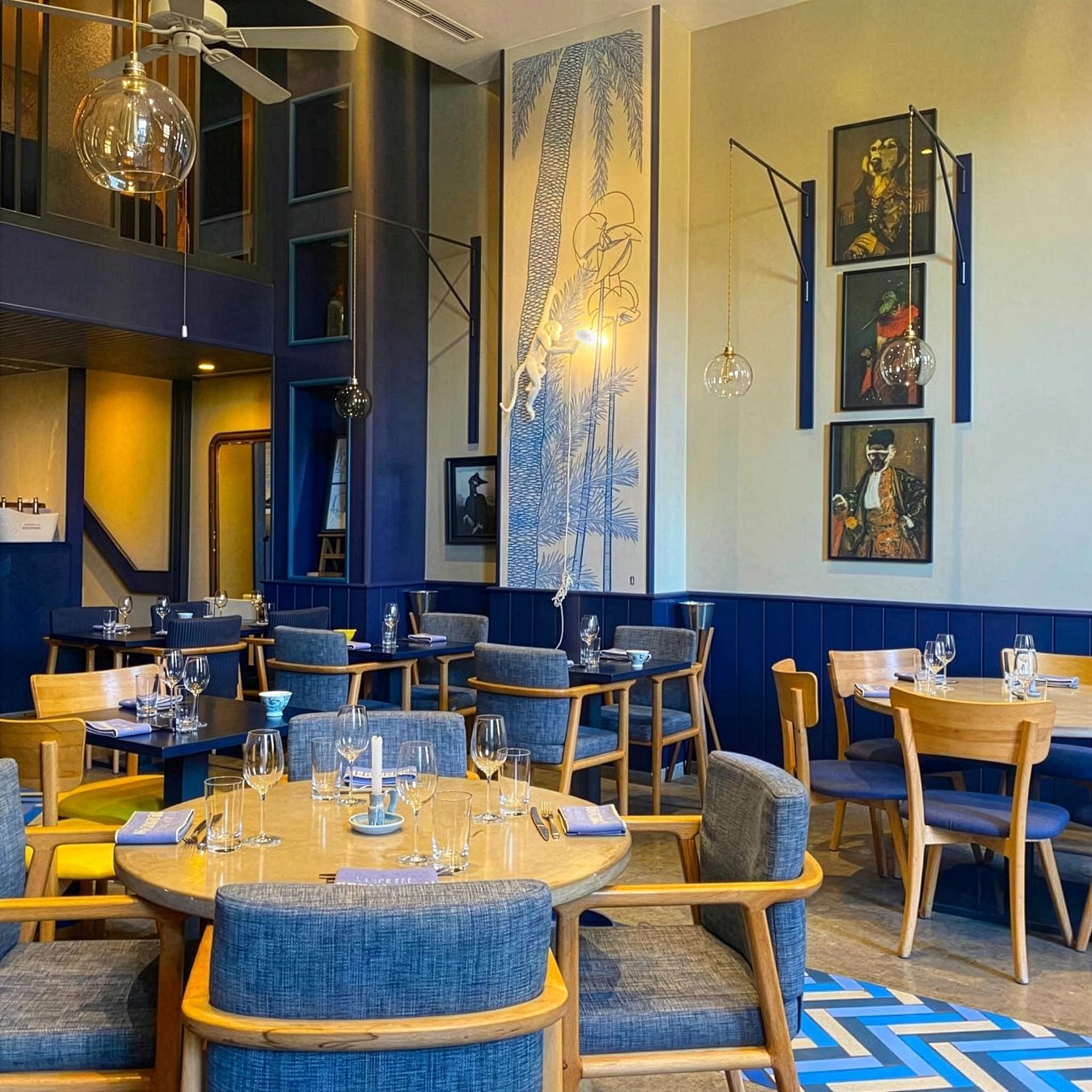
Ranked number 21 on MENA's 50 Best Restaurants 2026, Le Petit Cornichon on Rue Moulay Ali in Gueliz is built on a single idea: a French bistronomique table with a wine list of over 350 references and a kitchen directed by chef Erwann Lance that earns its position. No background concept, no design statement, no borrowed vocabulary. The cooking is precise and the sourcing is honest. Closed Saturday and Sunday, which removes the weekend tourist current and keeps the room consistent. The wine depth is unusual for Marrakech at any price point. Reservations open early and fill without notice.
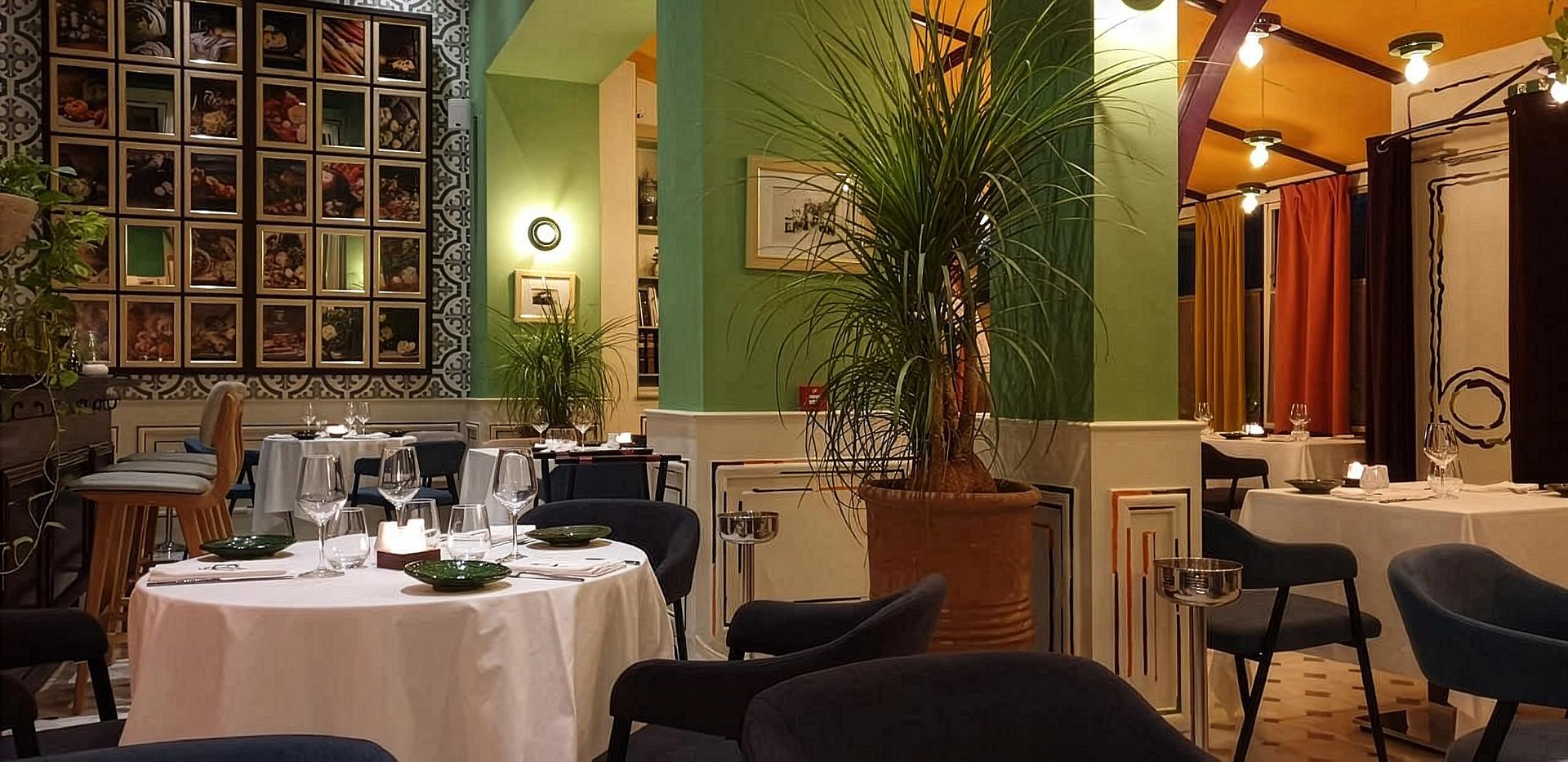
Alsatian chef Herve Paulus, who held Michelin stars at two restaurants in France before relocating to Marrakech in 2013, has been cooking on Rue Badr in Gueliz long enough to be embedded in the city's culinary memory. The seasonal menu runs French technique through local produce with no deviation from its own logic: sweetbreads with morels, hand-cut tartare, sauces built from actual reductions. The room, in vegetable-garden colours, is quiet in a way that concentrates attention on the plate. The lunch formula and evening carte represent among the most coherent value propositions in the city. Open Tuesday to Saturday. No showmanship, which in Marrakech is its own kind of distinction.
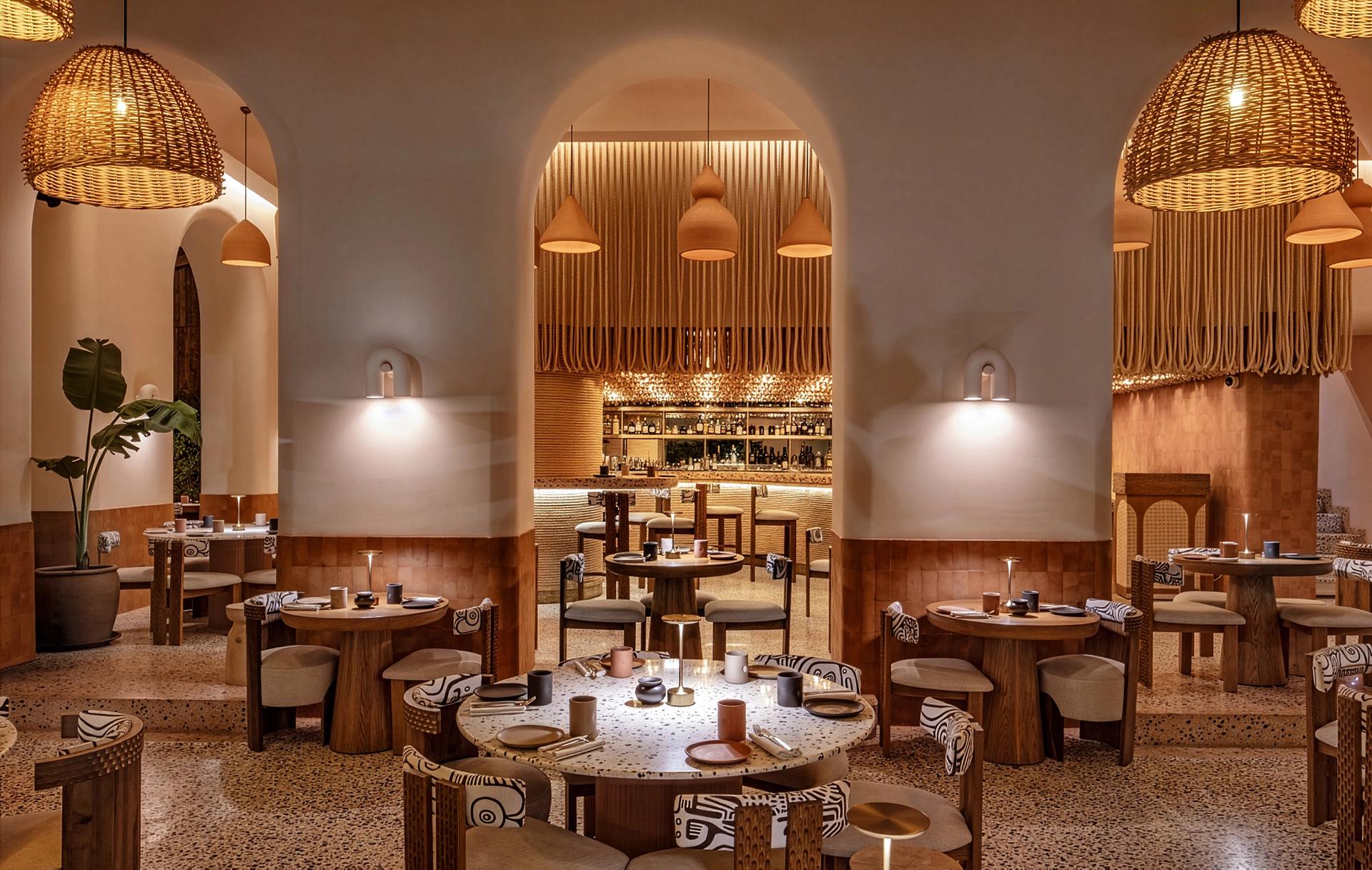
Designed by architect Yacine Sidali of YStudio on Avenue Mohammed V in Gueliz, Mizaan is the second restaurant from Simo and Omar, the pair behind L'Mida in the medina. Chef Abdel Alaoui works a Moroccan-Mediterranean-Levantine register in a space that understands how light and material function in this climate. The menu borrows from all three culinary traditions without privileging any one of them: Moroccan spicing, mezze logic, grilled proteins treated with the directness of a Beirut grill. The balance between the three sources of influence is the kitchen's most interesting argument. The room is among the best-designed mid-range interiors currently operating in Gueliz, and holds equally well at lunch and at dinner. Reservations recommended.
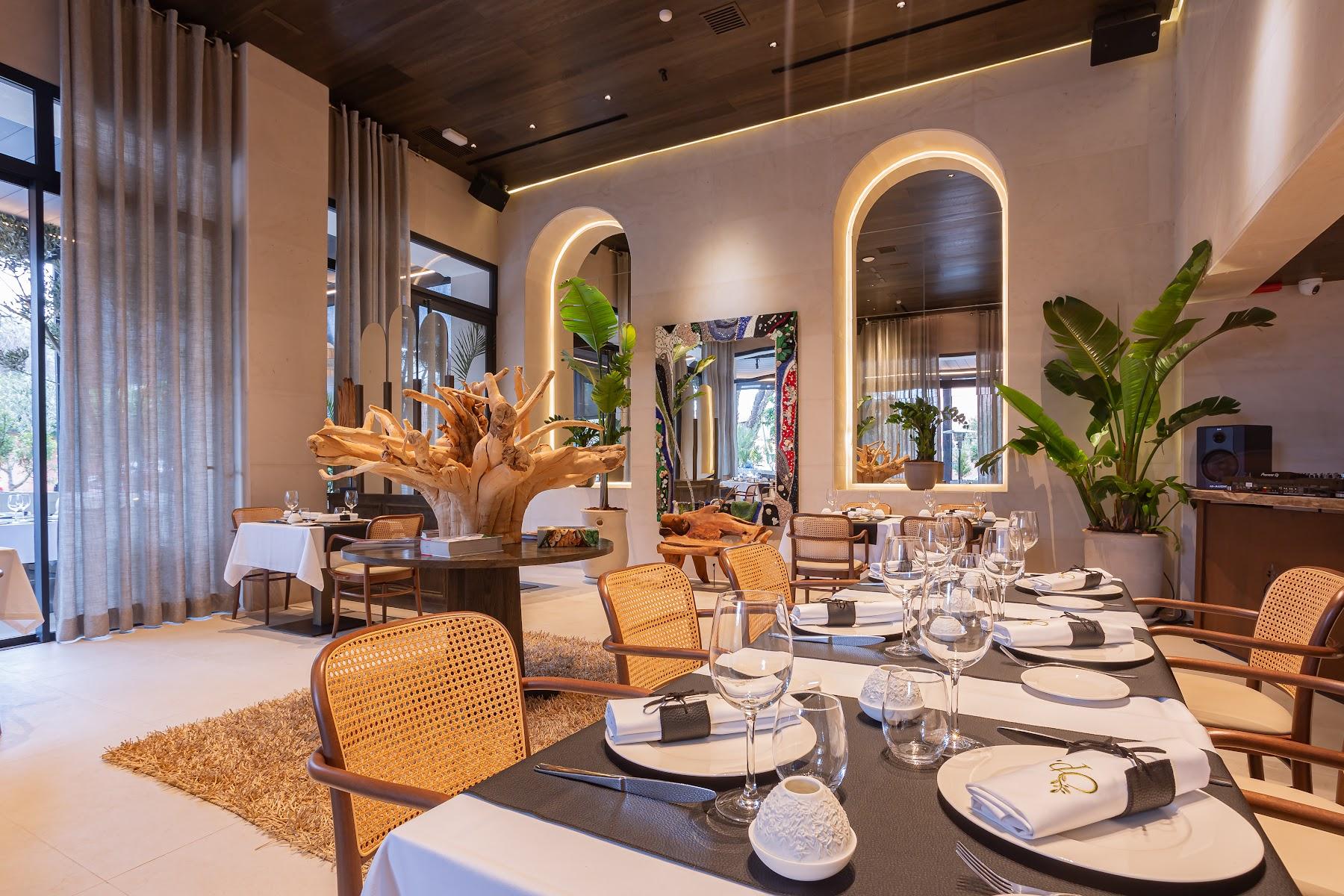
A bistronomique table in Gueliz, Restaurant MB applies the French bistro register to Marrakech with enough precision to hold its own. The room is plant-filled and calm; the kitchen works with the confidence of a chef who understands what a bistronomique meal is meant to do: build from quality ingredients, apply classic technique, remove excess. The lunch formula draws a local crowd; dinner is more deliberate in its pace. One of the most coherent representations of the French bistronomique tradition currently operating in Marrakech.
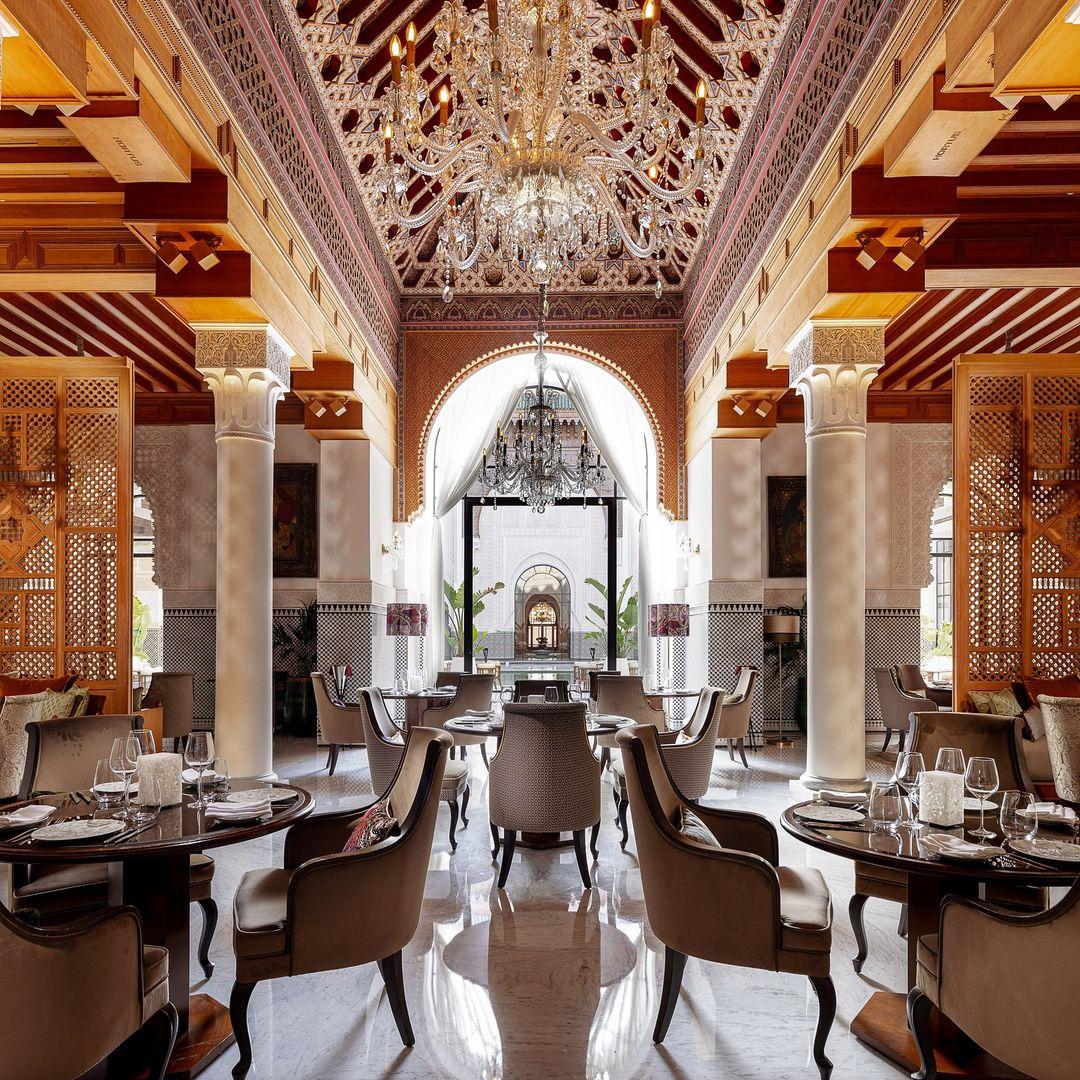
The Oberoi Marrakech's fine dining restaurant, directed by Michelin-starred chef Rohit Ghai, serves Indian cuisine in a room modelled on the Medersa Ben Youssef patio: carved plaster arches, a central water feature, lantern light after dark. Dinner from 7pm only. The menu covers regional Indian cooking with the technical rigour the Michelin recognition demands: slow-cooked curries, tandoor preparations, seafood dishes that carry both restraint and depth. Weekend evenings feature a Thali service that structures the meal as a sequence of small courses from different regional traditions. One of the few Indian fine dining rooms on the African continent operating at this level.
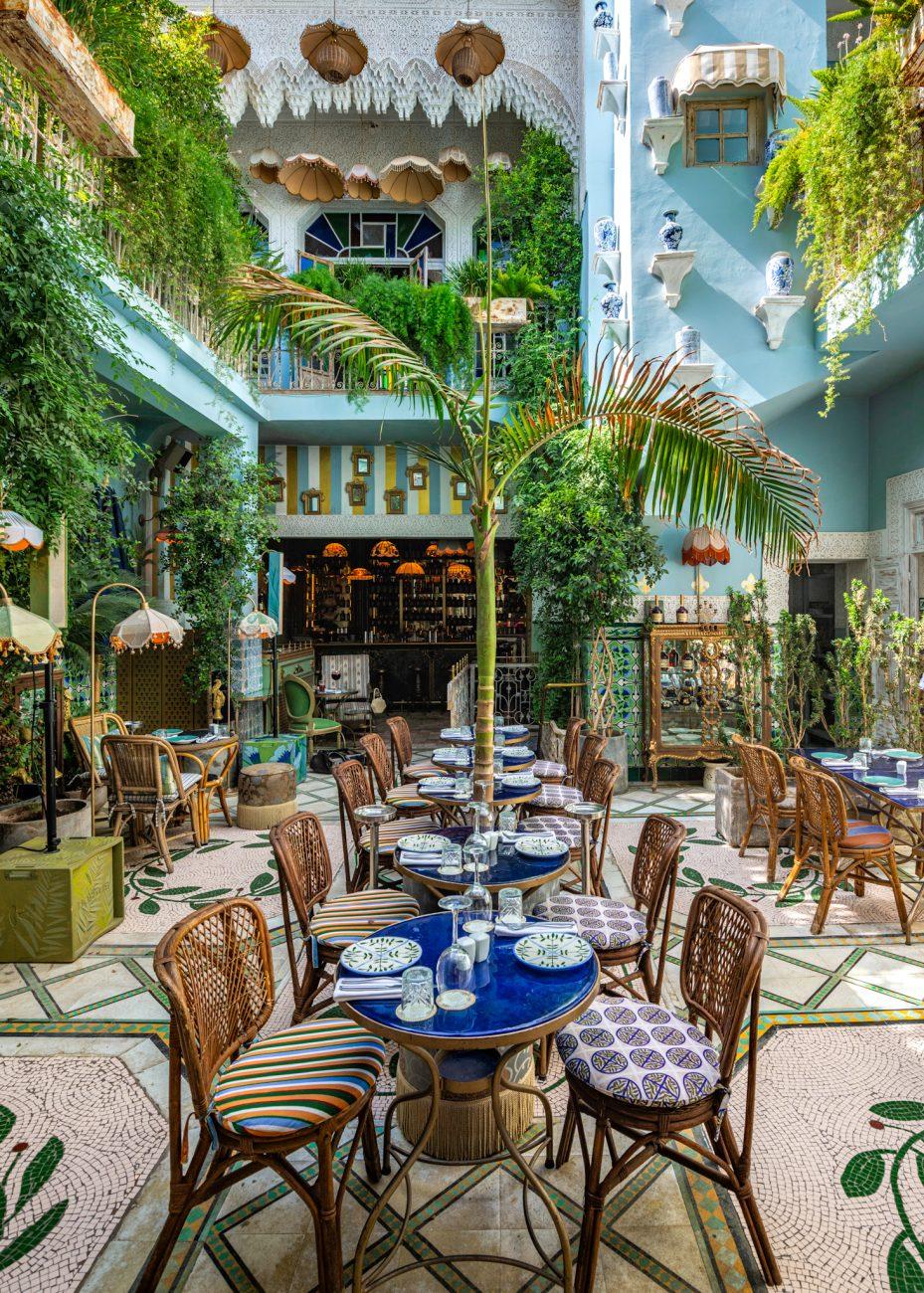
A 1936 family house near the Kasbah, restored by the Amazoz Group with hand-painted tiles, zellige floors, and carved plasterwork, Villa Aaron houses a Mediterranean-Moroccan sharing menu in a space that functions equally as a restaurant and an event venue. The kitchen connects Moroccan and Mediterranean registers without forcing a synthesis; the cocktail bar functions as a destination independent of the dining room. Private parking and full venue privatisation are available. A kitchen garden informs the seasonal menu.
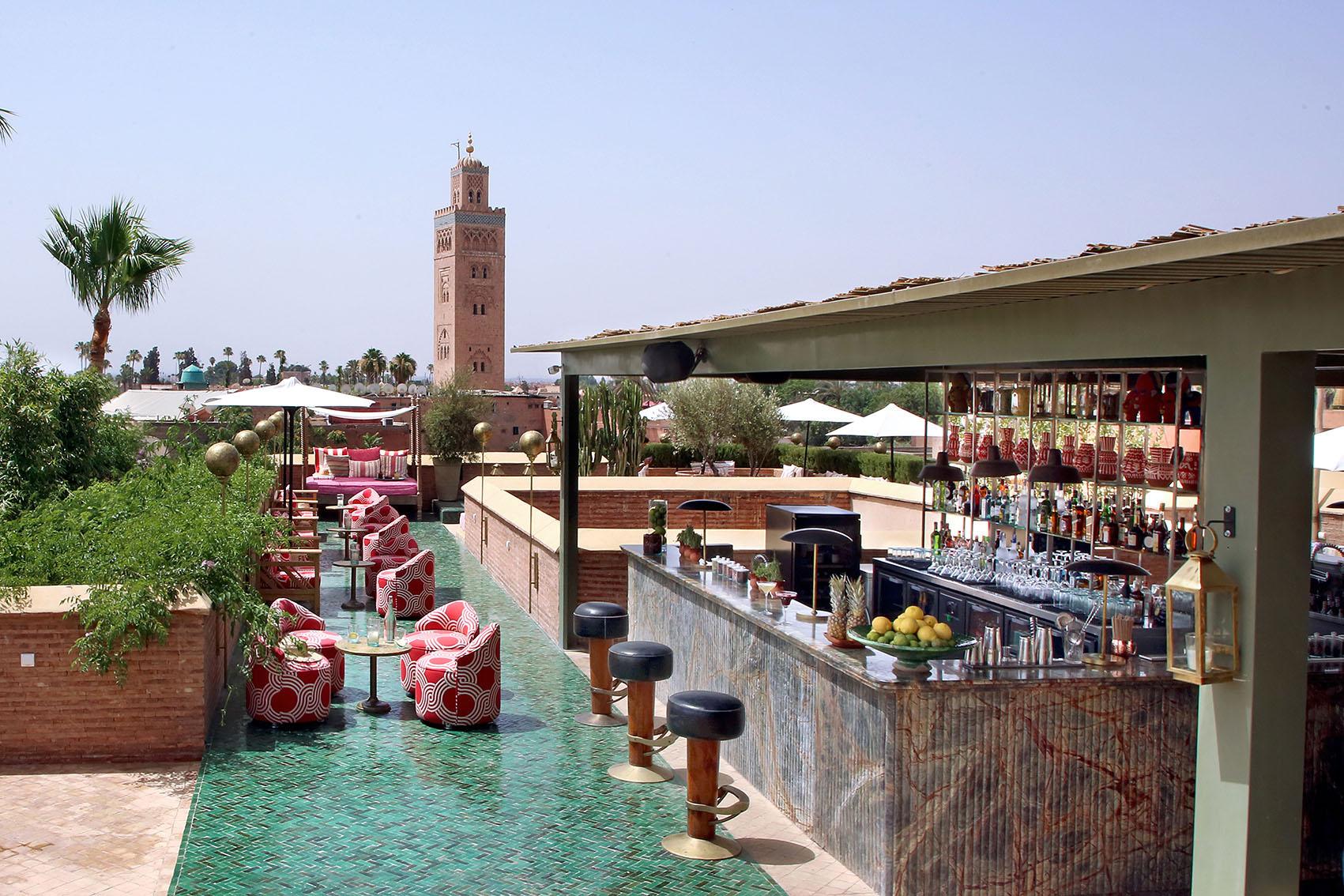
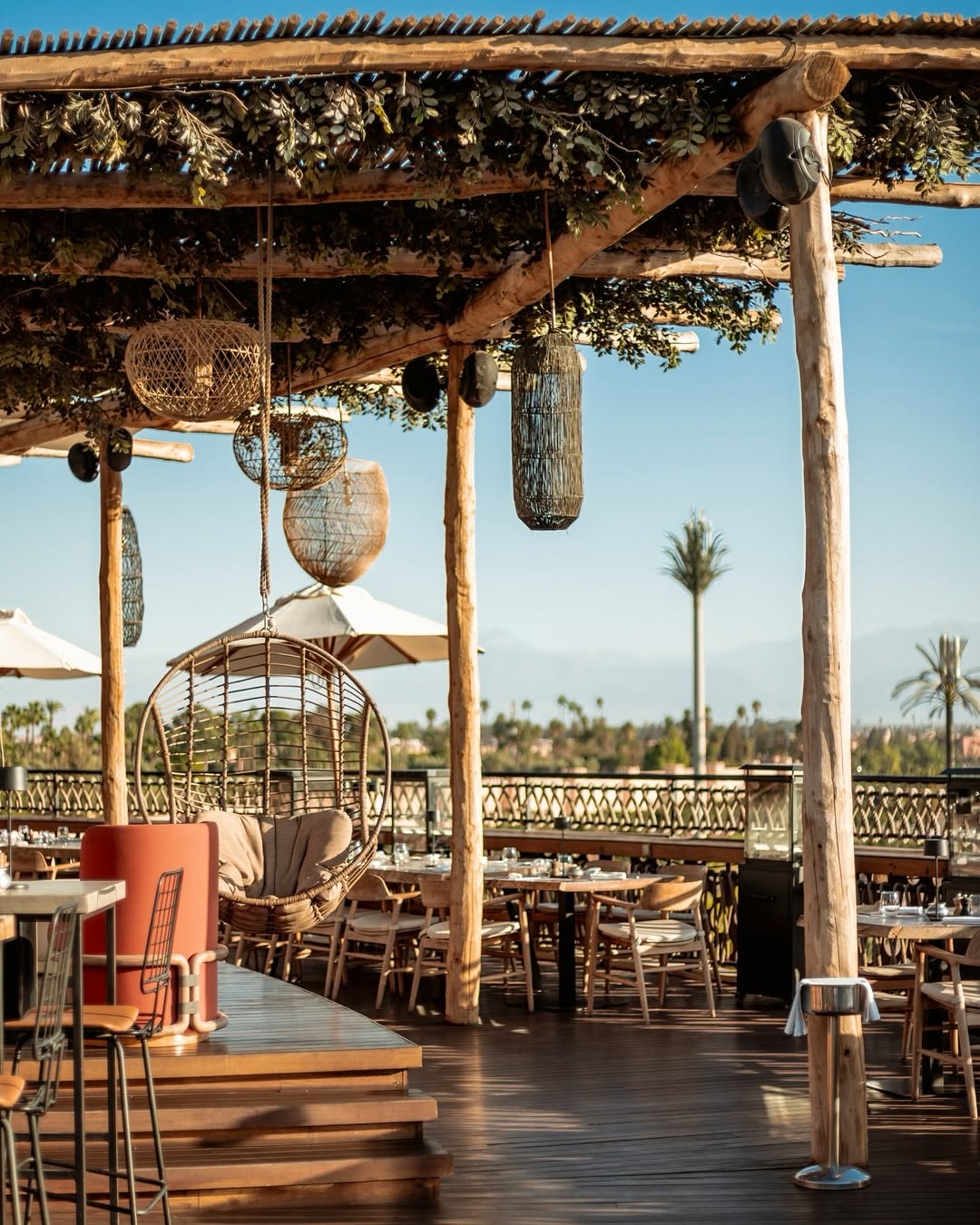
El Fenn occupies a sprawl of connected riads near Bab El Ksour, opposite the Koutoubia, and its rooftop restaurant is one of the few in the medina open to non-residents with genuine standing. The 1,300 square-metre terrace carries views of the minaret, the old city, and the Atlas; a 30-foot marble bar anchors the space. The kitchen works with local, seasonal, plant-forward cooking alongside meat and fish, sourcing from nearby farms and the medina's markets. The tone is relaxed throughout: no dress code, no ceremony. Non-residents enter through the boutique on Rue Lalla Fatima Zahra. Reservations required for the restaurant; the bar fills quickly at sunset and operates on a walk-in basis.
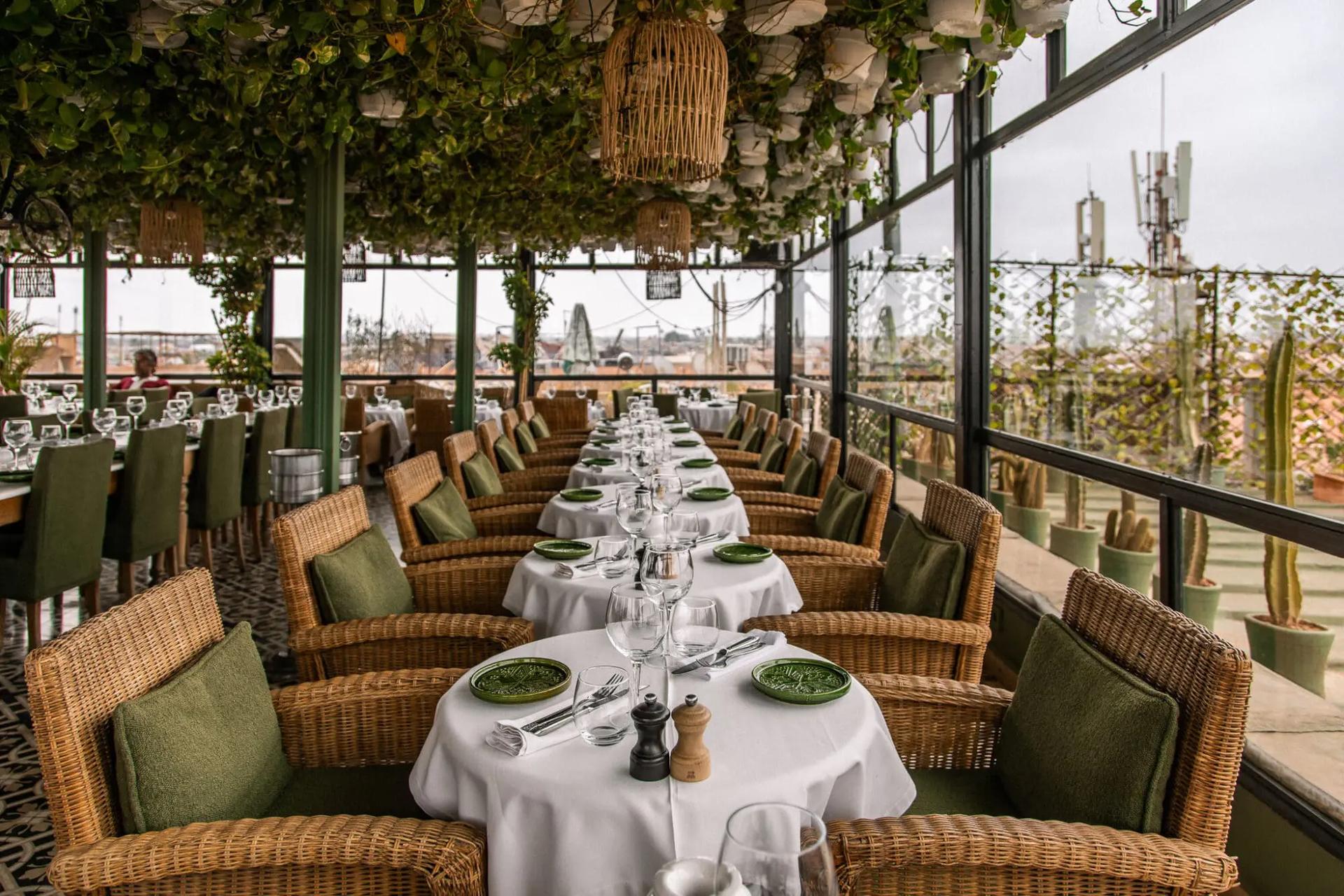
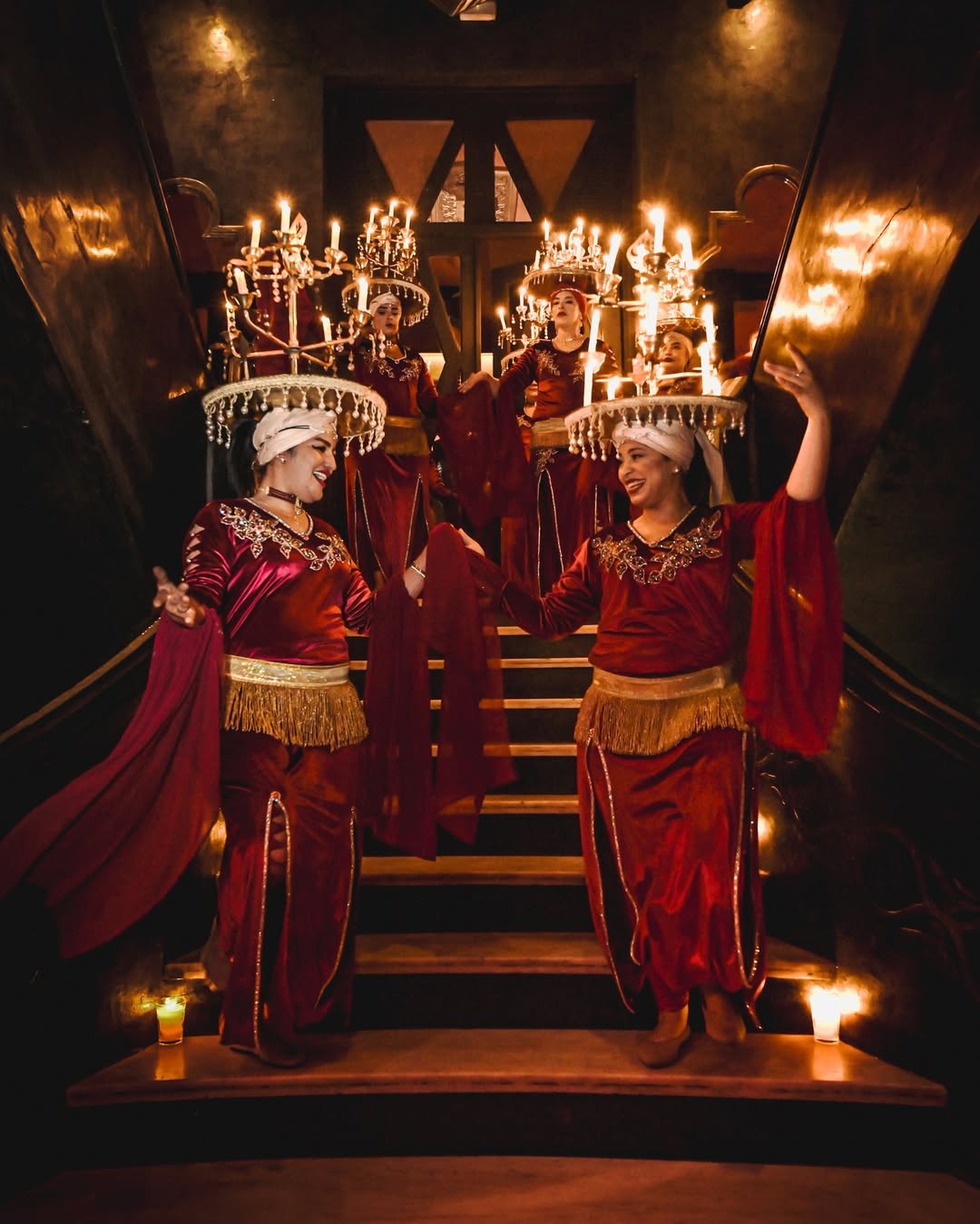
Nordine Fakir's Le Salama rises three floors above Rue des Banques, a narrow turning just off Jemaa el-Fna, and each level proposes a different register. The first two floors are a Moroccan restaurant in a colonial interior: moucharabieh screens, leather armchairs, live piano at the start of service. The tanjia marrakchia, slow-cooked in its traditional earthenware urn, is the plate to order. The lamb shoulder and the spread of kemias that opens the meal reward a slow pace and a full table. Above, the Sky Bar opens onto a panoramic terrace with unobstructed views across the medina to the Atlas. As the evening deepens, belly dancers move through the dining rooms and Le Salama shifts from restaurant to late-night destination without requiring a change of address. Open until 2am.
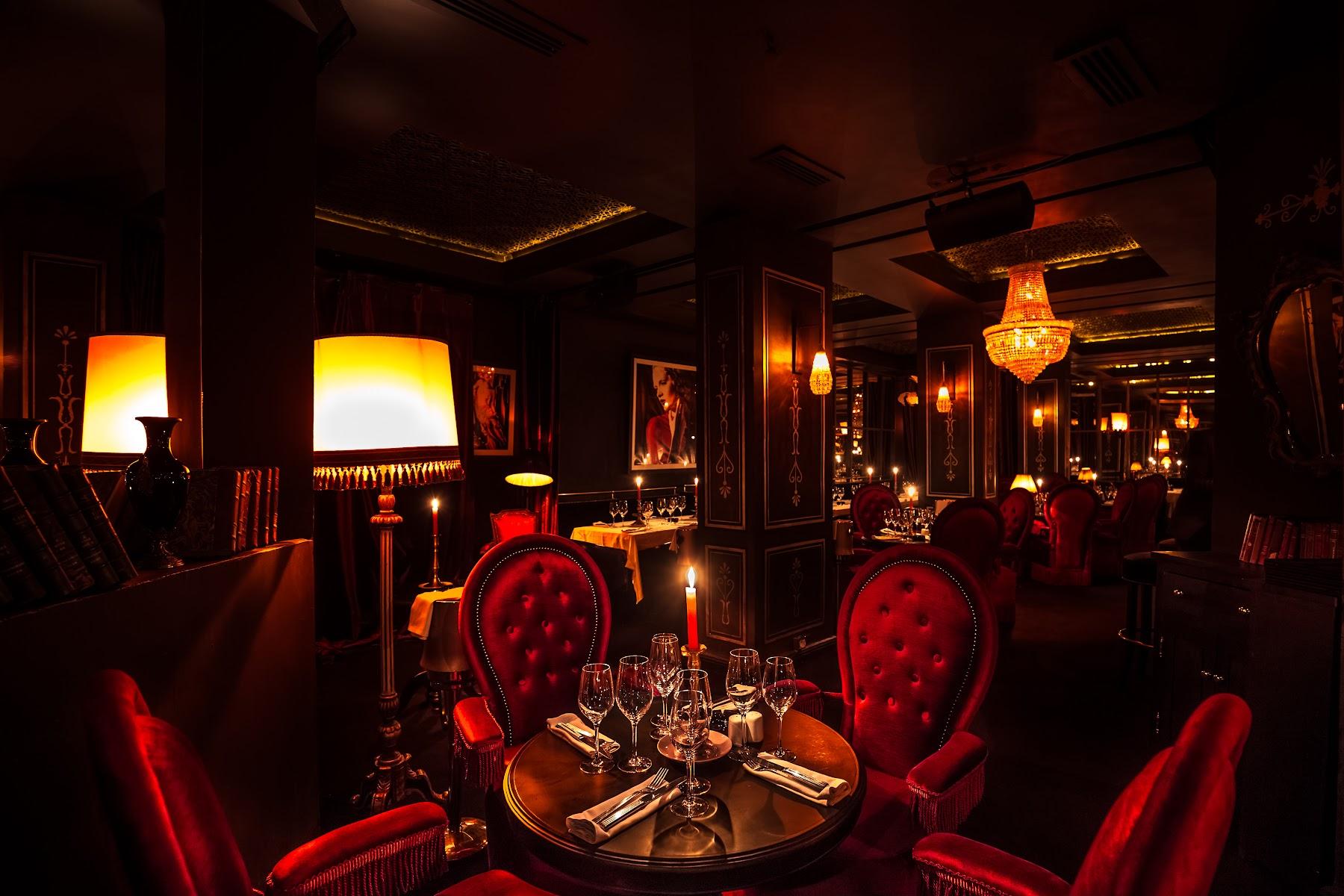
Le Palace occupies a prime stretch of Avenue Echouhada in Hivernage, the creation of local impresario Nordine Fakir: simultaneously restaurant, cocktail bar, and late-night destination. The ground floor is a colonial lounge with a mirrored bar, leather seating, a cigar corner, and deliberately warm, low lighting. The menu is French at its core with well-placed detours: the Crying Tiger steak, Thai-inspired with chili and fish sauce, has become the signature. Around it, the carte runs from tuna tataki through lobster linguini and Dover sole. As the evening deepens, a candlelit basement in crimson velvet and gilded mirrors, with black-and-white photographs of Yves Saint Laurent, shifts the atmosphere toward something closer to a private salon. A resident DJ, live singers between tables, champagne by the glass. It is not the place for a quiet tagine; it is where Marrakech goes when it wants to feel like somewhere else entirely.
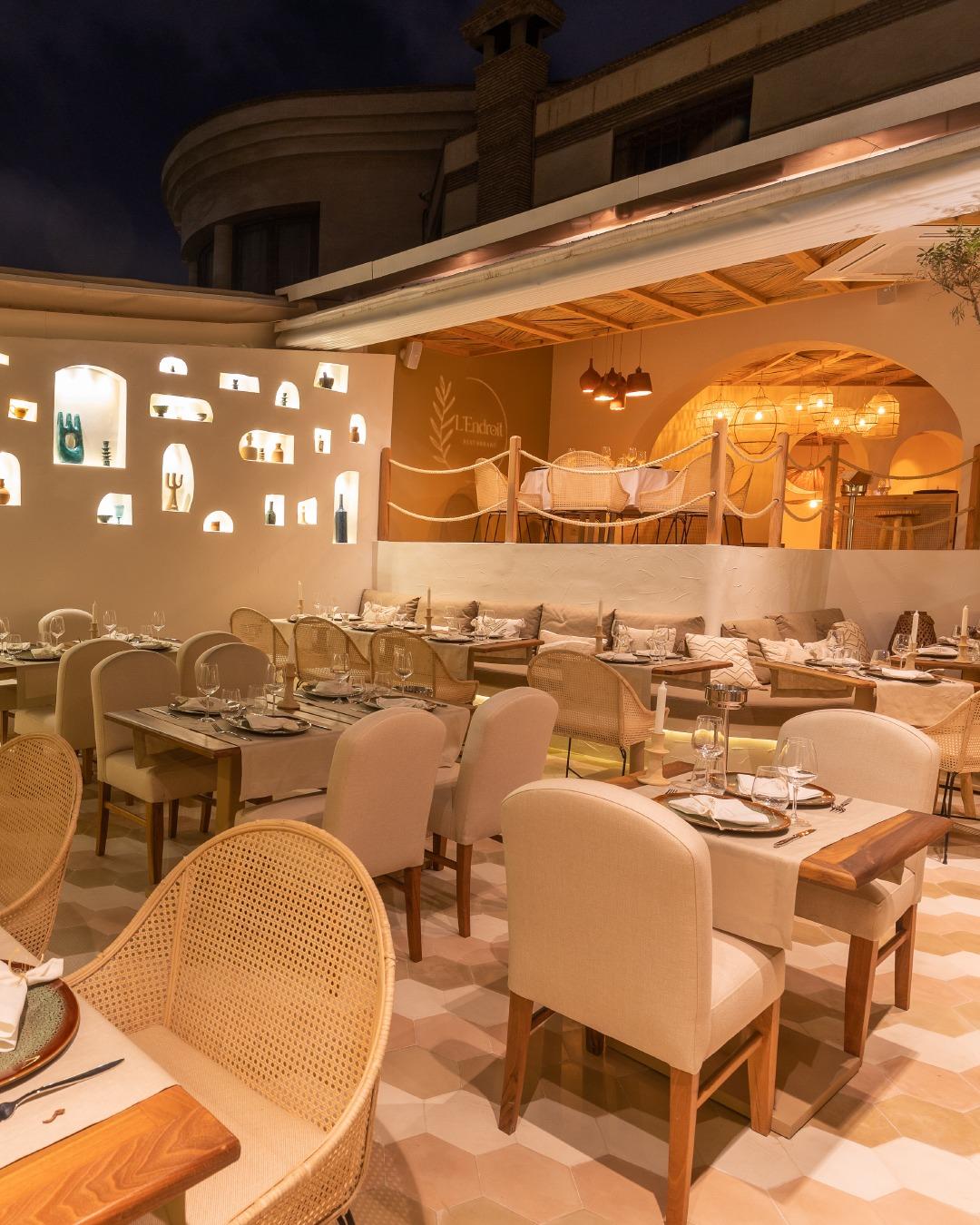
L'Endroit occupies a corner site in Hivernage just off Avenue du President Kennedy, with a large central bar, a sheltered terrace under a retractable roof, and a series of dining areas that break the room into distinct pockets. The kitchen belongs to Jean Emmanuel Christ, a Toulon-born chef who spent over twenty years cooking in Marrakech before opening this address. His focus is the sea: sole meuniere, monkfish bourride, lobster pasta, a proper bouillabaisse, oysters raw and gratinated. The sourcing is rigorous and the cooking sits in a confident register between bistronomie and something more refined, without tipping into formality. Desserts follow a southern French instinct: tarte au citron, oeuf a la neige, crepes Suzette. In a city where Mediterranean restaurants can feel generic, L'Endroit has a clear point of view and the technique to back it.
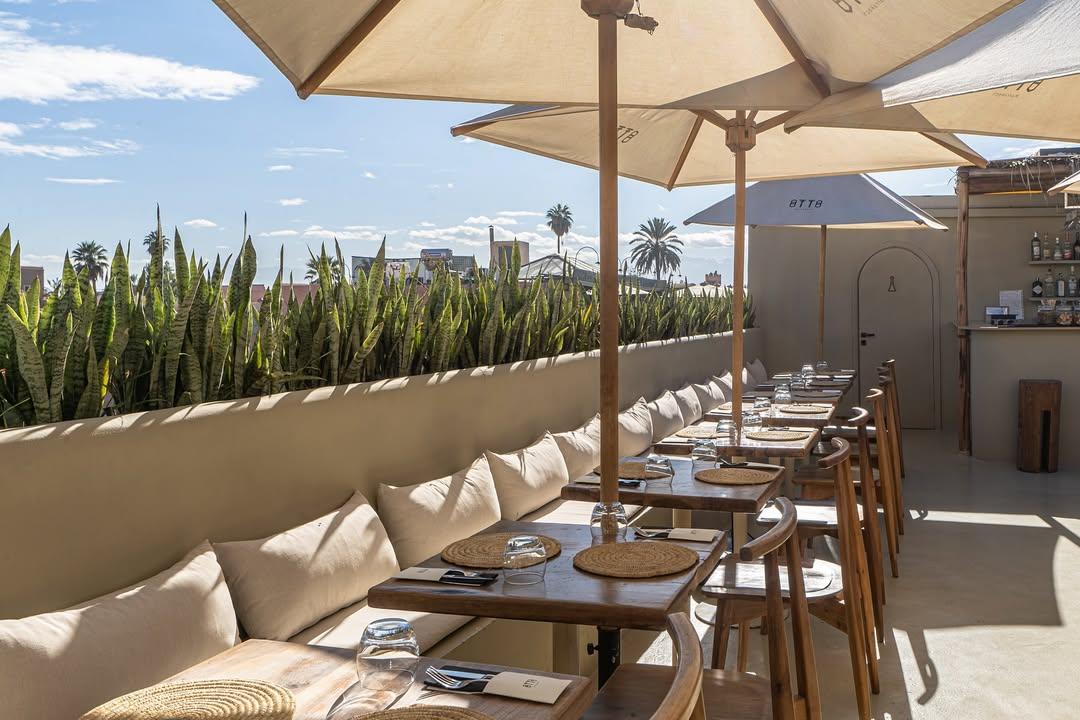
Otto sits a few steps from the Bahia Palace on Rue Riad Zitoun el Jdid, rising through a medina building to a rooftop terrace with an unobstructed sightline to the Koutoubia. The design is strikingly minimal for a building in the medina: neutral tones, clean surfaces, soft lighting. In a city that tends toward ornament, the restraint is itself a position. The kitchen works an Italian-Moroccan line through the Mediterranean: black risotto with scallops, grilled octopus with citrus mayonnaise, pistachio-crusted tuna, ravioli with ricotta and lemon zest. The cocktail programme includes inventive non-alcoholic options. After sunset, when the Koutoubia illuminates against the night sky, DJs shift the terrace toward a more social register.
€€€€
Hotel dining rooms where the estate, the garden, or the grounds become part of the experience: full-evening formats with service architecture designed for the setting, from palace riads to equestrian estates. Between 100 and 150 euro per person, drinks excluded.
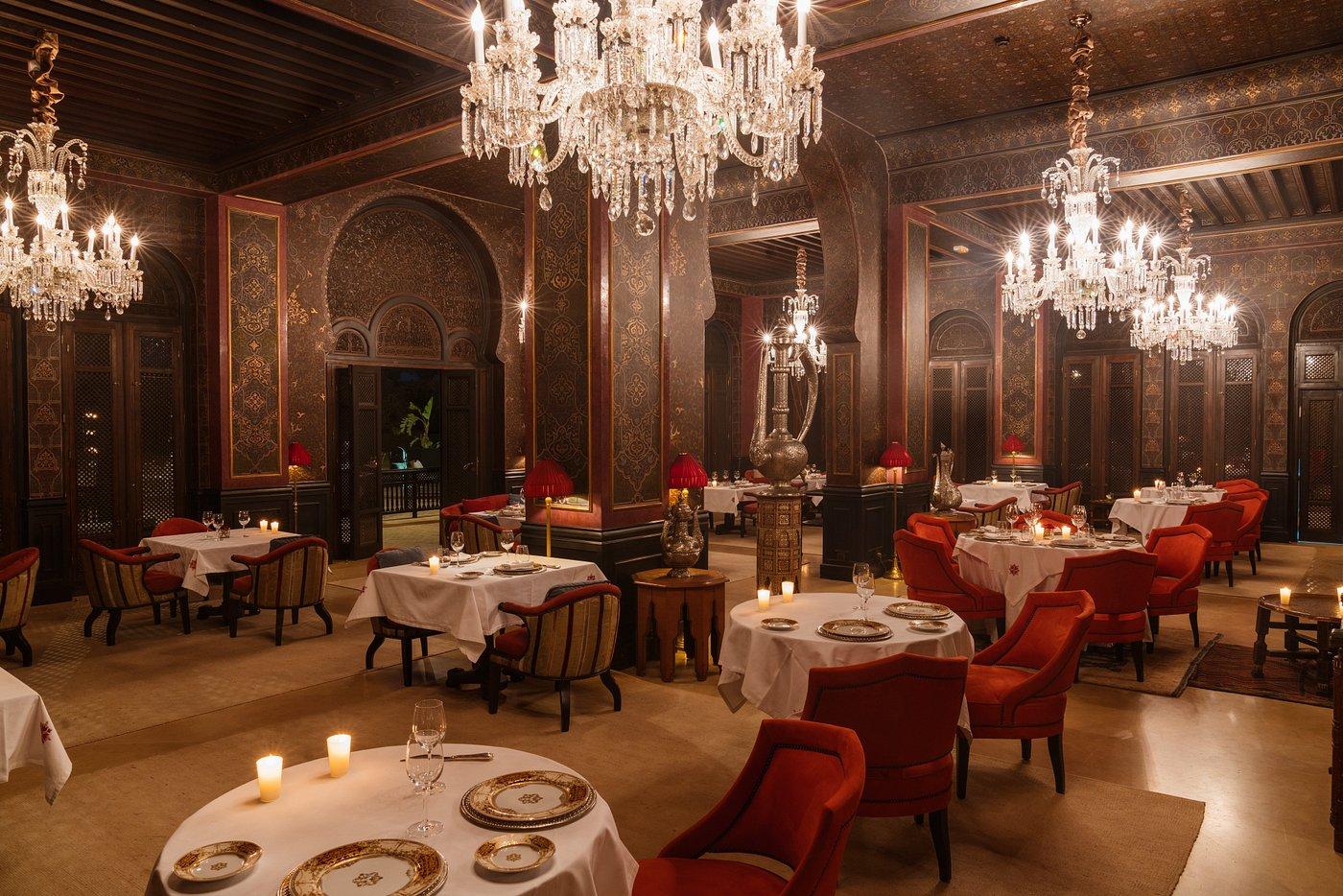
Selman Marrakech's Moroccan restaurant operates Monday to Saturday from 7:30pm with an all-female kitchen brigade, Ottoman-inflected decor, and live Andalusian musicians through service. The horse parade on the estate at dusk, Selman's purebred Arabians exercised along the circuit in view of the terrace, adds a dimension to the arrival that no urban address can replicate. The cooking is ceremonial Moroccan at the precision a hotel of this standing demands: pastilla, slow-cooked meats, salads arriving in sequence. The setting, the music, and the brigade are collectively the experience. Advance reservation is essential.
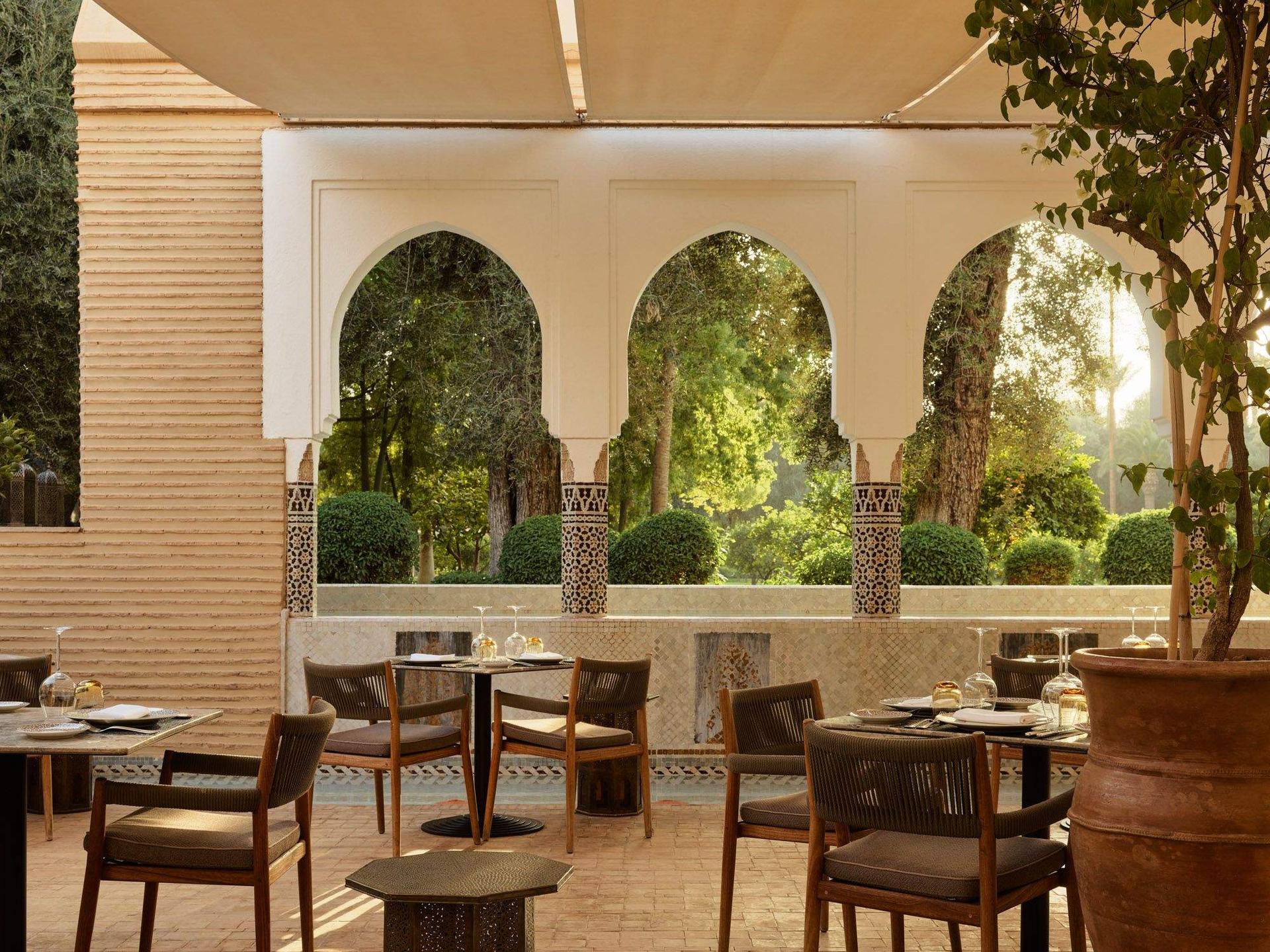
Deep in the Mamounia gardens in a lantern-lit riad, Le Marocain has been the hotel's Moroccan table for over thirty years. Chef Rachid Agouray's kitchen draws from the hotel's kitchen garden and moves between classic tagines and signature refinements, including a lobster pastilla that has become the address's most cited dish. Pierre Herme contributes to the pastry programme. Andalusian musicians play beside the courtyard fountain through the service. The architecture, the music, and the cooking produce a meal that functions as a complete sensory event. The walk through the Mamounia gardens to and from the riad is not incidental to the experience.
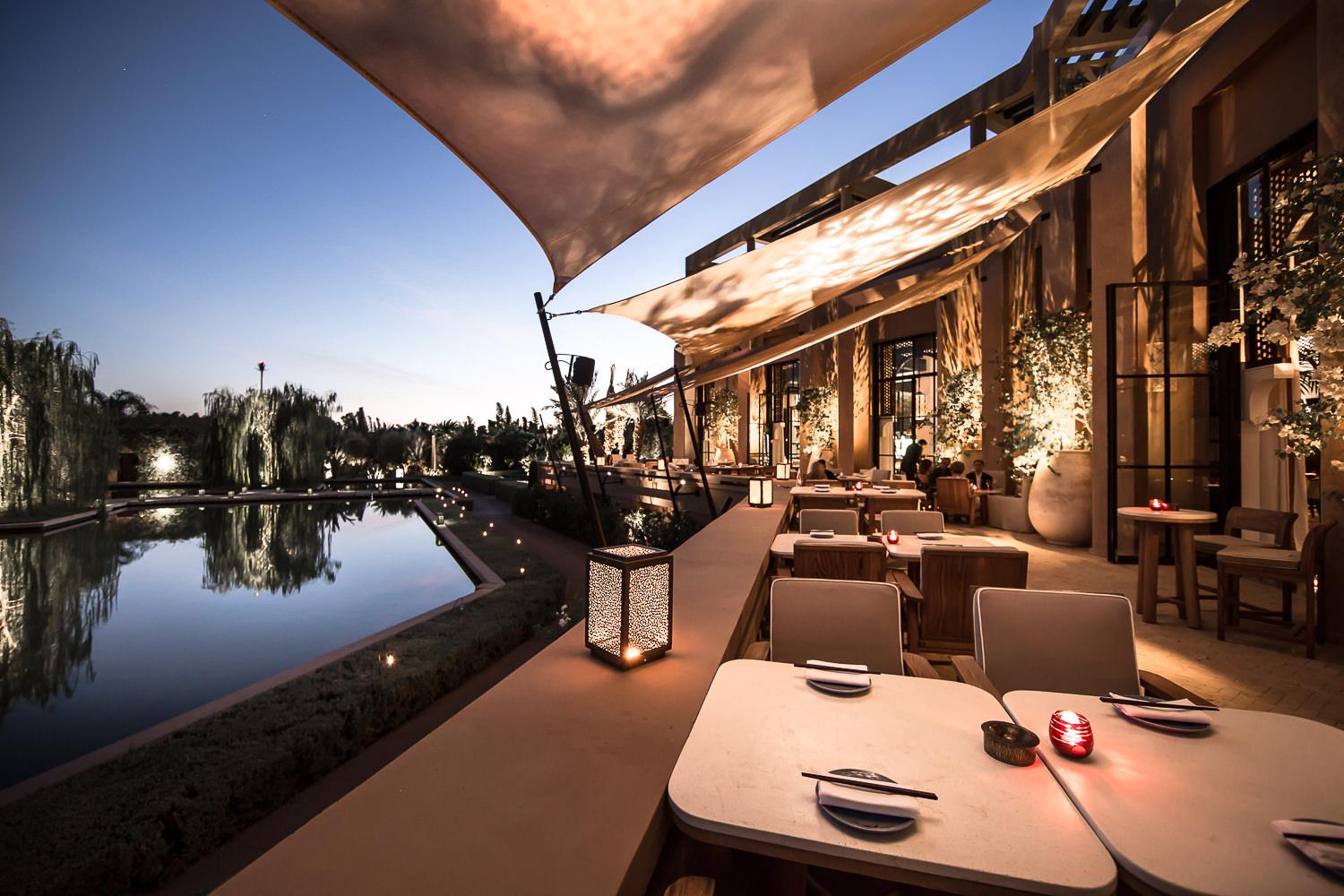
The Hakkasan group's Ling Ling concept at Mandarin Oriental Marrakech sits on the edge of an olive grove terrace on the Route de l'Ourika, a setting that shifts the familiar Hakkasan register into something specific to this property. Modern Cantonese sharing plates, a cocktail bar that functions independently of the table. The space was designed to allow the transition from dinner to late evening without requiring a change of address. Chef Hengfei Li's menu follows the Hakkasan sharing logic: dim sum, large plates for the table, a wine and cocktail programme calibrated for a long evening. One of the most coherent luxury social dining formats currently operating in Marrakech. On selected evenings, Othman Kabbadj takes over the entire restaurant for a hidden party: worth knowing about before you go.
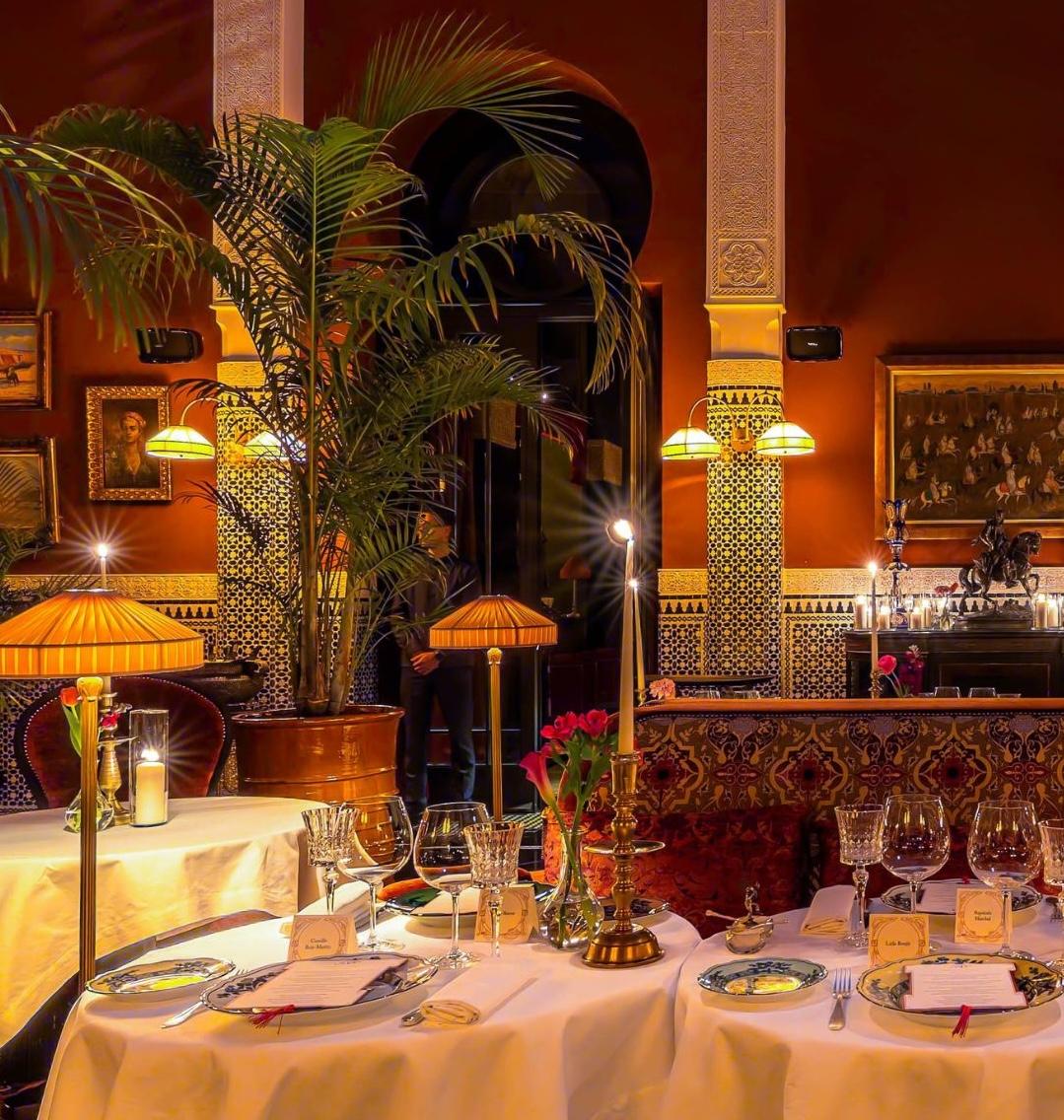
Jean-Francois Piege's evening restaurant at Selman Marrakech operates under a retractable roof that opens to the Atlas sky on clear nights, in a dining room by Jacques Garcia: zelliges, carved plaster, Ginori porcelain, Belle Epoque references carried without irony. The menu is French classicism in contact with Moroccan produce: tableside tartare, wood-fired sea bass, Oualidia prawns flambeed in cognac, a cheese trolley, a pastry programme of equivalent seriousness. The Selman estate, with its thoroughbred stables and quiet grounds, provides a spatial context that urban hotel restaurants cannot achieve. Sabo is one of the most complete fine dining experiences currently available in Marrakech.
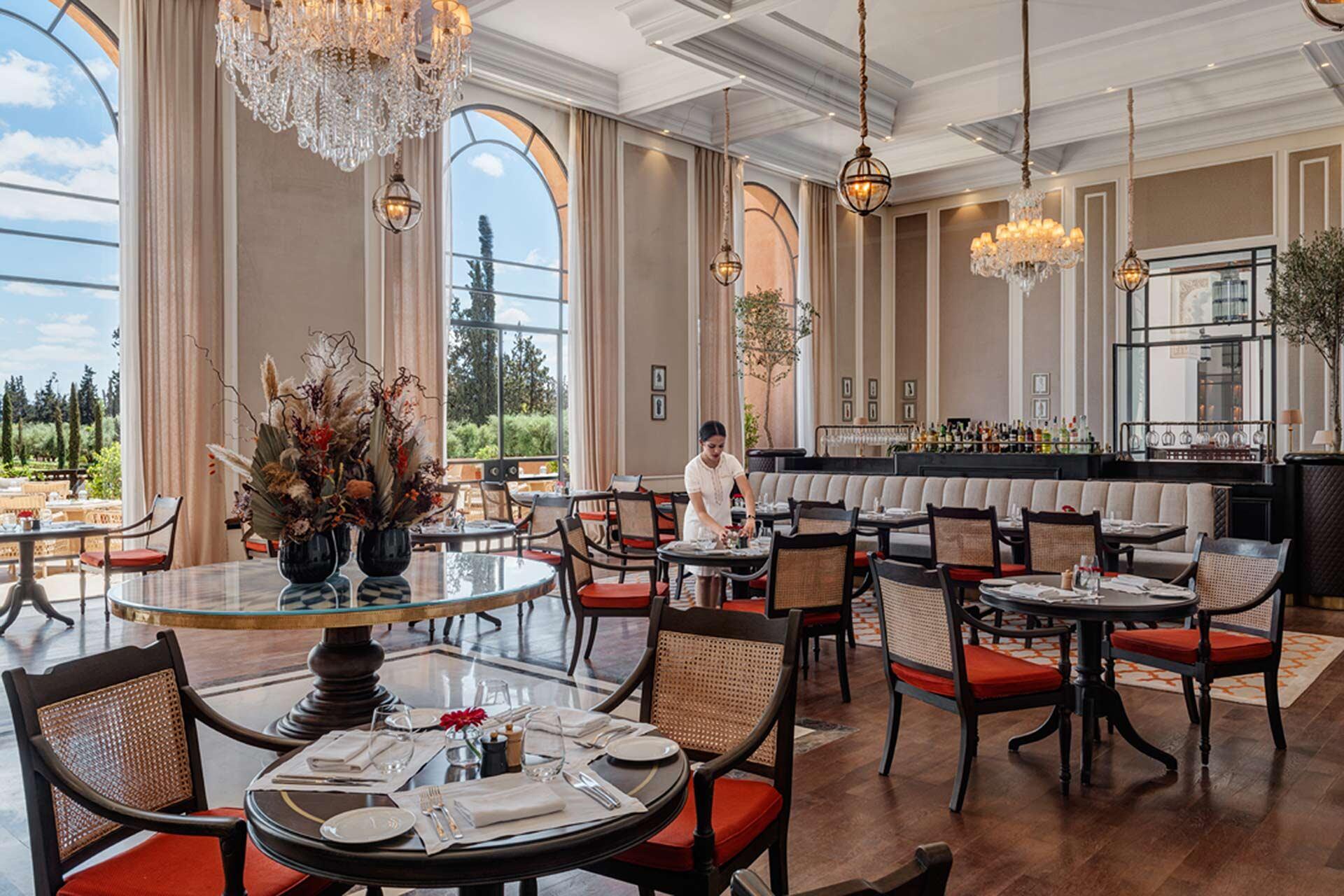
Tamimt, meaning delight in Amazigh, is the all-day restaurant of The Oberoi Marrakech, set in a room of frescoed ceilings, chandeliers, and views toward the Atlas. The menu covers Moroccan and international cooking at a standard consistent with the hotel's positioning. Evening Thali service, on selected nights, is developed in coordination with the Rivayat kitchen team and structures the meal as a sequence of regional Indian courses. The Atlas views from the terrace, particularly in winter and early spring when the peaks carry snow, add a dimension specific to this property. The natural choice for those staying at The Oberoi who want to eat within the estate.
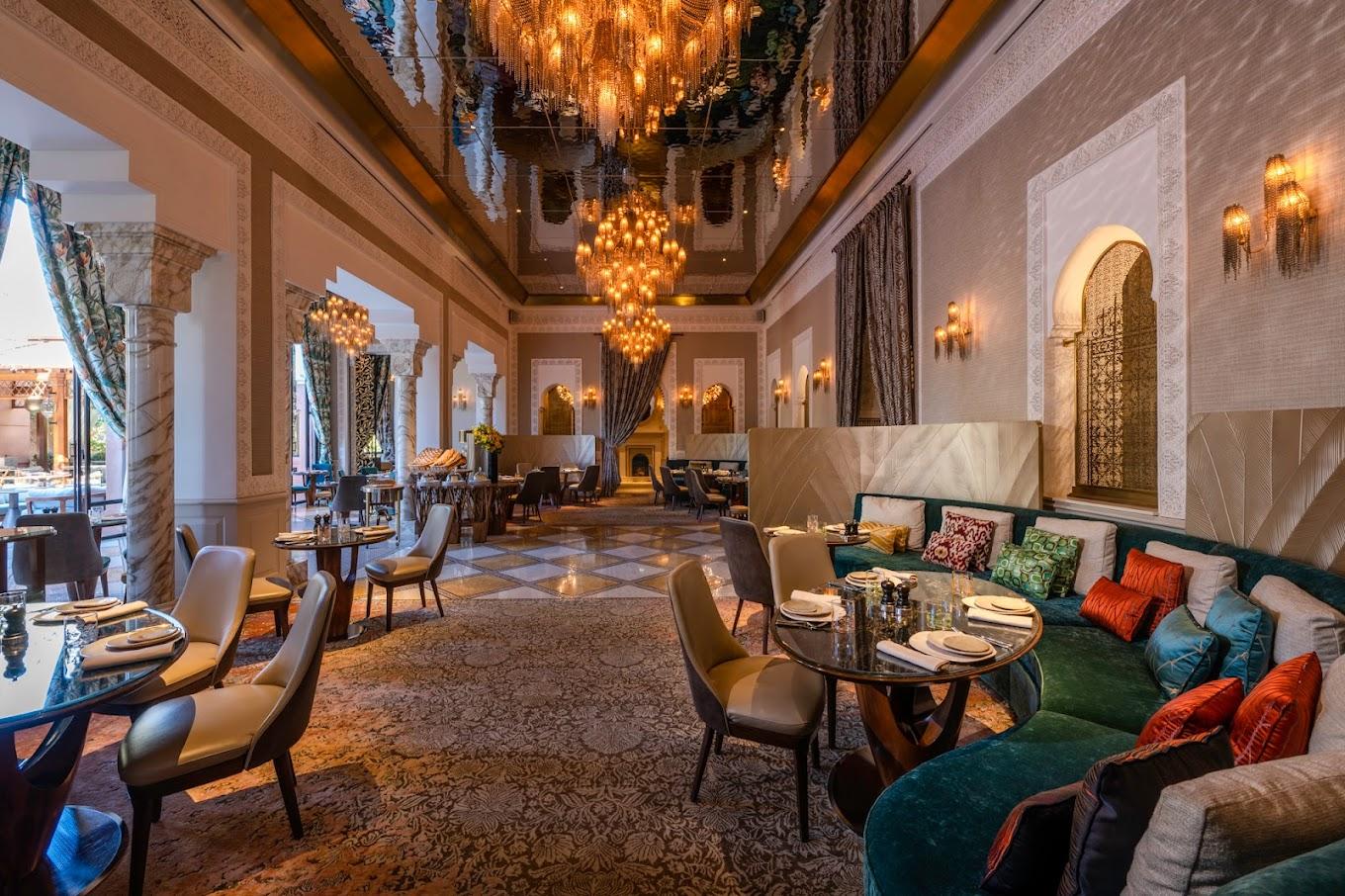
Helene Darroze's first restaurant on the African continent opened in November 2023 inside the Royal Mansour's brasserie space. The programme runs from breakfast through Sunday brunch and into dinner: French in structure, seasonal in logic, built on Moroccan produce where the produce warrants the application. Grand Parisian service rituals inside a palace hotel. Ranked number 48 in MENA's 50 Best Restaurants 2025. The Sunday brunch is among the most significant in the city: three hours in Darroze's brasserie register at the scale and confidence that the Royal Mansour's hospitality architecture enables.
Hôtel Royal Mansour, Rue Abou Abbas El Sebti, Marrakech 40000, Morocco
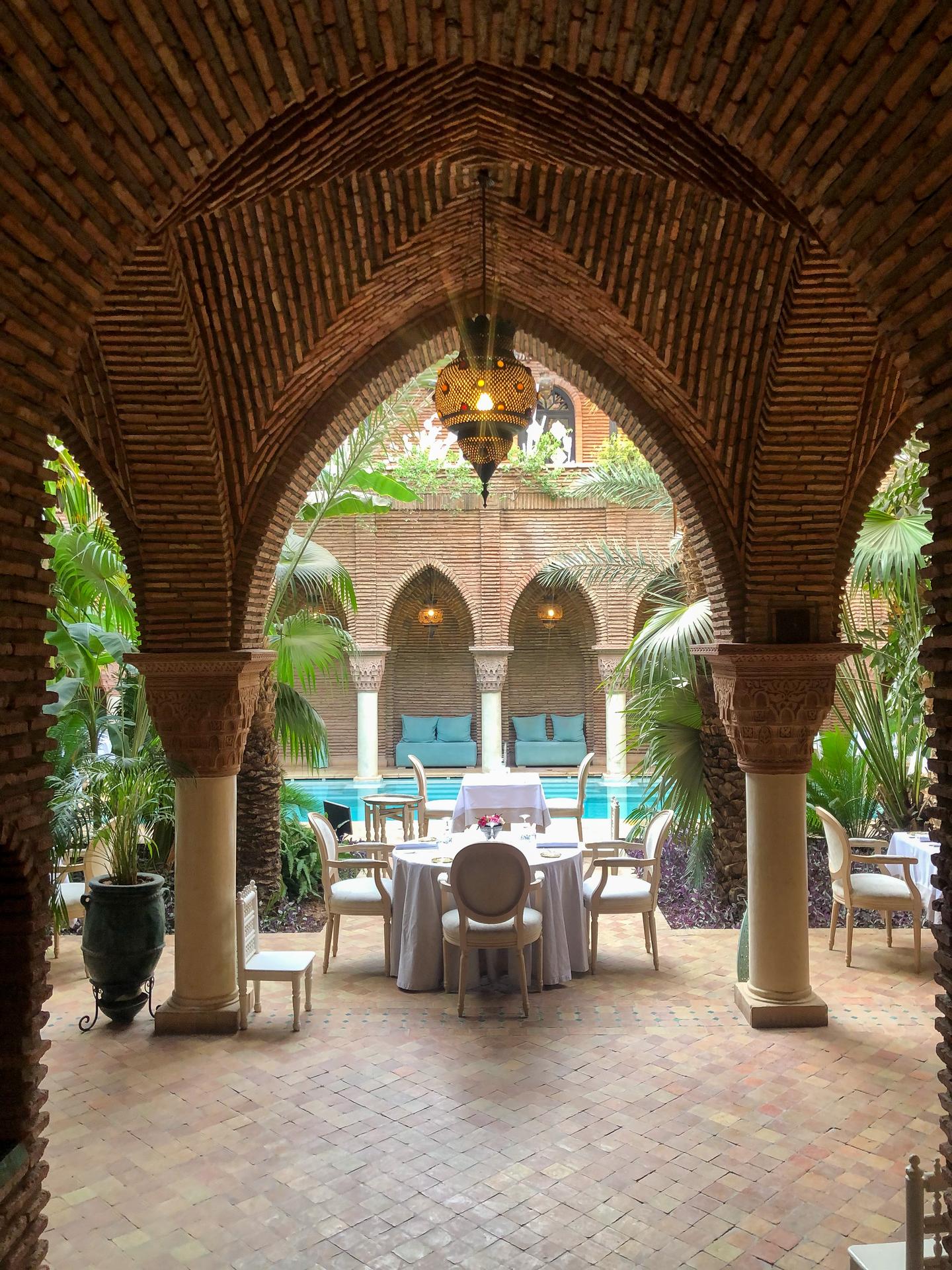
La Table de La Sultana is the evening restaurant at La Sultana Marrakech, a five-riad hotel in the Kasbah quarter built from the restored shell of a centuries-old royal granary. Dinner is served in the courtyard around the hotel's heated pool: candlelight on still water, an oud player among the marble arches and carved cedar columns. The kitchen operates on two tracks, a Moroccan tasting menu of up to thirteen courses and a French-accented seasonal carte, both rooted in what the hotel calls Terroir Cuisine. Vegetables and herbs arrive from the sister property's organic garden in Oualidia; seafood is sourced from the same lagoon. Heritage ingredients anchor the Moroccan repertoire: saffron from Taliouine, cumin from Alnif, argan from the Souss. The cellar holds over 3,000 bottles, including a house cuvee produced in collaboration with a Moroccan domaine. Advance reservation is essential.
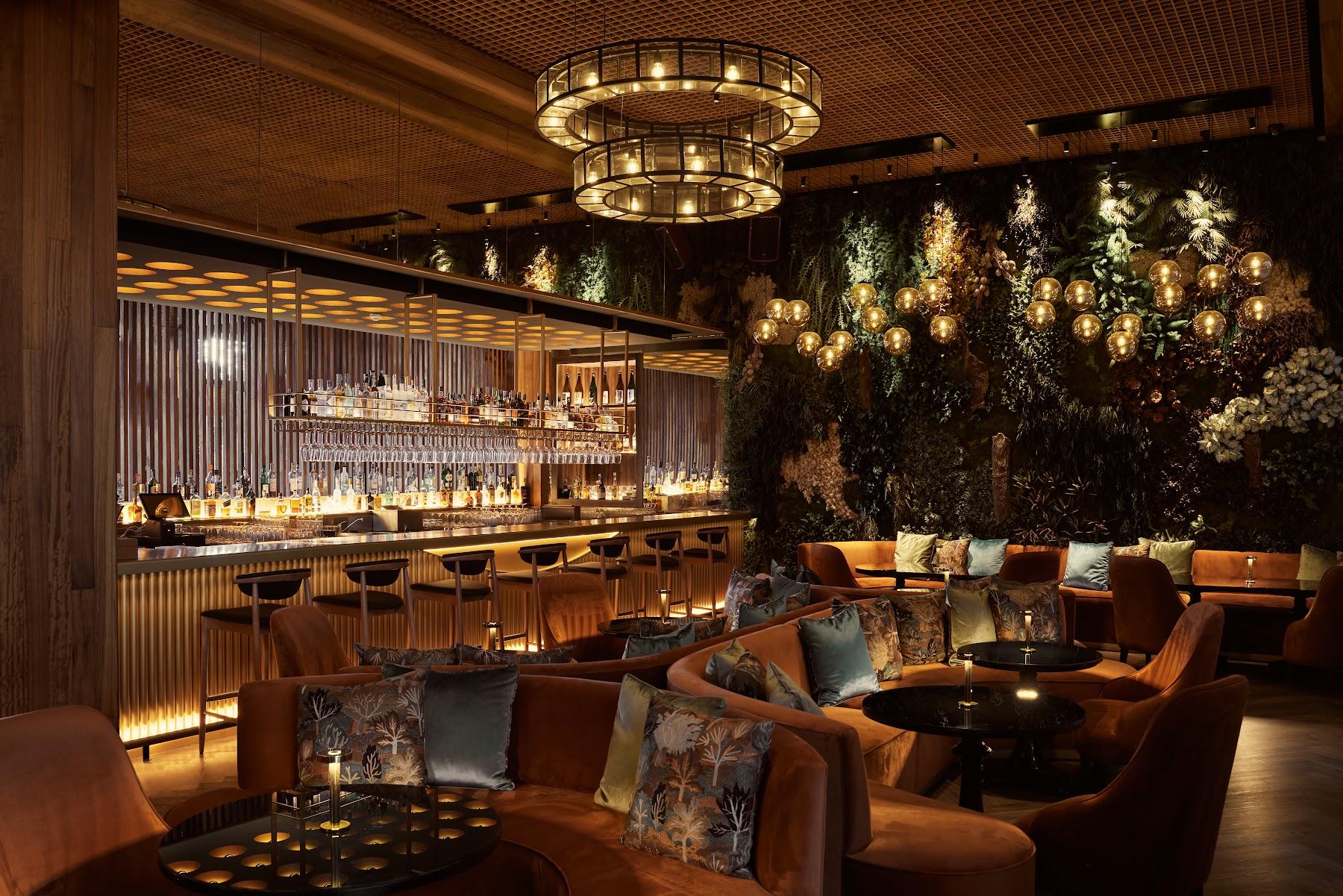
Nobu Restaurant sits inside the hotel of the same name in Hivernage, the brand's first property on the African continent. The dining room is wood-clad and set on an upper floor with views toward the Atlas, operating on the Japanese-Peruvian axis that has defined the Nobu kitchens worldwide. The signature black cod miso arrives with the same precision it does in London or Tokyo. Rock shrimp tempura, yellowtail sashimi with jalapeño, and seasonal creations drawing on Moroccan ingredients without abandoning the framework of new-style Japanese cooking. The adjacent Nobu Bar and Lounge offers a lower-key register with light bites, handcrafted cocktails, and DJs on Thursday, Friday, and Saturday evenings. The interior balances Japanese minimalism with Moroccan craft from local artisans throughout.
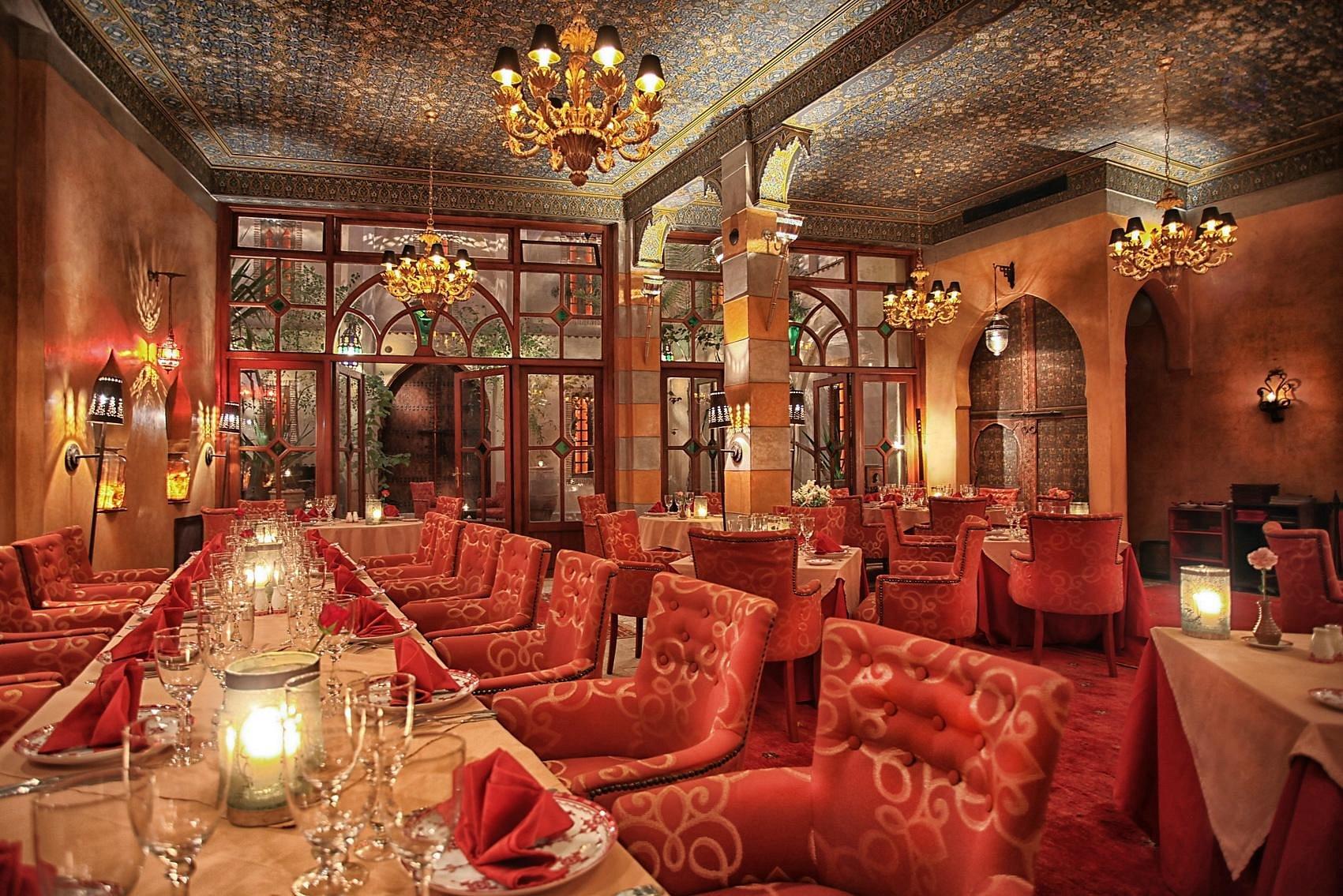
Le Restaurant at La Maison Arabe is the living continuation of a story that began in 1946, when two French women were granted permission by the Pasha of Marrakech to open the first restaurant serving foreigners in the medina. The Pasha sent one of his own dadas to teach them Moroccan cooking, and within a few years the address had drawn Churchill and the Aga Khan to its tables. The room honours that lineage without trading on it: antique palace doors, Italian lamps, a handpainted zouake ceiling, a stone fountain at the centre. The menu is exclusively Moroccan and stays faithful to the repertoire that made the house famous: refined tagines, slow-cooked dishes passed down through generations, specialties that belong to La Maison Arabe alone. Each evening, a duo of Arab-Andalusian musicians fills the room with oud and guitar. The 1930s-inspired Piano Bar, with jazz and a fireplace, offers a quiet opening to the evening.
€€€€€
The most formally ambitious tables in Marrakech: international names from the culinary canon working within two of the city's most considered architectural estates, at a level where the cooking and the setting are designed as one. 150 euro and above per person, drinks excluded.
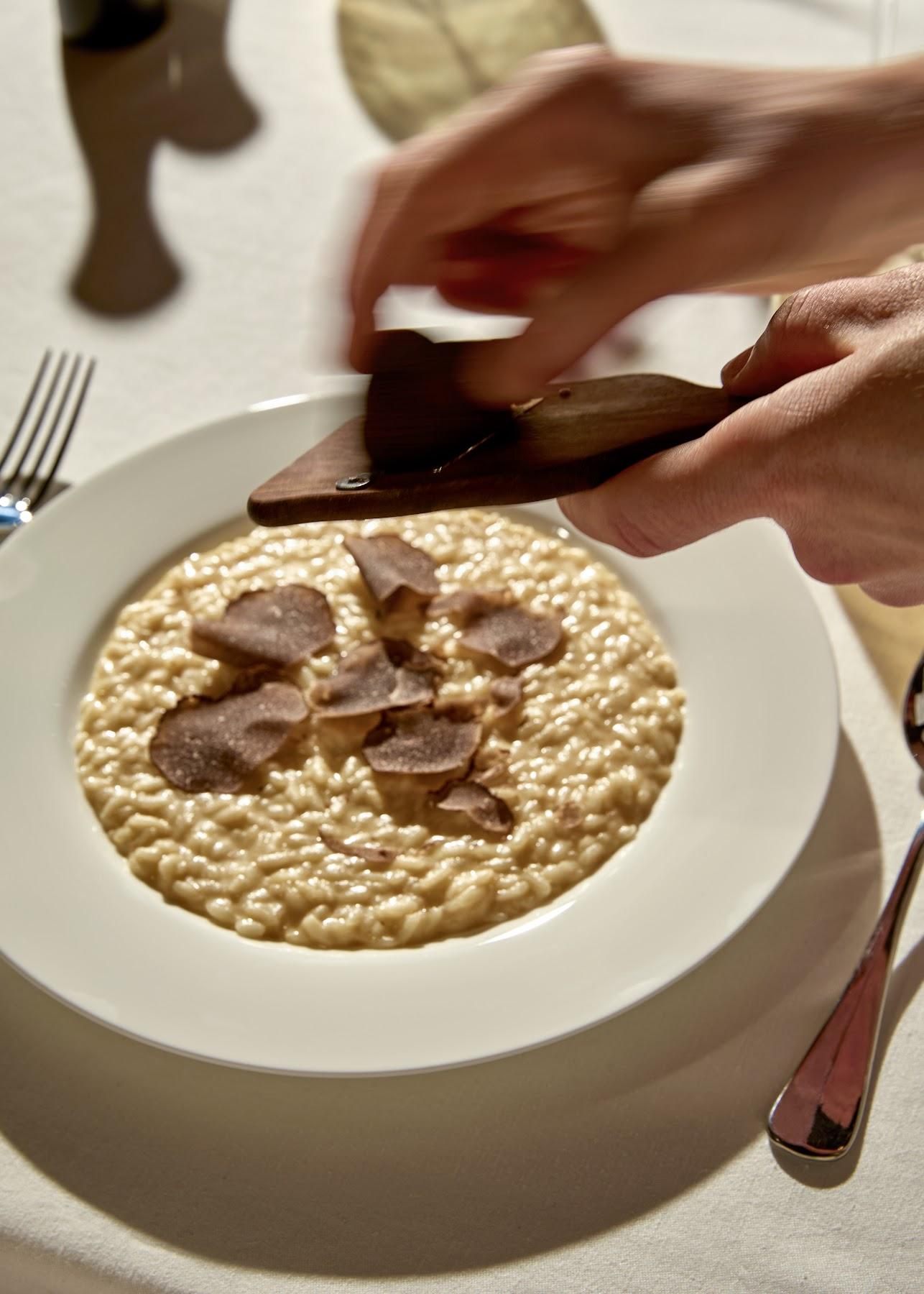
Aman's new Italian concept at Amanjena operates beside the pool within the rose-hued pavilion architecture of the resort, in a setting built around stillness, water, and an olive grove. Chef Francesco Balloo, whose formation spans three-Michelin-starred kitchens across Europe including Mirazur, leads a kitchen that is ingredient-led and seasonal: pasta produced in-house, wood-fired preparations, a supply chain that prioritises integrity over accessibility. The combination of Aman's spatial intelligence and Balloo's grounded Italian cooking produces a meal with no interest in performance. For those arriving specifically for the restaurant, the experience makes full sense only with Amanjena's grounds as its frame. For those staying at the property, it is the quiet dinner that does not declare what time the evening ends.
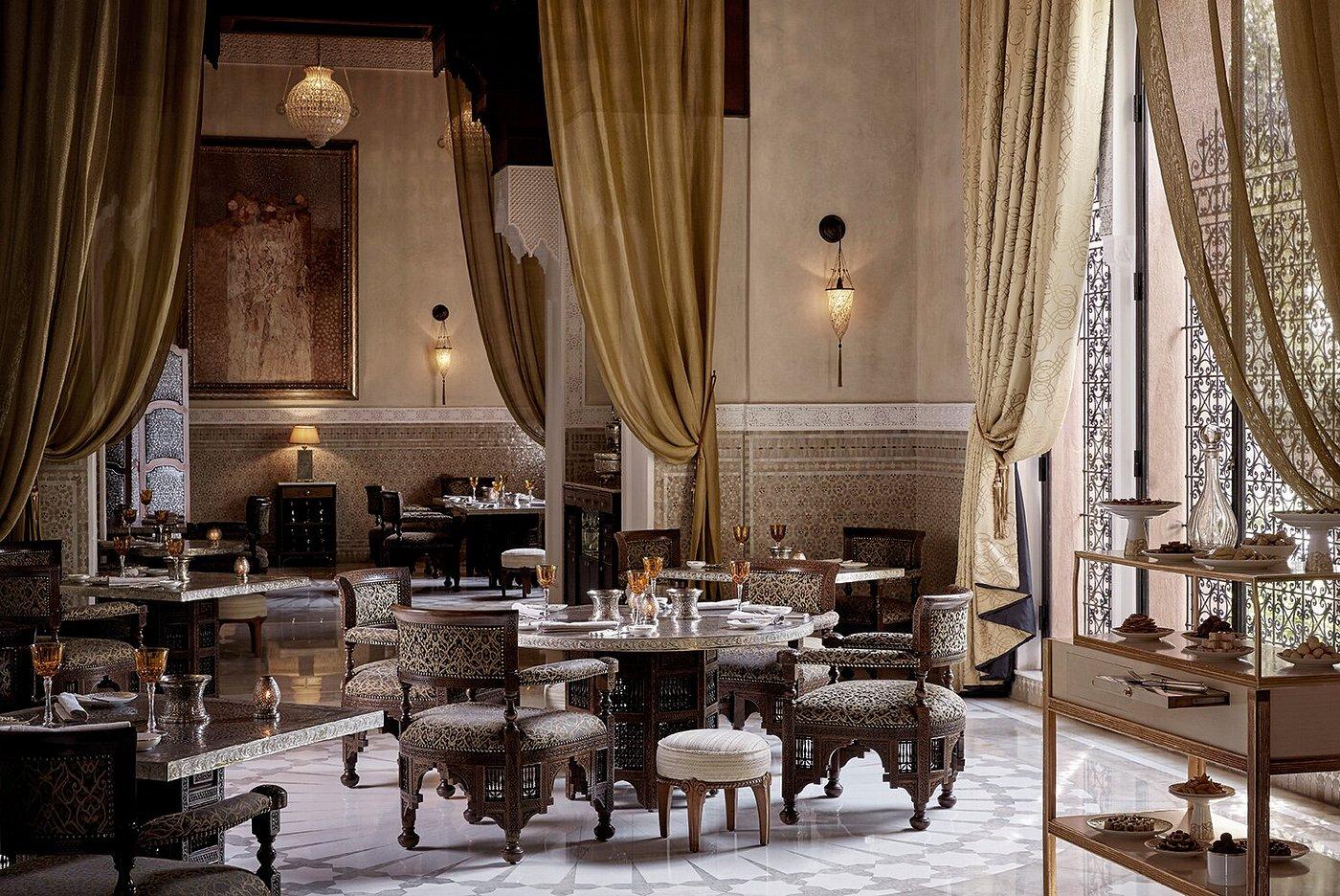
The Royal Mansour's Moroccan haute cuisine restaurant, a member of Les Grandes Tables du Monde and ranked number 19 in MENA's 50 Best Restaurants 2026, is directed by Helene Darroze in collaboration with Moroccan chef Karim Ben Baba. Ancestral recipes refined through modern technique, a ceremonial dining room in full Royal Mansour register, live oud music, tableside rituals in their correct sequence. A kitchen that understands the history of the cuisine it works within and has the resources to honour it. La Grande Table Marocaine is the reference point for Moroccan fine dining pursued at its most ambitious in the city where that cuisine originated.
Hôtel Royal Mansour, Rue Abou Abbas El Sebti, Marrakech 40000, Morocco
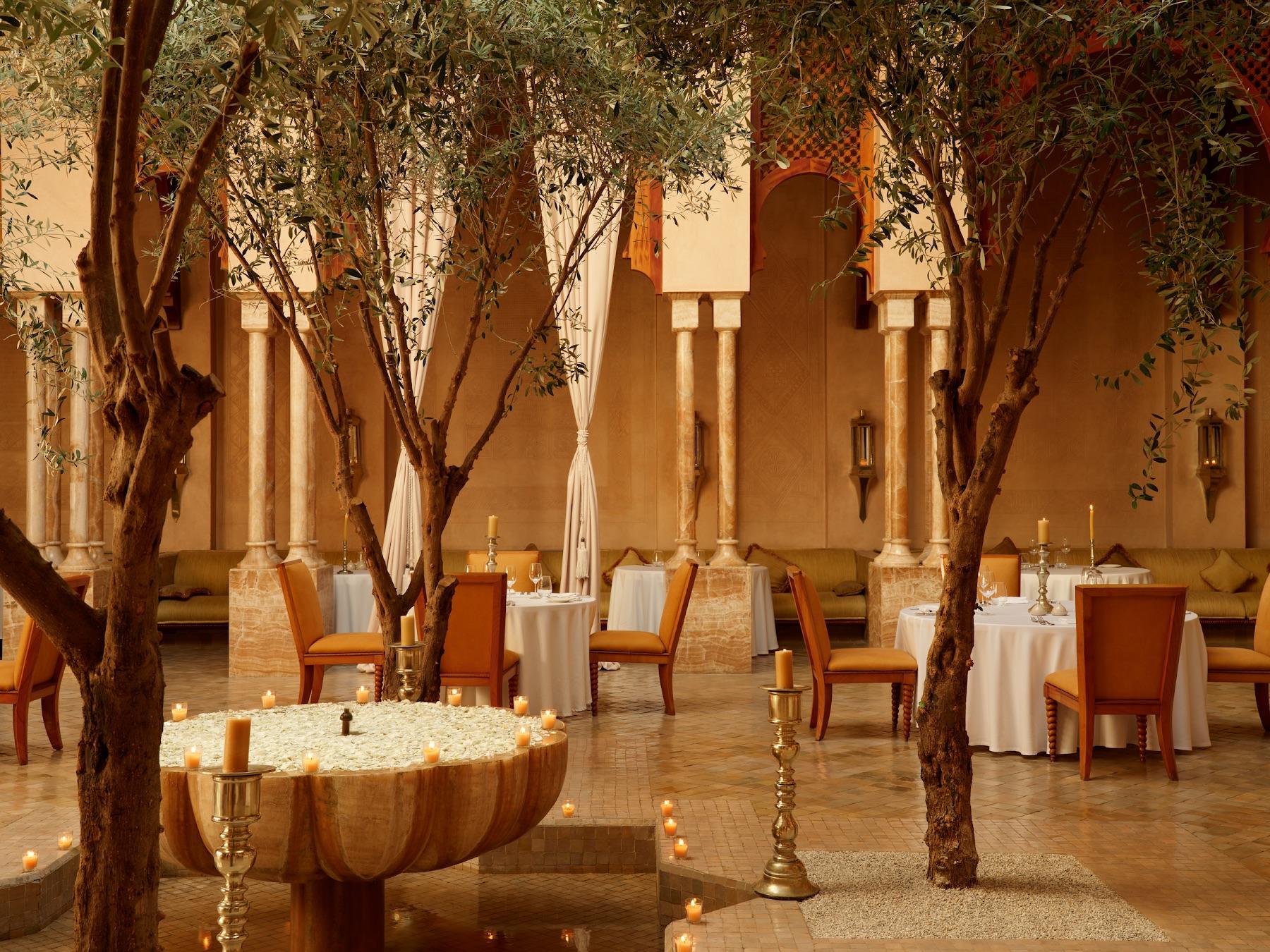
Amanjena's candlelit courtyard restaurant serves Moroccan cuisine rooted in Berber, Andalusian, and Moorish traditions without reaching for novelty or modern reinterpretation. Tagines, mechoui lamb, clay-cooked couscous: the menu is what it has always been. Fish comes from Essaouira; herbs from the resort's own gardens. The Trio Andalou plays oud and derbouka beside the courtyard fountain from Monday to Saturday. The honey-coloured marble columns, the retractable skylight, the fountain, and the musicians create a setting that belongs specifically to Amanjena. The Moroccan is not a hotel restaurant that happens to serve Moroccan food; it is a room built to receive a specific cuisine with the seriousness it deserves.
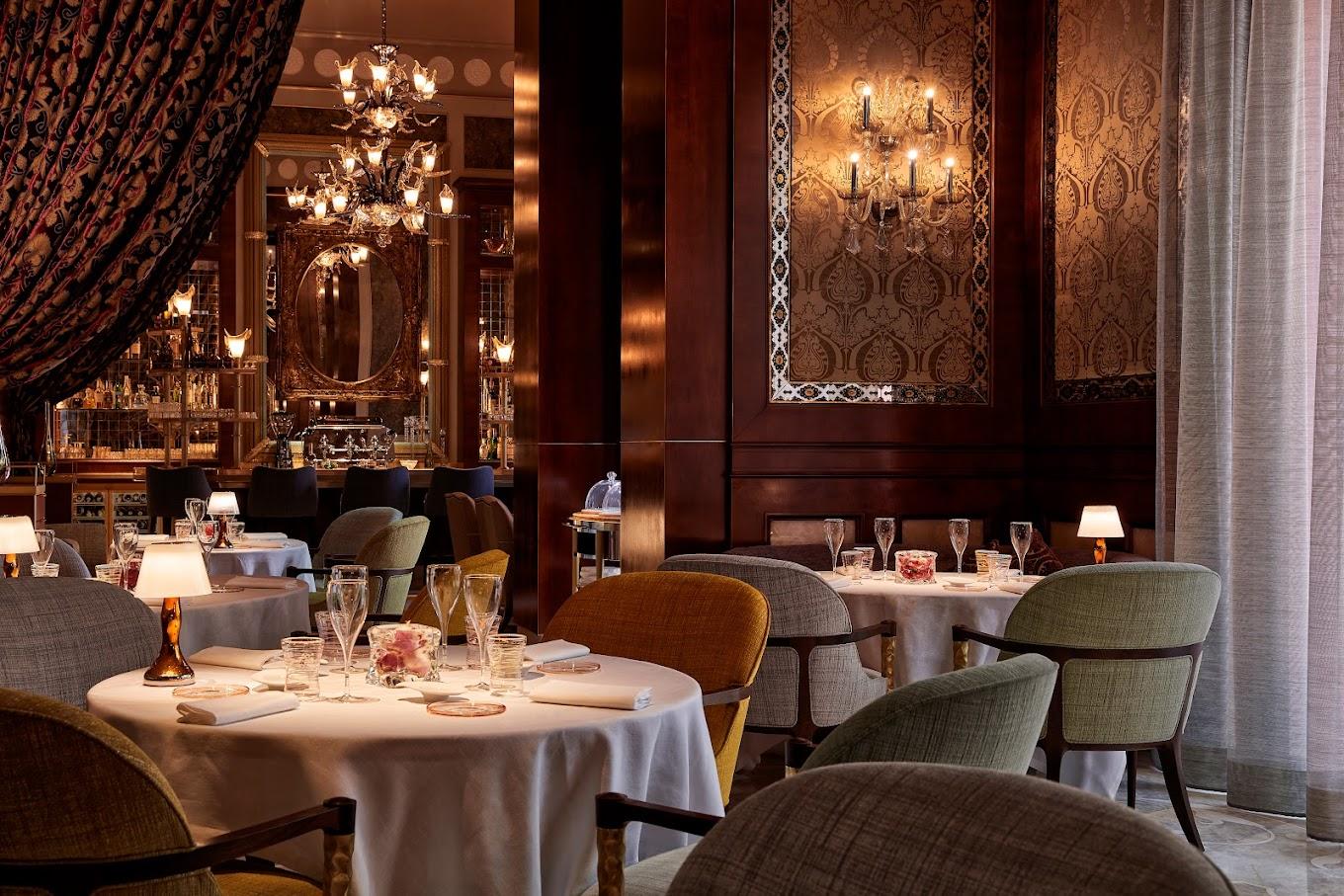
The Alajmo brothers' Italian table inside the Royal Mansour carries the lineage of one of Italy's great cooking families and a formal ambition reflected in its standing among MENA's 50 Best Restaurants. Massimiliano Alajmo became the youngest chef in history to hold three Michelin stars; at Sesamo he and his brother Raffaele work with Venetian sensibility in Moroccan context: langoustine spaghettoni, saffron risotto, Neapolitan pizzas, a cloud tiramisu that has become a reference across the city. At sunset the courtyard patio is among the most sought-after seats in Marrakech. Sesamo is what happens when one of Europe's great culinary families applies its full intelligence to a room inside the world's most ambitious palace hotel.
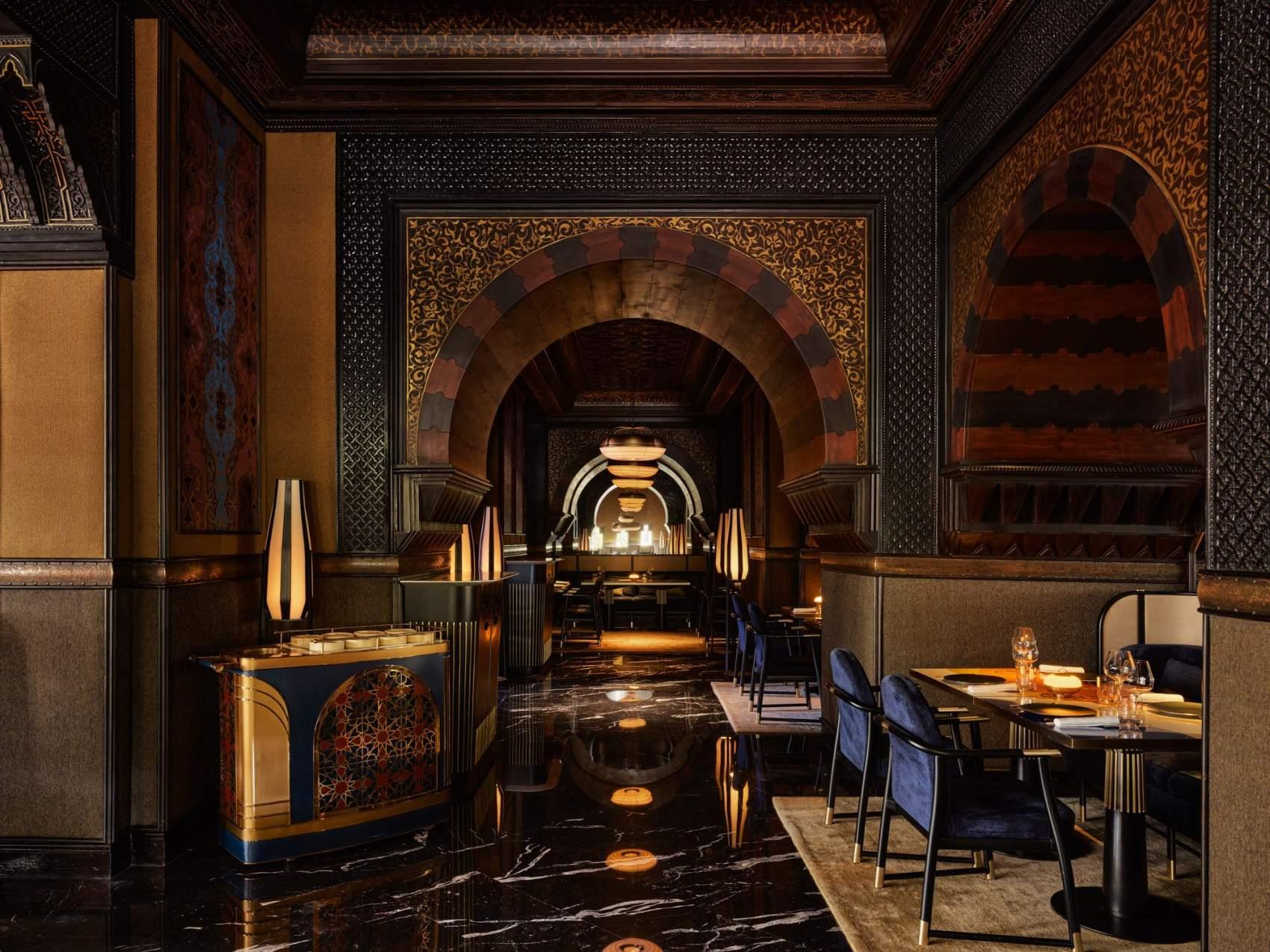
Jean-Georges Vongerichten's Asian-inspired restaurant at La Mamounia spans a menu that moves from Southeast Asia through Japan: sushi, dim sum, Thai-influenced curries, wok dishes, a cocktail programme calibrated for long evenings. Open Friday to Sunday for lunch and daily for dinner. The La Mamounia setting, one of the most architecturally significant hotels in Africa, provides a frame that Vongerichten's kitchen inhabits without deferring to. The combination of Vongerichten's intelligence about Asian ingredients and French technique, and the Mamounia's spatial confidence, produces a restaurant that would hold in any city. In this city it holds with particular authority.
You may also like…
BEST OF | EAT & DRINK
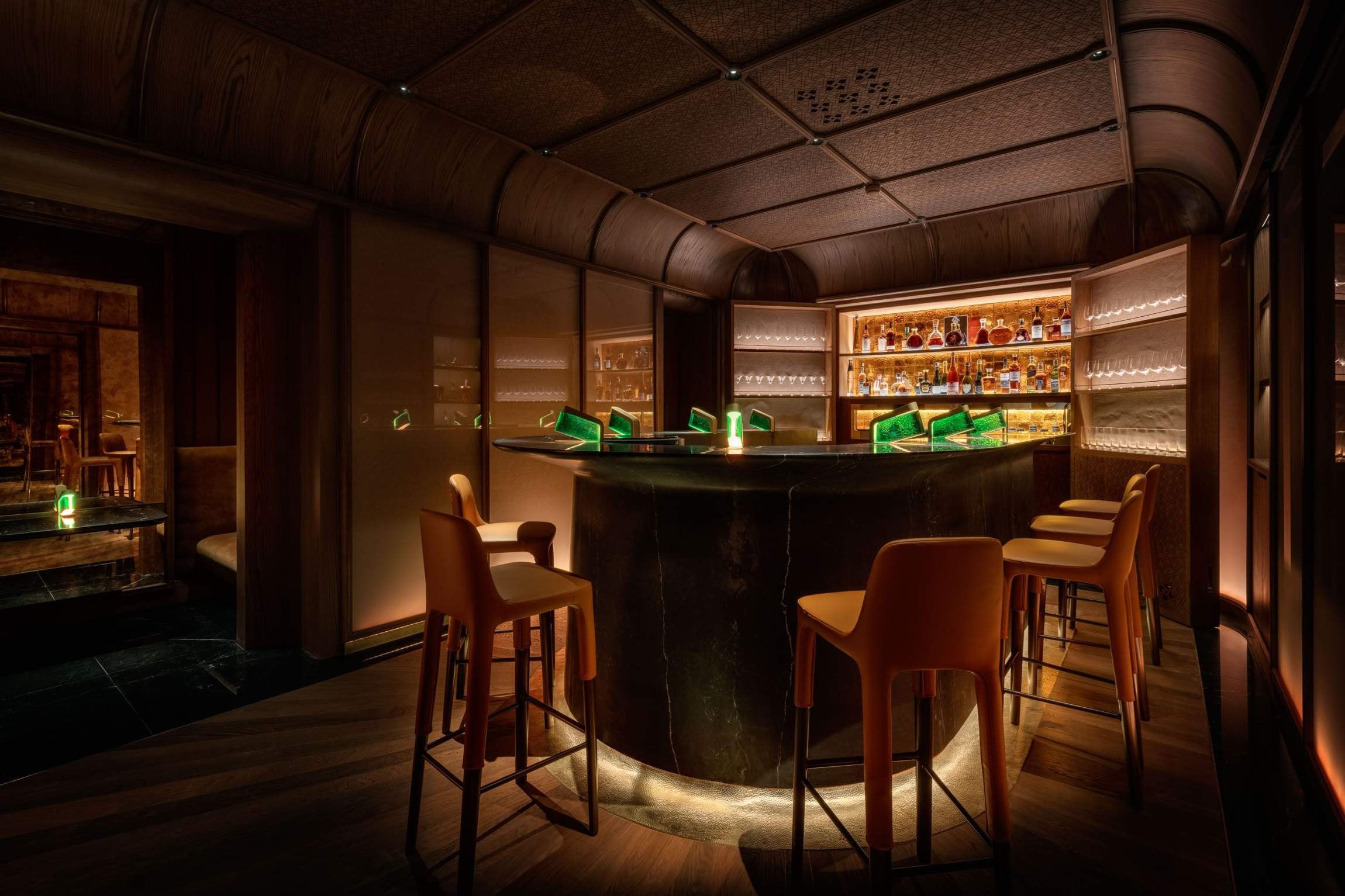
Marrakech's Most Iconic Hotel Bars
EAT & DRINK
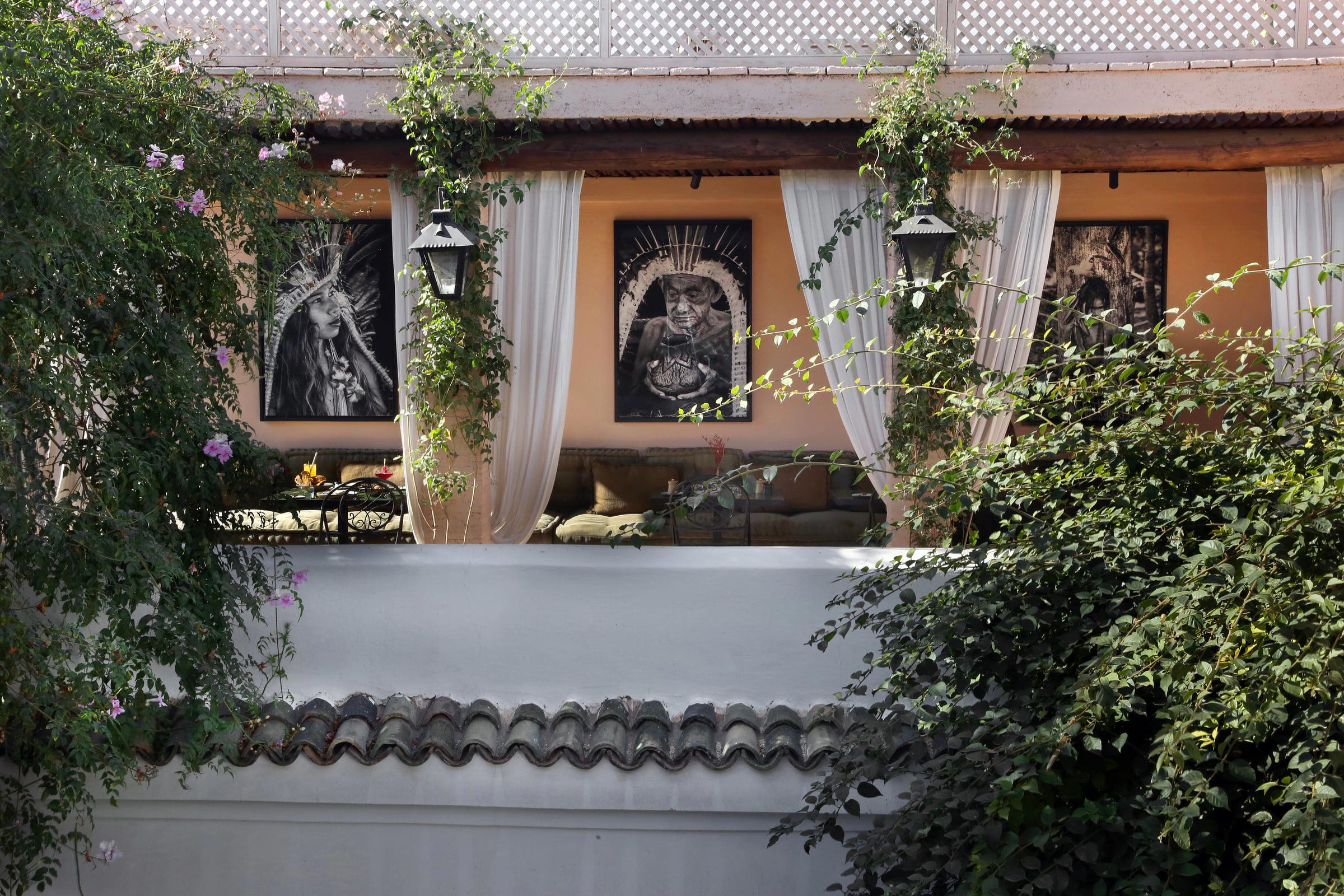
Eating Among Salgado's Amazonia: Noujoum at IZZA Marrakech
 Map
MapBEST OF | EAT & DRINK
Dinner and Show in Marrakech: 24 Festive Restaurants, from Belly Dancers to DJ Sets
 Map
MapBEST OF | EAT & DRINK